The Albanian Riviera around Himara has more historical landmarks per kilometer than almost anywhere else on the Mediterranean coast. Within a 30-minute drive of Himara's center. You will find a 5th-century BC hilltop castle, Byzantine monasteries with intact frescoes, Ottoman-era fortresses, Cold War submarine tunnels, and Bronze Age ruins, all set against the turquoise Ionian Sea.
Most visitors come for the beaches. The landmarks are what make them stay longer. This guide covers every significant historic site within easy reach of Himara, organized by distance, with the practical details you need to plan visits.
Landmarks at a glance
| Landmark | Distance from Himara | Type | Period | Entry | Time Needed |
|---|---|---|---|---|---|
| Himara Castle & Old Town | In town | Castle/settlement | 5th c. BC–present | 300 ALL (~3€) | 1–1.5 hrs |
| Athali Monastery | ~10 km | Monastery | 18th century | Free | 3–4 hrs (incl. hike) |
| Saint Theodore Monastery | ~15 km | Monastery | 14th century | Free | 1.5–2 hrs |
| Panagia Drymadon | ~15 km | Monastery | 13th–14th c. | Free | 45 min–1 hr |
| Porto Palermo Castle | ~10 km | Castle | 1804 | 300 ALL (~3€) | 1–1.5 hrs |
| Porto Palermo Submarine Tunnel | ~10 km | Military | 1969–1988 | View only | 20–30 min |
| Borsh Castle | ~20 km | Castle/fortress | 4th c. BC | Free | 2–3 hrs |
| Borsh Waterfall | ~20 km | Natural monument | Natural | Free | 20–30 min |
| Old Qeparo & Karos Fortress | ~12 km | Village/fortress | Bronze Age | Free | 2–3 hrs |
| Ancient Palaeste / Caesar's Trail | ~25 km | Trail/ruins | 48 BC | Free | 2–3 hrs |
| Albanian Riviera Bunkers | Everywhere | Military | 1967–1986 | Free | , |
In Himara
Himara Castle & Old Town
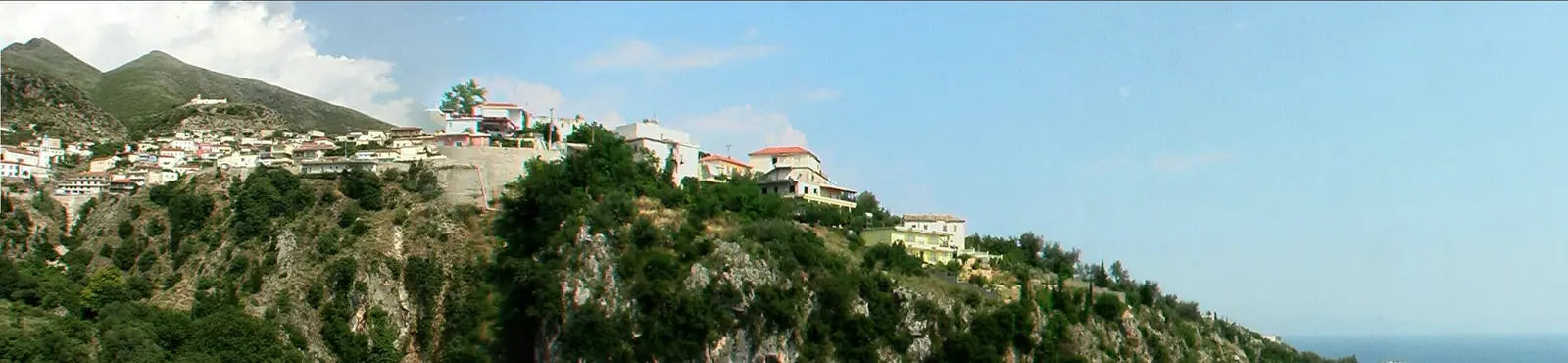
The most accessible landmark, perched on Barbaka hill directly above the town center, a 10-minute walk from the promenade. Fortifications date to the 5th century BC, with Byzantine-era churches containing faded frescoes, Ottoman-period walls, and panoramic views stretching to Corfu on clear days.
Entry: 300 ALL (~3€) | Time: 1–1.5 hours | Full guide: Himara Old Town & Castle
Athali Monastery
A moderate-to-hard hike from Himara's Spile neighborhood to an 18th-century monastery high on Athali Mountain. The trail takes 1.5–2 hours each way, climbing through Mediterranean scrub to a monastery that has been a site of pilgrimage for centuries. Frescoes dating to 1781 survive inside, and the August 15 feast of the Dormition draws 500+ attendees.
Entry: Free | Time: 3–4 hours round trip | Full guide: Athali Monastery
North of Himara (Dhermi area, ~15 km)
Saint Theodore Monastery
Between Dhermi and Gjipe Beach, this 14th-century monastery has one of the most unusual histories on the Riviera: built on a temple to Zeus, converted to a Soviet navy holiday resort in the 1950s, then an Albanian military observation post. Under restoration since the late 2010s.
Entry: Free | Time: 1.5–2 hours | Combine with: Gjipe Beach | Full guide: Saint Theodore Monastery
Panagia Drymadon Monastery
A 13th–14th century basilica with Byzantine dome on the hilltop above Dhermi village. A Cultural Monument of Albania, with well-preserved 1781 frescoes by the Archbishop of Himara and Delvina. The monastery operated continuously until 1967, when the communist regime forced the last nun to leave.
Entry: Free | Time: 45 min–1 hour | Combine with: Dhermi village, Drymades Beach | Full guide: Panagia Drymadon
Ancient Palaeste & Caesar's Trail
Modern Palasa village, just below Llogara Pass, sits on the site where Julius Caesar landed seven legions in 48 BC during the Roman Civil War. A 2.4 km hiking trail descends from Llogara National Park to the Palasa Stream Delta, following Caesar's route over the mountains.
Entry: Free | Time: 2–3 hours | Combine with: Llogara Pass, Paragliding | Full guide: Ancient Palaeste & Caesar's Trail
South of Himara (~10–20 km)
Porto Palermo Castle
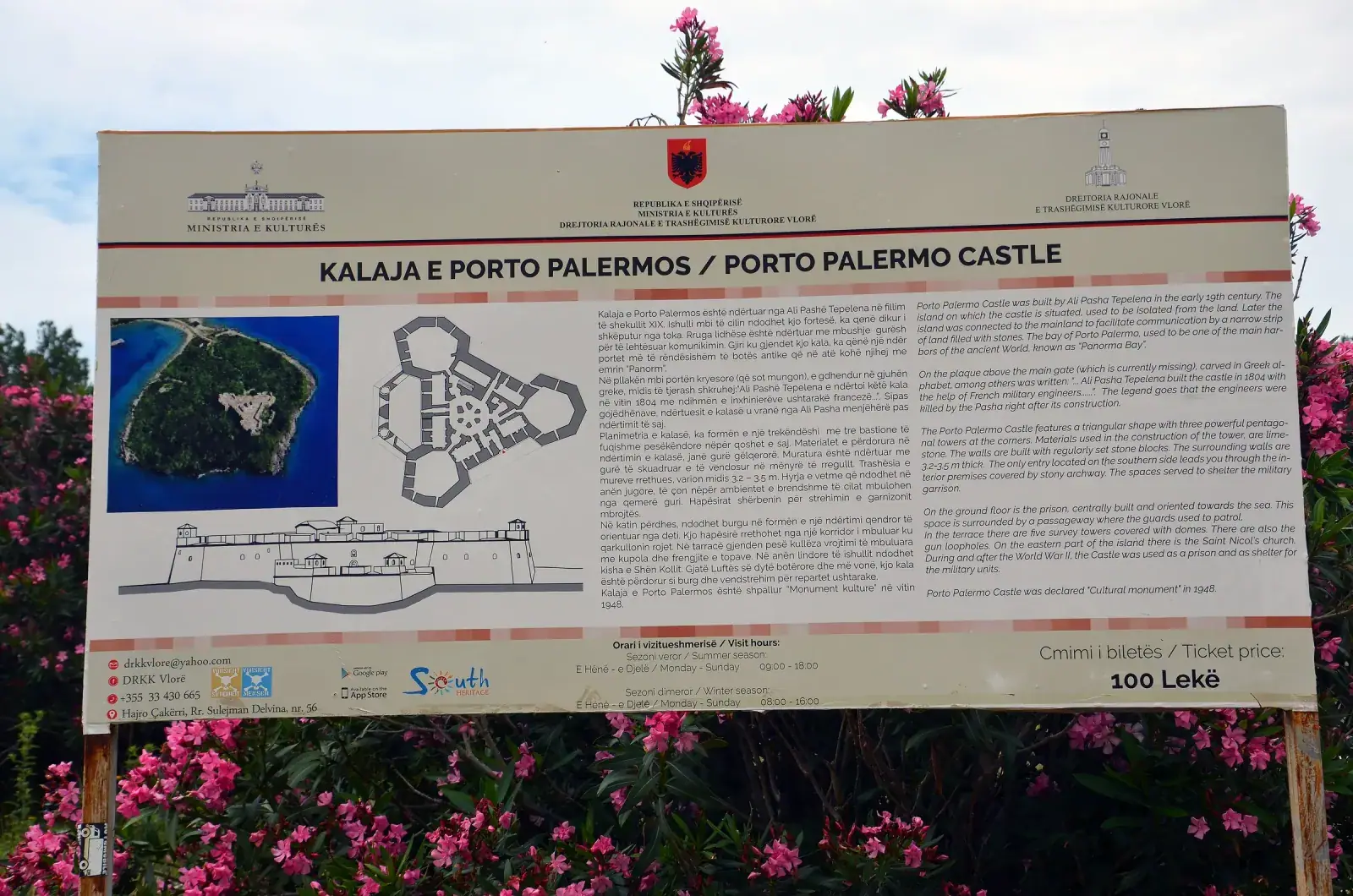
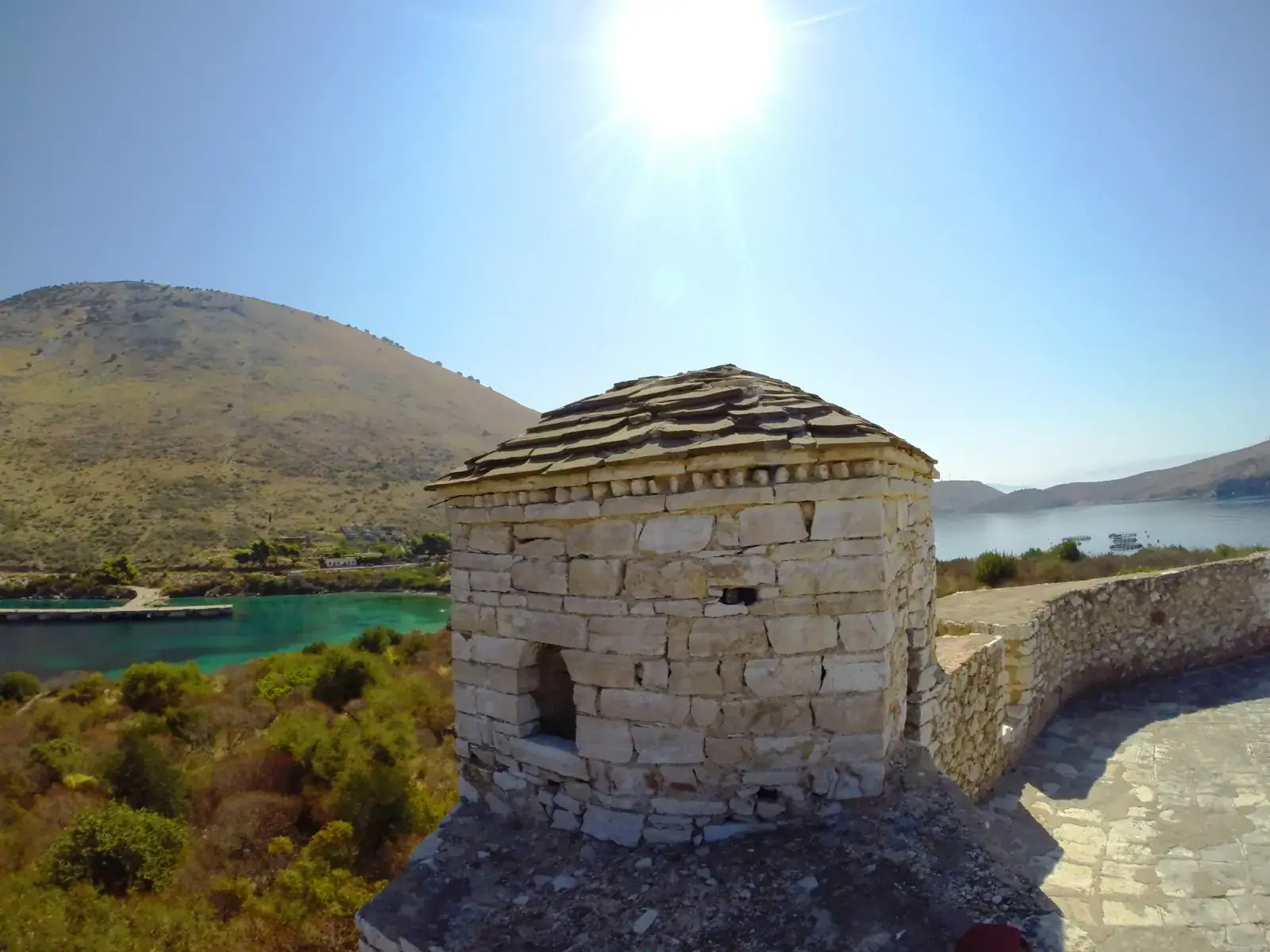
Ali Pasha of Ioannina's triangular fortress, built in 1804 on a narrow peninsula surrounded by turquoise water. One of the best-preserved Ottoman-era castles in Albania, with vaulted interior chambers and exceptional bay views. The easiest and most rewarding day trip from Himara.
Entry: 300 ALL (~3€) | Time: 1–1.5 hours | Full guide: Porto Palermo Castle & Bay
Porto Palermo Submarine Tunnel
Across the bay from the castle, a 650-meter tunnel carved through the mountain between 1969 and 1988 to shelter four seized Soviet Whiskey-class submarines. You cannot enter (military restricted zone), but it is visible from the coastal road and from boat tours.
Entry: View only | Time: 20–30 minutes | Combine with: Porto Palermo Castle | Full guide: Porto Palermo Submarine Tunnel
Old Qeparo Village & Karos Fortress
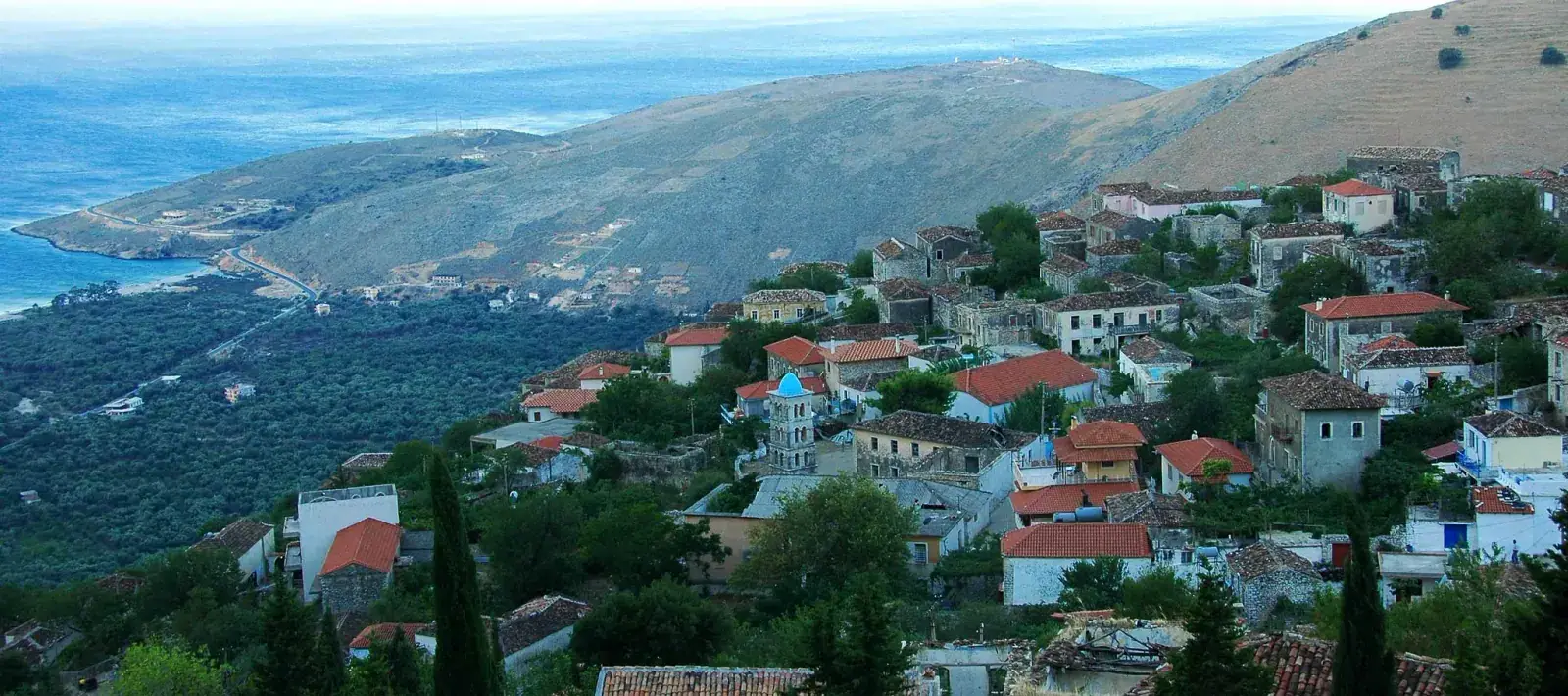
A semi-abandoned stone village at 450 meters elevation, with a Bronze Age fortress 200 meters beyond. Karos Fortress has fortification walls dating to the Late Bronze Age and Iron Age, among the oldest known structures on the Riviera. The village itself features traditional limestone architecture and a slowly reviving guesthouse scene.
Entry: Free | Time: 2–3 hours | Combine with: Porto Palermo, Qeparo Beach | Full guide: Old Qeparo & Karos Fortress
Borsh Castle
A hilltop fortress at 500 meters above sea level with 3,000 years of occupation, from Chaonian acropolis (4th century BC) to Ottoman fortification under Ali Pasha. Five hectares of ruins with cyclopean masonry blocks up to 3 meters wide. Free, uncrowded, unrestored, and authentic.
Entry: Free | Time: 2–3 hours | Combine with: Borsh Beach, Borsh Waterfall | Full guide: Borsh Castle
Borsh Waterfall
A natural monument in the center of Borsh village, with mountain springs cascading through and a traditional restaurant (Ujvara) built over the flowing water. The easiest landmark stop on the entire Riviera: park. Walk ten steps, enjoy.
Entry: Free | Time: 20–30 minutes (1.5 hrs with lunch) | Combine with: Borsh Beach, Borsh Castle | Full guide: Borsh Waterfall
Communist-era bunkers
There isn't one site to visit. Mushroom-shaped concrete bunkers (QZ type, 3-meter diameter) dot beaches, hillsides, and roadsides from Vlora to Saranda. Built between 1967 and 1986 as part of Enver Hoxha's nationwide fortification obsession. Never used in combat. The Porto Palermo submarine tunnel is the most dramatic example.
Entry: Free (exterior only) | Full guide: Communist Bunkers on the Albanian Riviera
Suggested landmark routes
Route 1: southern circuit (half day)
Best for history buffs with a car.
- Porto Palermo Castle: 300 ALL entry, 1 hour
- Porto Palermo Submarine Tunnel: viewpoint stop, 15 min
- Old Qeparo Village & Karos Fortress: 2 hours
- Swim at Porto Palermo Bay or Qeparo Beach
Total: 4–5 hours | Distance: ~25 km from Himara
Route 2: Borsh triple (half day)
Castle, waterfall, and beach in one visit.
- Borsh Castle: morning hike, 2 hours
- Borsh Waterfall + Ujvara lunch: 1.5 hours
- Borsh Beach: afternoon swim
Total: 5–6 hours | Distance: ~20 km from Himara
Route 3: Dhermi monastery circuit (half day)
Two monasteries plus the beach.
- Panagia Drymadon: hilltop above Dhermi, 1 hour
- Saint Theodore Monastery: between Dhermi and Gjipe, 1 hour
- Gjipe Beach: hike down from the parking lot
Total: 4–5 hours | Distance: ~15 km from Himara
Route 4: the full historical day
Everything in one ambitious day.
| Time | Stop | Duration |
|---|---|---|
| 8:00 | Himara Castle & Old Town | 1 hour |
| 9:30 | Drive to Porto Palermo | 20 min |
| 10:00 | Porto Palermo Castle + tunnel viewpoint | 1.5 hours |
| 11:30 | Drive to Borsh | 15 min |
| 12:00 | Borsh Waterfall + Ujvara lunch | 1.5 hours |
| 13:30 | Borsh Castle hike | 2 hours |
| 15:30 | Drive to Borsh Beach | 10 min |
| 16:00 | Swim at Borsh Beach | 2 hours |
Total: Full day | Distance: ~40 km round trip
Timeline: 3,000 years of landmarks
| Period | Landmark | What Happened |
|---|---|---|
| Bronze Age | Karos Fortress | First fortification walls built |
| 4th c. BC | Borsh Castle | Chaonian acropolis established |
| 5th c. BC | Himara Castle | First fortifications on Barbaka hill |
| 48 BC | Palaeste | Caesar lands seven legions |
| 6th c. AD | Borsh Castle | Justinian lists it among Byzantine forts |
| 13th–14th c. | Panagia Drymadon | Basilica with dome built above Dhermi |
| 14th c. | Saint Theodore | Monastery built on Zeus temple site |
| 18th c. | Athali Monastery | Monastery built/expanded on Athali Mountain |
| 1781 | Panagia Drymadon | Archbishop Ioanni commissions frescoes |
| 1804 | Porto Palermo Castle | Ali Pasha builds triangular fortress |
| 1952–1961 | Saint Theodore | Soviet navy uses monastery as holiday resort |
| 1967–1986 | Riviera Bunkers | 175,000+ bunkers built nationwide |
| 1969–1988 | Submarine Tunnel | Tunnel carved for seized Soviet subs |
Practical tips for landmark visits
- Start early. Most sites involve uphill walks with no shade. Morning visits are significantly more comfortable
- Bring water everywhere. Only Himara Castle and Porto Palermo Castle have any facilities nearby
- Cash is king. No ATMs in Borsh or Old Qeparo. Porto Palermo and Himara Castle accept cash only
- Sturdy shoes. Required for Borsh Castle, Karos Fortress, Athali Monastery, and Caesar's Trail. Sandals are fine for Porto Palermo Castle and Borsh Waterfall
- Combine with beaches. Every landmark route passes a beach. Build swims into your itinerary
- Dress modestly at monasteries. Cover shoulders and knees when entering churches at Athali, Saint Theodore, and Panagia Drymadon
FAQ
Which landmark near Himara is the most impressive?
Porto Palermo Castle wins for visual impact, a triangular fortress on a turquoise bay. Borsh Castle wins for historical depth, 3,000 years of occupation in unrestored ruin. Himara Castle wins for convenience, 10 minutes from the promenade.
Can I visit landmarks without a car?
Himara Castle and Athali Monastery are walkable from town. For everything else, you will need a car, scooter, or taxi. Minibuses on the Himara–Saranda route stop near Borsh and Qeparo, giving foot access to those villages. See our getting around guide.
How many landmarks can I visit in one day?
With a car: 3–4 comfortably. The Full Historical Day route above covers Himara Castle, Porto Palermo, and Borsh (castle + waterfall + beach) in a packed but feasible day. Without a car, plan for 1–2 sites per day.
Are the landmarks suitable for children?
Porto Palermo Castle and Borsh Waterfall are the most family-friendly, with easy access and no strenuous hiking. Himara Castle is a short walk. Borsh Castle and Karos Fortress involve steep hikes unsuitable for young children. See our family travel guide.
What is the oldest landmark near Himara?
Karos Fortress near Old Qeparo has fortification walls from the Late Bronze Age, making it the oldest known structure on the Albanian Riviera, predating even Borsh Castle's 4th-century BC Chaonian walls and Himara Castle's 5th-century BC fortifications.