
About Himara
The town, the municipality, the dialect, and the geography that makes this stretch of the Albanian Riviera different from anywhere else on the Ionian.
What Himara Is
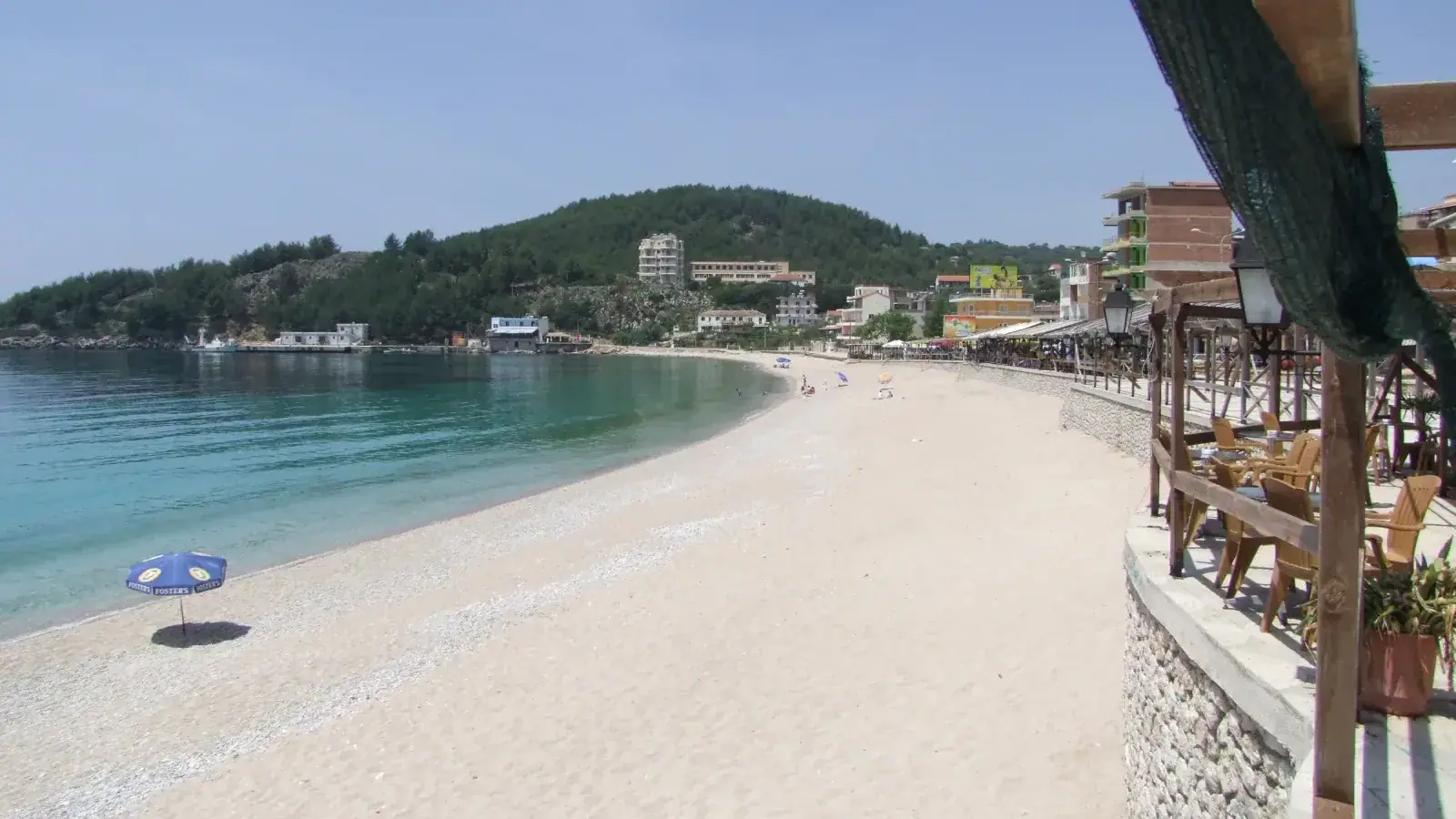
Himara (Albanian: Himarë; Greek: Χιμάρα or Χειμάρρα) is both a coastal town and a municipality on the southwestern coast of Albania, in Vlorë County. The town sits on the central stretch of the Albanian Riviera, between the Ceraunian Mountains and the Ionian Sea. The municipality, formed by the 2015 administrative consolidation, covers roughly 572 km² and includes the units of Himarë, Horë-Vranisht, and Lukovë, taking in villages from Palasë in the north to Lukovë in the south.
Two characteristics set Himara apart from neighbouring towns. The first is its ethnic Greek community, concentrated in the coastal zone, which has maintained a distinct cultural identity through the Ottoman, Italian, and communist periods to the present day. The second is the Himariote dialect of Greek, spoken in the coastal villages. It keeps archaic features no longer found in standard Modern Greek, preserved by centuries of relative isolation.
Quick reference
Geography
The town of Himara is built where a low coastal plain meets the steep flanks of the Ceraunian Mountains (Albanian: Vargmali i Vetëtimave; Greek: Ακροκεραύνια), a 100 km mountain range that runs along the southern Albanian coast and separates the Ionian Sea from the inland plains. The highest peak, Maja e Çikës, rises to 2,045 m (6,710 ft) just inland from the town.
The coastline that defines the Himara municipality runs roughly from Llogara Pass in the north to Lukovë in the south, about 50 km of beaches, headlands, out-of-the-way coves, and small fishing harbours. The water is exceptionally clear because the rivers flowing into the sea here are short, the seabed is rocky, and the Ionian here is deep. Depths of 100 m occur within a kilometre of the shore in places.
The municipality includes some of the best-known beaches on the Albanian Riviera: Spile, Livadhi, Potami, Llamani, Jale, Filikuri, and Gjipe. The inland villages of Pilur, Kudhës, Vuno and Old Qeparo sit at 200 to 700 m, most of them on ledges above the coast.
People, Languages, and the Greek Minority
The 2011 Albanian census recorded the combined population of the former municipalities (now consolidated into Himarë) at approximately 7,800, though this figure is widely understood to underrepresent the population because of a partial Greek-minority boycott. Local civil registers and emigration patterns suggest a registered residency closer to 27,000, with seasonal swings driven by tourism and the Albanian-Greek diaspora returning in summer.
The defining demographic feature of the coastal Himara region is its ethnic Greek community. The seven traditionally Greek-speaking villages, Himarë (the town itself), Dhërmi, Palasë, Ilias, Vuno, Qeparo, and Kudhës, form what is known as the Himariote region. The Greek-speaking community has roots reaching deep into antiquity, and the dialect spoken in these villages preserves features that have disappeared from standard Modern Greek.
Inland villages within the municipality (Horë-Vranisht and Lukovë's hinterland) are predominantly Albanian-speaking, with the Lab dialect, a sub-dialect of Tosk Albanian. Practical effect for visitors: in coastal Himara, Dhërmi, and Vuno you'll hear Greek and Albanian used interchangeably; in hilltop villages further inland you'll hear mostly Albanian.
For visitors, this matters less than for linguists: Albanian and English get you everywhere, and most service workers speak good English in the tourist season. But it explains the cultural feel of the region. The Orthodox churches, the Greek-influenced cuisine, the family taverns where the menu is in Albanian and the conversation in the kitchen is in Greek are not tourism overlays. They are how the place actually works.
For more on the cultural specifics, see our guides on Greek heritage in Himara, Orthodox churches in Himara, and Albanian iso-polyphony (the UNESCO-listed regional musical tradition).
A 2,500-Year Timeline, Briefly
The site that is now Himara has been continuously settled for more than two and a half millennia. The settlement appears in classical Greek sources as Chimaira (Χίμαιρα), the same word as the mythological creature, a name that referred either to the wild, goat-haunted terrain or, by Byzantine reinterpretation, to the seasonal mountain torrents that crash down to the sea. Read the full etymology in our name-origin guide.
Settled as Chimaira; an ancient inscription reads "Phoebus Apollo founded the city of Chimaira." The site appears in Roman-era records and carries on through the Byzantine period without major disruption.
Becomes an Ottoman administrative division (nahiye), retaining a degree of local autonomy unusual for Ottoman territory.
Sultan Suleiman the Magnificent mounts an expedition to the region; following negotiation, Himara is granted special privileges, including reduced taxation and a measure of self-governance, a status it largely retained for centuries.
Local revolt led by Spyros Spyromilios expels Ottoman forces, coinciding with Albanian independence. The region has remained part of Albania since.
Communist era under Enver Hoxha. Albania becomes the most isolated country in Europe; the Riviera is largely closed to foreign visitors. Hoxha's bunkerization programme leaves concrete bunkers visible on Himara's hillsides today.
Himarë municipality is reorganised in Albania's nationwide administrative reform, consolidating Himarë, Horë-Vranisht, and Lukovë into one municipality.
Tourism on the Albanian Riviera grows rapidly. Himara transitions from a quiet regional centre to one of the Riviera's main tourism towns alongside Dhërmi and Saranda.
For deeper history of specific landmarks, see our guides on Himara Old Town and Castle, Porto Palermo Castle, Ancient Palaeste and Caesar's landing, and the communist-era bunkers.
Climate
Himara has a Mediterranean climate moderated by the Ionian Sea and the Ceraunian Mountains. Summers are hot and dry; winters are mild and wet. The mountain wall behind the coast traps marine air and creates a microclimate noticeably warmer in winter and slightly cooler in summer than the inland plains.
For month-by-month travel detail, see best time to visit Himara and our month-by-month weather guide.
Why Himara Is Different from the Rest of the Riviera
Travelers passing through often ask: why pick Himara over Dhërmi, Ksamil, or Saranda? Each has its own draw. Himara's specific differentiators, distilled from years of comparison, are these:
- Greek-speaking heritage and culture. Himara is the Riviera's anchor for the ethnic Greek community. The food, music, and Orthodox-Christian rhythm of the year reflect this.
- A real working town, not a resort strip. Himara has a year-round population, a school, a Friday market, a hospital, and an old town. Unlike Dhërmi or Ksamil, life here continues outside the tourist season.
- Geographic centre of the Riviera. Located between the Llogara Pass to the north and the Borsh coast to the south, Himara is the natural base for exploring the entire Riviera by car or scooter.
- More restaurants per capita than any town on the coast. Family-run tavernas serving fresh seafood remain affordable even as prices rise. See our best restaurants in Himara guide.
- Greater accommodation diversity. Hostels, boutique hotels, family guesthouses, full-service resorts, and short-term apartments are all in walking distance of the town centre, a contrast to the resort-only towns on the strip.
For specific comparisons, see Himara vs Dhërmi, Himara vs Ksamil, Himara vs Saranda vs Ksamil, and Himara vs Vlora.
Himara Today
In 2026, Himara is the most prominent year-round town on the central Albanian Riviera. It is reachable by an hour-long bus ride from Vlora, by ferry-and-bus combinations from Corfu via Saranda, and by direct private transfer from Tirana International Airport (TIA) in 4-5 hours. The Llogara Tunnel is expected to open in late 2026 or early 2027, and will shorten that drive meaningfully.
The town's economy is increasingly tourism-driven, but it remains anchored by olive cultivation, fishing, and the diaspora remittances that have shaped it for generations. The summer population swells from roughly 8,000 to several times that as hotels fill, beach bars open, and Greek and Albanian families return for August.
For practical visiting, our 15 things to know before visiting covers the essentials, our 3-day itinerary gives you a starting plan, and getting here covers transport in detail.
External References
For research, citations, or further reading, the canonical references for Himara as an entity are:
- Himarë on Wikipedia for the historical overview, demographics and administrative status
- Himarë municipality on Wikidata (Q13037409) for the administrative-area entity
- Himarë on Google Maps for coordinates and street view
- Himara on Get Your Guide
Frequently Asked Questions
Is Himara Greek or Albanian?
Both, depending on what you mean. Himara is administratively part of Albania. It sits in Vlorë County and has been within the Albanian state since 1912. Culturally, the coastal town and several nearby villages (Dhërmi, Palasë, Vuno, Qeparo) are home to a long-established ethnic Greek community that speaks the distinct Himariote dialect of Greek, while the inland villages are Albanian-speaking. So Himara is an Albanian town with a historic Greek-speaking minority, and both identities are part of its character.
What does Himara mean?
The name comes from the ancient Greek Chimaira (Χίμαιρα), the same word as the mythological fire-breathing creature. Scholars link it either to the wild, goat-haunted mountain terrain or, in a later Byzantine reading, to the seasonal mountain torrents (cheimarros, 'winter stream') that crash down to the sea after heavy rain.
Where is Himara?
Himara is on the southwestern coast of Albania, in Vlorë County, on the central stretch of the Albanian Riviera between the Ceraunian Mountains and the Ionian Sea (40.1017°N, 19.7447°E). It is roughly a 4–5 hour drive south of Tirana and about 1.5 hours north of Saranda.
How big is Himara and what is its population?
The Himarë municipality covers roughly 572 km² across the units of Himarë, Horë-Vranisht, and Lukovë. The 2011 census recorded about 7,800 people, but this is widely seen as an undercount due to a partial Greek-minority boycott; local civil registers suggest a registered residency closer to 27,000, and the summer population rises several times higher with tourism and the returning diaspora.
Plan Your Visit
The complete travel guide to Himara: beaches, restaurants, hotels, transport, and everything else you need.