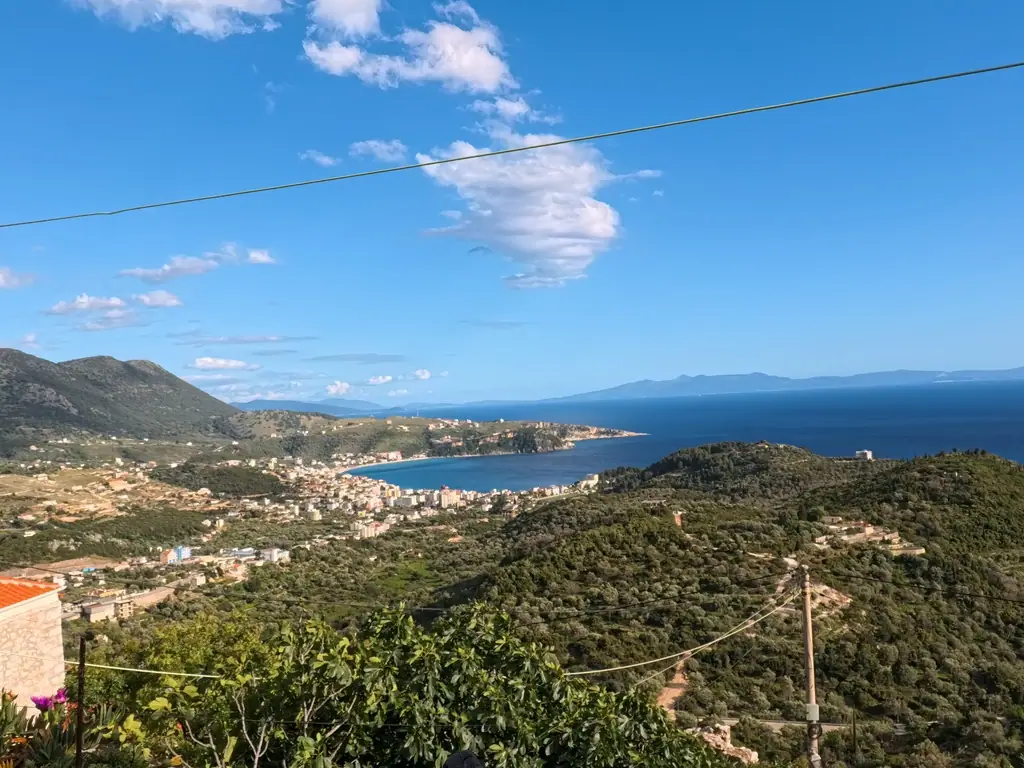
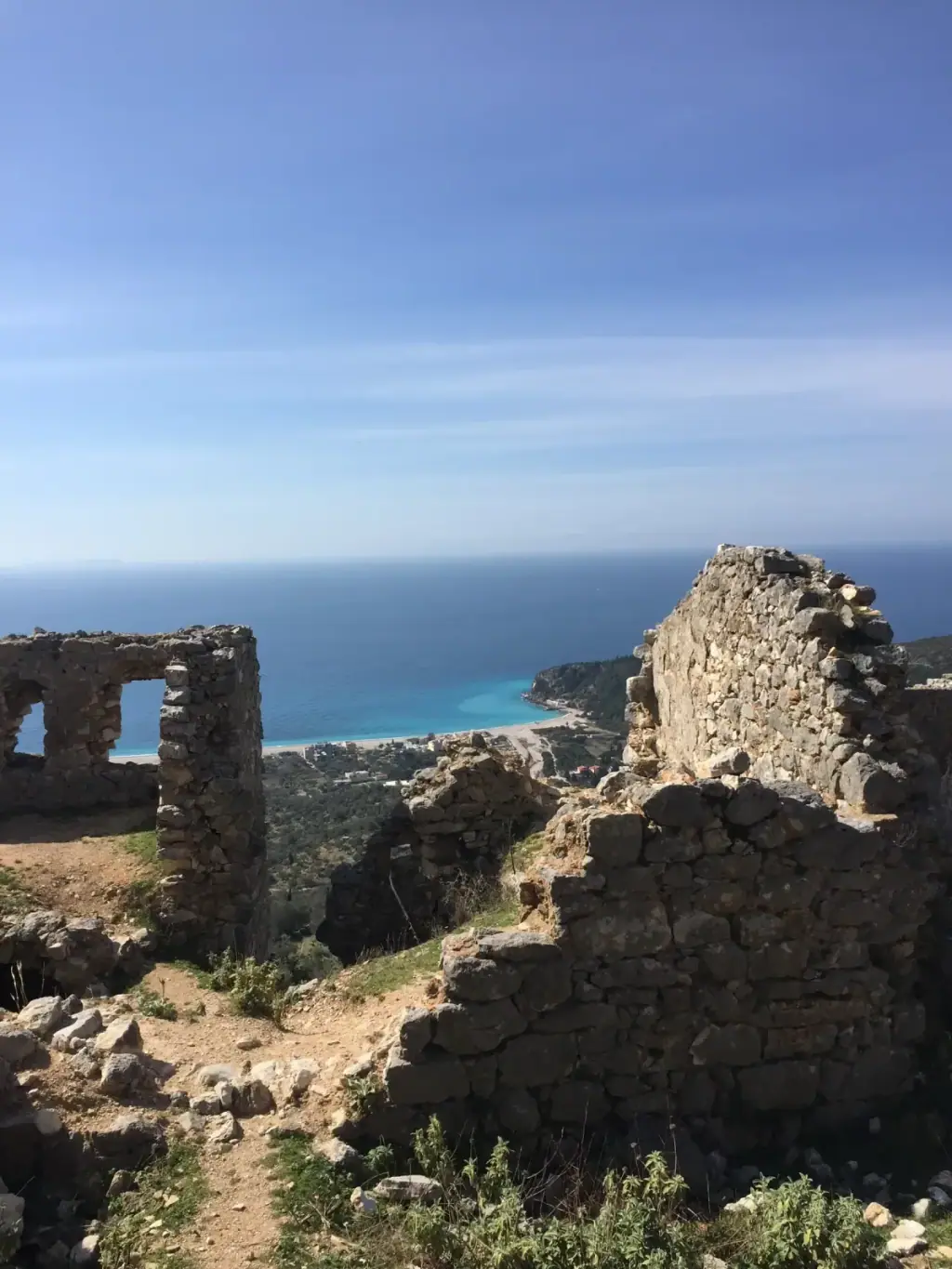
Himara Castle is a free, always-open hilltop fortress and old town, locally called Kastro, in Albanian Himara e Vjetër (Old Himara) or Kalaja e Himarës, on Barbaka hill, a 15-20 minute walk above modern Himarë. While most visitors come to Himara for the beaches, this is the reason the place has a story to tell: fortifications dating to the 5th century BC, Byzantine churches with faded frescoes, stone houses clinging to the hillside, and panoramic views stretching across the Ionian Sea to Corfu on a clear day. Entrance is free, and you can explore the entire site in 1-2 hours.
At a Glance
| Detail | Info |
|---|---|
| Location | Barbaka hill, above Himara town center |
| Fortifications | Dating to 5th century BC |
| Entrance fee | Free |
| Time needed | 1-2 hours |
| Walk from town | 15-20 minutes uphill |
| Best time to visit | Morning or late afternoon |
| Highlights | Byzantine churches, fortification walls, panoramic views, Cafe Butterfly |
A Brief History of Himara Castle
Himara's history runs deeper than almost any other settlement on the Albanian coast. The timeline stretches back over 2,500 years, and the castle walls have seen Greek colonists, Roman legions, Byzantine emperors, Ottoman armies, and Italian occupiers come and go. What follows is the castle-side summary, for the era-by-era story of the town itself, read the full history of Himara.
Ancient Origins (5th Century BC - 2nd Century BC)
The earliest fortifications on Barbaka hill date to the 5th century BC, built by the Chaonians, an ancient Greek tribe that controlled much of the Epirus coast. Himara sat at a strategic point along the coastal route between the Greek colonies to the south and Illyrian territories to the north. The natural elevation of Barbaka hill made it an obvious defensive position: steep approaches on three sides and clear sightlines across the Ionian Sea.
By the 2nd century BC, Rome had absorbed the region. Julius Caesar himself mentioned Himara (then called Chimaera) in his writings during the civil war against Pompey. Roman troops passed through the area during the campaigns of 48 BC, and the town served as a waypoint on the coastal route through Epirus.
Byzantine Period (4th Century - 15th Century)
This is when Himara got the character you still see today. Under Byzantine rule, the settlement on Barbaka hill became a fortified Christian community. The churches you find inside the castle walls, with their stone construction, domed roofs, and frescoed interiors, date primarily to this era. The most notable is the Church of the Panagia (Virgin Mary), which retains fragments of medieval frescoes despite centuries of weathering and neglect.
The Byzantine period established Himara's Greek-speaking Christian identity that persisted for centuries. While the rest of Albania saw populations shift and convert under various rulers, Himara's isolation behind mountain passes and its strong fortifications allowed the community to maintain its language, religion, and customs with remarkable continuity.
Ottoman Period (15th Century - 1912)
When the Ottoman Empire swept through the Balkans in the 15th century, most Albanian towns submitted or fell. Himara was an exception. The town resisted Ottoman control repeatedly, using its mountain fortress and the loyalty of its population to maintain a degree of autonomy that was unusual in the empire.
The Himariots negotiated special privileges, lower taxes, the right to bear arms, and exemption from the devshirme (the child levy that took Christian boys for the Janissary corps). This semi-autonomous status wasn't given freely; it was extracted through repeated revolts and the practical difficulty of subduing a fortified hillside community surrounded by mountains.
Throughout the Ottoman centuries, Himara remained predominantly Greek Orthodox Christian, with the old town serving as the community's spiritual and defensive center. The stone houses, narrow lanes, and church compounds you walk through today were built and rebuilt during this long period of contested autonomy.
Modern Era (1912 - Present)
When Albania declared independence in 1912, Himara was part of a region with competing Greek and Albanian territorial claims. The town's Greek-speaking population complicated the drawing of national boundaries, and the question of Himara's identity remained sensitive throughout the 20th century.
During World War II, Italy occupied Albania in 1939, but Himara was one of the first towns in Albania to be liberated when Italian forces retreated in 1943. The old town saw fighting during the liberation, and the community's resistance became part of local identity.
Under communist rule (1944-1991), the old town declined as the government pushed modernization and discouraged traditional communities. Many families moved down the hill to the new town along the coast. After communism fell, Himara's old town was largely abandoned, and restoration efforts have been slow but ongoing.
Today, a Greek minority community remains historically centered here, and the old town is experiencing a quiet revival, helped by tourism and a growing appreciation for what these ancient walls represent.
What to See in Himara Old Town
The Fortification Walls
The first thing you'll notice walking up to the old town is the scale of the fortifications. The outer walls encircle the hilltop, with sections dating from the ancient period through Byzantine reconstruction to Ottoman-era repairs. You can trace the different construction eras in the stonework, rough-cut megalithic blocks at the base give way to more refined Byzantine masonry higher up.
The main gate is the most dramatic entry point. Walk through it and you're stepping into a space that has been continuously inhabited for over two millennia. The walls are thick, several meters in places, and you can walk along sections of the ramparts for elevated views over both the town and the coastline.
Byzantine Churches
Inside the walls, several Byzantine-era churches survive in various states of preservation. These are not grand cathedrals, they're small, stone-built community churches with the characteristic domed roofs and narrow windows of late Byzantine architecture.
Church of the Panagia. The most significant of the castle churches. Look for the faded frescoes on the interior walls. Centuries of exposure have dimmed them, but you can still make out figures of saints and biblical scenes in the remaining pigment. The iconography follows the standard Byzantine program, with Christ Pantocrator in the dome area and saints along the nave walls.
Other chapel ruins. Several smaller chapels dot the old town, some reduced to foundations and partial walls. These give a sense of how central the church was to the fortified community. There was no shortage of places to worship within the castle walls.
The churches are generally open and accessible. There's no ticketed entry or formal visiting hours, you simply walk in and look around. Be respectful; some are still occasionally used for services.
Stone Houses and Narrow Lanes
Between the churches and the walls, the old town is a network of narrow cobblestone lanes winding between traditional stone houses. Many are in various stages of ruin, with collapsed roofs and overgrown courtyards. Others have been partially restored or are still inhabited.
The architecture is characteristic of southern Albanian and northern Greek mountain villages: thick stone walls for insulation, small windows to manage heat, flat or gently sloped roofs, and external staircases leading to upper floors. The building material came from the hillside itself, giving the old town a unified appearance that blends into the landscape.
Walking the lanes is the best part of the visit. There's no set route, just wander. You'll find arched doorways, vine-covered walls, cats sleeping on warm stones, and sudden openings where a collapsed house reveals a sweeping view of the coast below. It's atmospheric in a way that no amount of description fully captures.
Panoramic Views
The views from Himara Castle are the best on this stretch of coast. From the ramparts and various vantage points within the old town. You can see:
- Livadhi Beach. The 1.5 km sweep of Livadhi Beach stretches out directly below to the south, with its pine-fringed edges and turquoise shallows
- Spile Beach. The main town beach and promenade are visible to the west, with the fishing boats and waterfront restaurants
- The Ionian Sea. Open water to the west and south, deepening from turquoise near shore to navy blue at the horizon
- Corfu. On clear days, the Greek island of Corfu is visible on the western horizon, roughly 70 km away. Morning tends to offer the best visibility before afternoon haze builds
The sunset views from the castle are exceptional. As the sun drops toward the Ionian Sea, the light turns golden and the coastline below glows, this is the single best sunset viewpoint in Himara, better than any beach.
Cafe Butterfly
Perched on the castle walls with unobstructed views of the coast, Cafe Butterfly is one of the most memorable places to have a coffee on the Albanian Riviera. The cafe is built into the fortifications themselves, with seating areas on different levels of the ancient walls.
Order an espresso or a fresh orange juice and sit with a 180-degree panorama of the Ionian Sea, Livadhi Beach, and the mountains rolling south toward Saranda. Prices are reasonable, a coffee runs 150-200 lek ($1.50-2), and cold drinks are 200-400 lek ($2-4).
The cafe is the perfect halfway-point reward for the uphill walk, or a place to linger after exploring the old town. It's popular with both tourists and locals, especially in the late afternoon when the light softens. On a warm evening, there are few better spots anywhere on the Riviera to sit with a drink and watch the world below.
How to Get There
The old town is a 15-20 minute walk uphill from the Himara town center. There are two main approaches:
From the promenade (main route): Head inland from the waterfront and follow the signs toward Kastro. The road climbs steeply through the modern town before narrowing into the path that leads to the castle gate. The route is paved but steep. Wear proper shoes, not flip-flops.
From the main road: If you're driving, a road branches off the main Vlore-Saranda highway and climbs to a small parking area near the old town entrance. Parking is free but limited to a handful of spaces. In peak season, arrive early or park lower and walk the last stretch.
By car or scooter: You can drive most of the way up. The road is narrow and winding but manageable. Park at the designated area, don't try to drive into the old town itself.
The walk is the best approach if you're reasonably fit. The climb gives you time to appreciate the setting, and the gradually revealing views as you ascend are part of the experience.
Best Time to Visit the Castle
Morning (8-10 AM): The light is soft, the stones are cool, and you'll likely have the place nearly to yourself. This is the best time for photography of the churches and lanes, with warm directional light and no crowds. The views toward Corfu are often clearest in the morning before haze builds.
Late afternoon (5-7 PM): The second-best window. The heat has broken, the light turns golden, and you can time your visit to end with sunset. This is when Cafe Butterfly is at its best, and the panoramic views are at their most dramatic.
Midday (12-3 PM): Avoid if possible. There's almost no shade in the old town, the stone radiates heat, and the steep walk up is punishing in full sun. If midday is your only option. Bring water, wear a hat, and plan a shorter visit.
For sunset photos: Arrive by 6 PM in summer (5 PM in shoulder season). Claim a spot on the western ramparts or at Cafe Butterfly. The sun sets over the open Ionian Sea, and the light show over the water is worth planning around.
| Time of Day | Temperature | Crowds | Light Quality | Recommended? |
|---|---|---|---|---|
| Early morning (8-10 AM) | Cool | Empty | Soft, golden | Best for exploring |
| Midday (12-3 PM) | Hot | Moderate | Harsh | Avoid |
| Late afternoon (5-7 PM) | Warm | Moderate | Golden | Best for photos & sunset |
| Evening (after 7 PM) | Pleasant | Quiet | Fading | Good for atmosphere |
Practical Info
Cost: Free. There is no entrance fee for the castle or old town.
Time needed: Plan 1-2 hours. One hour covers the main sights at a brisk pace. Two hours allows for wandering the lanes, sitting at Cafe Butterfly, and waiting for the right light.
What to bring:
- Water, there's no fountain or shop in the old town besides Cafe Butterfly
- Comfortable shoes with grip, the cobblestones are uneven and the paths are steep
- A hat and sunscreen in summer
- Camera, this is the most photogenic spot in Himara
Accessibility: The old town is not wheelchair accessible. The approach is steep, the paths are uneven cobblestone, and there are steps throughout. Anyone with mobility issues will find the climb and the terrain challenging.
Combine with: The castle visit pairs naturally with a day exploring Himara's coast. See it in the morning, then spend the afternoon at Livadhi Beach or Spile Beach. Or visit late afternoon and follow it with dinner on the waterfront. Check our 3-day Himara itinerary for how the castle fits into a full visit, or read things to know before visiting Himara for broader trip planning.
Best season: The castle is visitable year-round, but the best experience is during the main season (May-October) when Cafe Butterfly is open and the weather cooperates. For ideal conditions, visit in June or September, warm enough to enjoy but without the punishing July-August heat. See our guide to the best time to visit Himara for seasonal details.
Combining the Castle With Other Activities
The old town works well as part of a fuller day. Here are the best combinations:
Castle + Beach day: Explore the old town in the morning, then head to Livadhi Beach for the afternoon. The beach is a 10-minute drive from town, and from the sand you can look back up at the castle you just explored.
Castle + Sunset dinner: Visit in the late afternoon, catch the sunset from the ramparts or Cafe Butterfly, then walk down to the promenade for dinner at one of the waterfront tavernas.
Castle + Boat tour: Take a morning boat tour to the sea caves, return by early afternoon, and explore the old town in the cooler late afternoon hours. You can browse Himara boat tours and walking experiences on GetYourGuide if you want a fixed-price option.
For a full Himara plan that fits the castle into context with beaches, restaurants, and day trips, see our 3-day Himara itinerary.
Frequently Asked Questions
Is there an entrance fee for Himara Castle?
No. The castle and old town are completely free to enter. There are no tickets, no gates, and no formal opening hours. You can walk up at any time of day. The only expense is whatever you choose to spend at Cafe Butterfly, which is the sole commercial establishment inside the walls.
How long does it take to walk up to the old town?
The walk from Himara's town center takes 15-20 minutes at a steady pace. The path is paved but steep, gaining roughly 100 meters in elevation. Take it slowly in hot weather and bring water. The walk is part of the experience, the views improve with every switchback.
Can you drive to Himara Castle?
Yes, partially. A narrow road climbs from the main highway to a small parking area near the old town entrance. From there it's a short walk. Parking is free but limited to a handful of spaces, so arrive early in peak season. You cannot drive into the old town itself.
Are Himara Old Town and Himara Castle the same place?
Essentially yes. The fortified old town on Barbaka hill sits inside the castle walls, so locals use the names interchangeably. Kastro, Himara Castle (Kalaja e Himarës), Old Himara (Himara e Vjetër), and Himara Old Town all refer to the same walled hilltop settlement above the modern coastal town.
Is Himara Old Town worth visiting?
Absolutely. It's one of the most historically significant sites on the Albanian Riviera, with fortifications spanning over 2,500 years, Byzantine churches with surviving frescoes, and panoramic views that rank among the best on the coast. Budget 1-2 hours and visit outside midday heat for the best experience.
What is Cafe Butterfly at Himara Castle?
Cafe Butterfly is a cafe built into the castle fortifications, with seating on the ancient walls overlooking the Ionian Sea. It serves coffee, fresh juices, and cold drinks at reasonable prices (150-400 lek). It's open during the tourist season and is one of the most scenic spots for a drink anywhere on the Albanian Riviera.