Porto Palermo Castle is one of those places where history, architecture, and landscape line up in a way that makes you stop and stare. A triangular stone fortress built on a narrow peninsula, surrounded by a bay so turquoise it looks artificial, with a Cold War submarine tunnel hidden in the cliffs across the water. It sits just 8-10 km south of Himara on the SH8 coastal road, making it the easiest and most rewarding day trip from Himara. Come for the Ottoman-era military history, the communist-era paranoia, or just a swim in the clearest water on the Albanian Riviera. Porto Palermo delivers on all three. The whole visit takes about an hour, but you'll want to stay longer.
At a glance
| Detail | Info |
|---|---|
| Location | 8-10 km south of Himara on the SH8 |
| Drive time from Himara | 14-20 minutes |
| Entrance fee | 300 ALL (~3€), cash only |
| Currency accepted | Albanian Lek only (no euros at the gate) |
| Summer hours | 9 AM - 7 PM, daily |
| Winter hours | 8 AM - 4 PM, daily |
| Time needed | 45 minutes - 1.5 hours |
| Built | 1804 by Ali Pasha of Tepelena |
| Status | Cultural Monument (since 1948) |
The history of Porto Palermo Castle
The bay's history predates the castle by centuries. The ancient Greeks called the area Panormos, a name that meant "all-port" or "safe harbour", and they weren't wrong. The natural cove is one of the most protected anchorages on the Albanian coast, sheltered from open-sea winds by surrounding hillsides. The name shifted to Porto Palermo during the Byzantine era and stuck through every subsequent occupation.
Ali Pasha's fortress (1804)
The castle you see today was built in 1804 by Ali Pasha of Tepelena, the powerful and ruthless Ottoman governor who controlled much of southern Albania and northwestern Greece in the late 18th and early 19th centuries. Ali Pasha employed French military engineers for the design, a collaboration commemorated by an inscription on the walls that has since been lost.
Local legend says Ali Pasha built the fortress for Vasiliqia, a woman he loved. Another local story claims that after the castle was completed, the French engineers were executed to prevent them from sharing its military secrets with anyone else. Whether either tale is true is debatable, but they capture something about Ali Pasha's character. He combined genuine cultural patronage with casual brutality.
There's also an ongoing architectural debate. Some historians argue the castle has Venetian origins rather than Ottoman, pointing to its triangular shape which closely resembles the Venetian fortress at Butrint. The walls and construction technique are consistent with Venetian military architecture in the region. Others maintain the 1804 date and Ali Pasha's commissioning as established fact. What's not disputed: the castle is an unusually well-preserved example of early 19th-century fortification, regardless of who drew the first plans.
After Ali Pasha (1822 - present)
Ali Pasha fell in 1822, killed on the orders of the Ottoman Sultan, who had grown tired of his independent streak. The fortress returned to direct Ottoman control. It served various military functions until Albanian independence in 1912.
During World War II, Italian occupation forces repurposed the castle as a prison. After the war, the communist government of Enver Hoxha recognized the site's military value and declared Porto Palermo a Cultural Monument in 1948. The Albanian Navy established a base in the bay, and the castle became part of a broader military zone that included the submarine tunnel carved into the cliffs at the northern end of the bay.
The site was off-limits to civilians for decades. Only after communism fell in 1991 and the military gradually withdrew did Porto Palermo open to visitors. Today it's one of the most-visited historical sites on the Albanian Riviera, though it still feels uncrowded compared to anything in Greece or Croatia.
Architecture: what makes the castle unusual
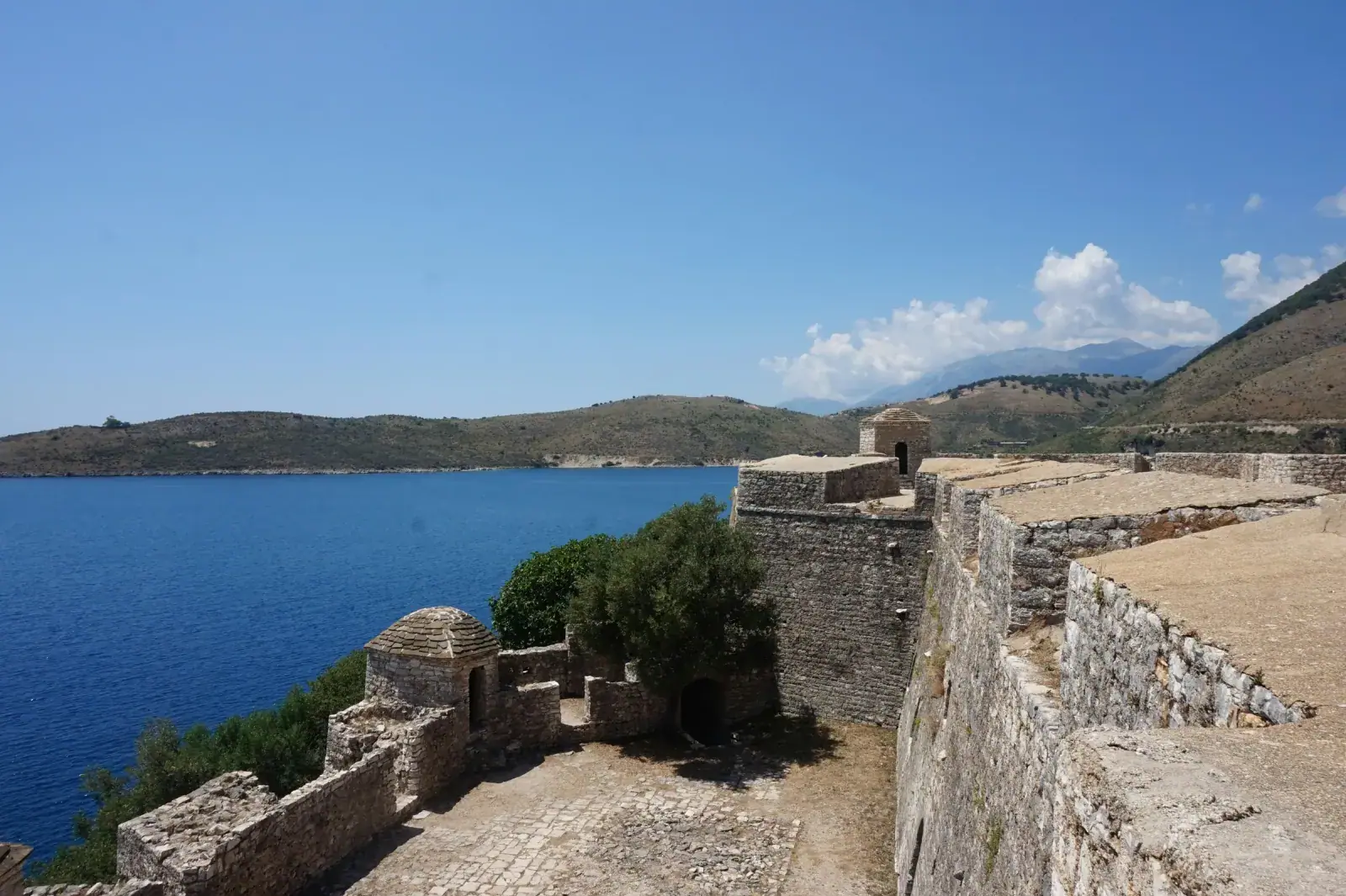
Porto Palermo's most distinctive feature is its triangular ground plan. Most castles in the region, including Himara's own castle on Barbaka hill, follow rectangular or irregular layouts dictated by terrain. Porto Palermo is a deliberate geometric design: three straight walls meeting at three corners, each anchored by a pentagonal bastion tower.
The walls
The limestone walls are massive, 3.2 to 3.5 meters thick, built from stone blocks measuring up to 1.6 meters wide. This isn't decorative stonework; it's built to absorb cannon fire. The walls have held up remarkably well over two centuries, with minimal restoration. What you see is largely original construction, weathered but structurally sound.
Interior layout
Step inside and you enter a hexagonal central chamber with a domed ceiling supported by six large stone pillars. This central space connects to a network of corridors, rooms, and passages that lead to different parts of the castle. The interior includes:
- Prison cells, small dark rooms with thick walls and narrow openings, used throughout the castle's military history from Ottoman times through the Italian occupation in WWII
- A central courtyard, open to the sky, giving light and air to the surrounding chambers
- Ali Pasha's room, a larger chamber traditionally identified as the pasha's personal quarters, with a portrait of Ali Pasha on display
- Soldiers' quarters, barracks rooms along the interior corridors
- Corner towers. The three pentagonal bastions hold watchtower positions with views over the bay and approaches
The upper terrace
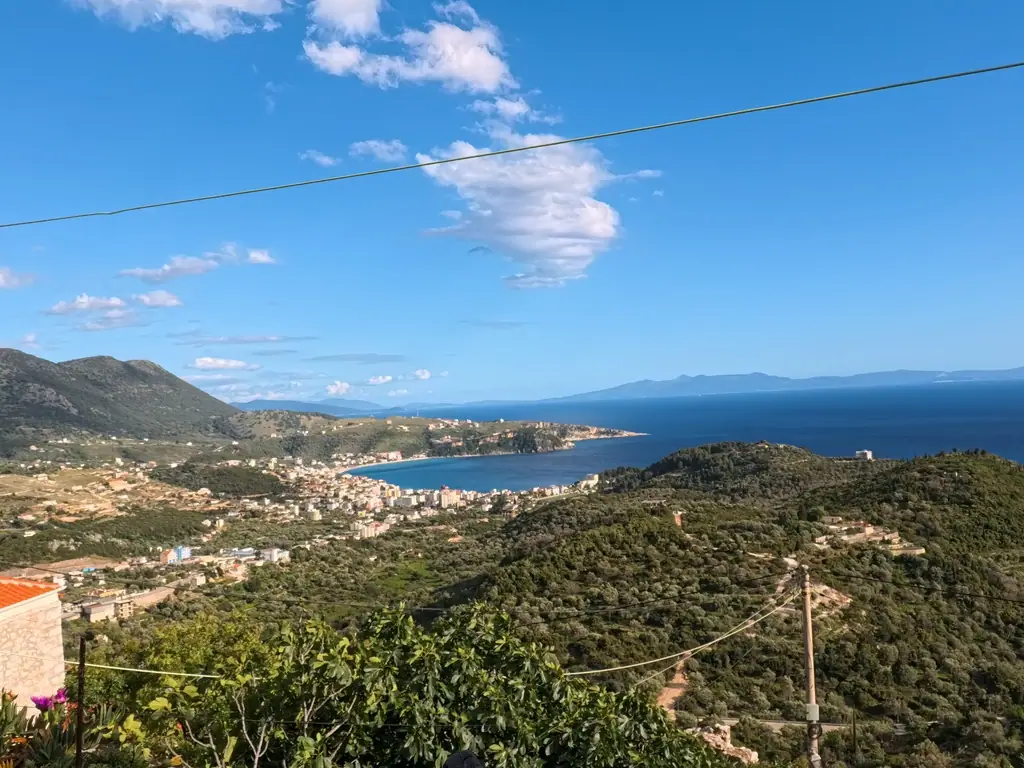
Climb to the roof terrace and you get the best views of the visit. The full sweep of the bay opens up below you: turquoise shallows near the shore deepening to cobalt further out, the hillsides rising green and dry on both sides, and the road you drove in on curving along the coastline above. On a clear day, you can trace the coast north toward Himara and south toward Borsh. This is the spot for photographs.
Porto Palermo vs Himara Castle
Both castles are reachable from Himara and worth visiting, but they're very different experiences.
| Feature | Porto Palermo Castle | Himara Castle (Old Town) |
|---|---|---|
| Built | 1804 (possibly earlier Venetian origins) | 5th century BC origins, Byzantine reconstruction |
| Style | Military fortress, geometric design | Fortified hillside settlement |
| Shape | Triangular, three bastions | Irregular, following hilltop terrain |
| Entrance fee | 300 ALL (~3€) | 300 ALL (~3€) |
| Time needed | 45 min - 1.5 hours | 1-2 hours |
| Getting there | 14-20 min drive south from Himara | 15-20 min walk uphill from Himara center |
| Best for | Military architecture, bay views, swimming nearby | Byzantine churches, atmosphere, sunset views |
| Condition | Well-preserved single structure | Ruins and partial restorations spread across hillside |
| Extras | Submarine tunnel (viewable), bay swimming | Cafe Butterfly, panoramic sunset |
If you have time for only one, Porto Palermo gives you the more complete single-site experience in a shorter time: fortress, history, bay, swim. Himara's old town rewards a slower visit with layers of history spanning 2,500 years, Byzantine frescoes, and the best sunset on the Riviera. Ideally, do both.
The Cold War submarine tunnel
This is the part of Porto Palermo that most visitors don't expect. At the northern end of the bay, carved into the limestone cliffs, sits a Cold War-era submarine tunnel built in 1969 during the height of Enver Hoxha's isolationist military paranoia.
The tunnel is enormous: over 650 meters long and roughly 12 meters high. It was designed to house four Soviet Whiskey-class submarines, each between 75 and 90 meters in length. Albania had seized four of twelve Russian submarines after breaking with the Soviet Union and leaving the Warsaw Pact in 1961. The tunnel was built to hide and protect these submarines from aerial attack, part of Hoxha's broader program of bunkerization that scattered over 170,000 concrete bunkers across the Albanian landscape.
For decades, the tunnel has been disused and classified as a restricted military zone. While the tunnel gate was briefly opened for a ceremony in August 2024, it currently remains closed to the public. It's a backdrop rather than an attraction you can walk into. You can see the entrance from the road on the northern side of the bay, and the scale of the opening in the cliff face gives you a sense of the engineering involved.
The combination of a 19th-century Ottoman fortress and a Cold War submarine base in the same small bay is uniquely Albanian. Nowhere else on the Mediterranean gives you that particular layering of history.
The bay and beach
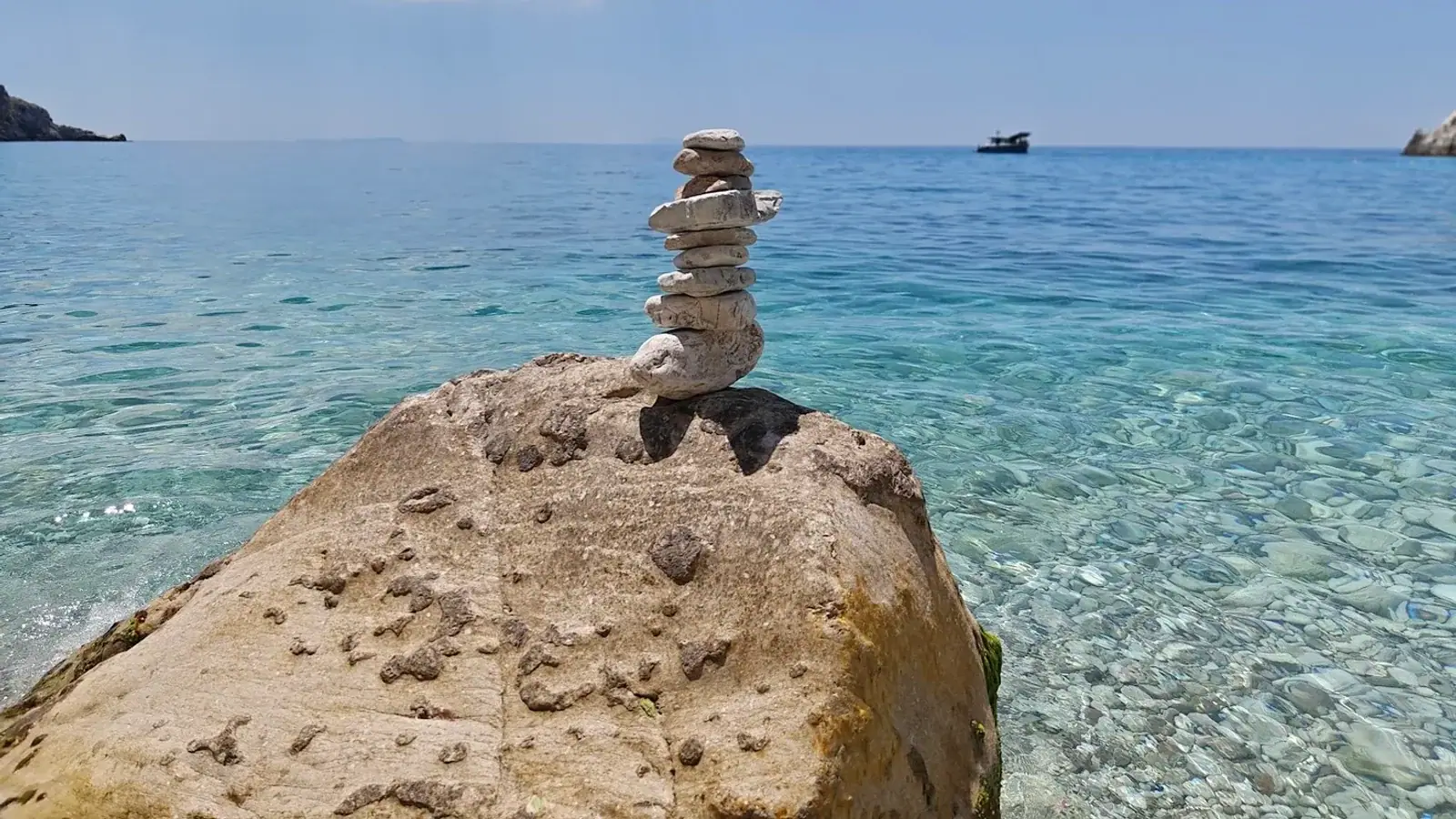
Porto Palermo Bay is one of the calmest and clearest swimming spots on the Albanian Riviera. The protected cove faces away from the prevailing winds, the water is sheltered by hillsides on three sides, and the visibility is exceptional. You can see the bottom clearly in 5-6 meters of water.
The beach is a modest pebble strip near the fortress, not a long sandy stretch. Don't come expecting sunbed rows and beach bars. That's not the appeal. The appeal is the water itself: calm, warm in summer, and almost unnaturally clear. If you have a snorkel, bring it. The rocky edges of the bay have decent underwater visibility and marine life.
Water activities are available in season. Kayaking, SUP, and snorkeling tours run from the bay, typically costing around 41€ per person. You can also browse Porto Palermo tours and boat trips for fixed-price options. You can also simply swim off the rocks near the castle. There's no entry fee for the water, only for the fortress itself.
The overall atmosphere is peaceful and uncrowded. Even in August, when Himara's beaches are packed and Dhermi is a wall of sun loungers, Porto Palermo Bay stays relatively quiet. The lack of large-scale beach infrastructure keeps it that way.
How to get there from Himara
The drive is simple. Head south from Himara on the SH8 coastal road, the same road that runs the length of the Albanian Riviera. Porto Palermo is 8-10 km south, and the turnoff is signed. The total drive takes 14-20 minutes depending on traffic and how cautiously you take the curves.
By car: The most practical option. The road is paved and in good condition. A small parking area sits near the castle entrance; parking is free. In peak summer, spaces can fill up by mid-morning, so arrive early or be prepared to park along the road shoulder.
By scooter: Works perfectly for this trip. The coastal road is scenic and the distance is short. Scooter rentals in Himara run about 15-20€ per day.
By taxi: A one-way taxi from Himara costs roughly 1,500-2,000 ALL (15-20€). Agree on the price before you go, and arrange a pickup time or keep the driver waiting (negotiate a round-trip rate).
By bus: There's no direct bus service to Porto Palermo. Buses running the Himara-Saranda route pass the general area but won't drop you at the castle turnoff reliably. A car or scooter is the way to go.
Combine it: Porto Palermo sits perfectly for a half-day loop south from Himara. Visit the castle, swim in the bay, then continue 5 minutes north to Llamani Beach or 10 minutes south to Borsh Beach. You can hit all three and be back in Himara for a late lunch. For more routing ideas, see our day trips from Himara guide.
Practical tips
Cash only. The ticket booth accepts only Albanian Lek, not euros. Bring exact change or small bills. The nearest ATMs are in Himara.
Footwear matters. The castle interior has uneven stone floors and steep stairways to the upper terrace. Flip-flops technically work but proper shoes are better, especially if the stone is wet.
Bring water. There's no cafe or shop inside the castle. In summer, the exposed stone heats up fast. Carry at least a half-liter per person.
Best time of day. Early morning (9-10 AM) or late afternoon (5-7 PM in summer). Midday is hot and the stone offers no shade. The light is also better for photographs in the morning and late afternoon, because the bay's turquoise colour pops most when the sun isn't directly overhead.
Photography. The upper terrace is the money shot, with panoramic bay views in every direction. Inside, the hexagonal chamber and the corridors make for atmospheric low-light shots. Bring a wide-angle lens if you have one.
Nearby stops. Qeparo village sits in the hills above the bay, a traditional stone village with panoramic views and old houses slowly being restored. Borsh Waterfall is a 20-minute drive further south. Neither requires much time, and both combine naturally with a Porto Palermo visit.
Frequently asked questions
How much does it cost to enter Porto Palermo Castle?
Entrance is 300 ALL, roughly 3€. Cash only, Albanian Lek only. No card payments, no euros accepted at the gate. The nearest ATMs and currency exchange are in Himara, so sort your cash before driving down. The bay and beach area are free to access.
Can you go inside the submarine tunnel at Porto Palermo?
Not yet. The tunnel remains a restricted military zone, though the gate was briefly opened for a ceremony in August 2024. It currently remains closed to the public. You can see the tunnel entrance from the road on the northern side of the bay. The scale of the opening is impressive even from a distance.
How long do you need at Porto Palermo?
Most visitors spend 45 minutes to 1.5 hours. That covers the castle interior, the upper terrace views, and a walk around the exterior walls. Add another hour if you want to swim in the bay or snorkel along the rocks. A half-day is ideal if you combine the castle with a swim and a stop at a nearby beach.
Is Porto Palermo worth visiting from Himara?
It's the single best short trip from Himara: a 15-minute drive to a 200-year-old fortress on a turquoise bay with Cold War submarine history and excellent swimming. The effort-to-reward ratio is unmatched by anything else within an hour of town. Budget a morning or afternoon and you won't regret it.
What is the best way to combine Porto Palermo with other stops?
Drive south from Himara, visit the castle first, swim in the bay, then loop to Llamani Beach (5 minutes north) or continue to Borsh Beach (10 minutes south). This half-day circuit covers a fortress, two beaches, and some of the best coastal scenery on the Riviera without rushing.