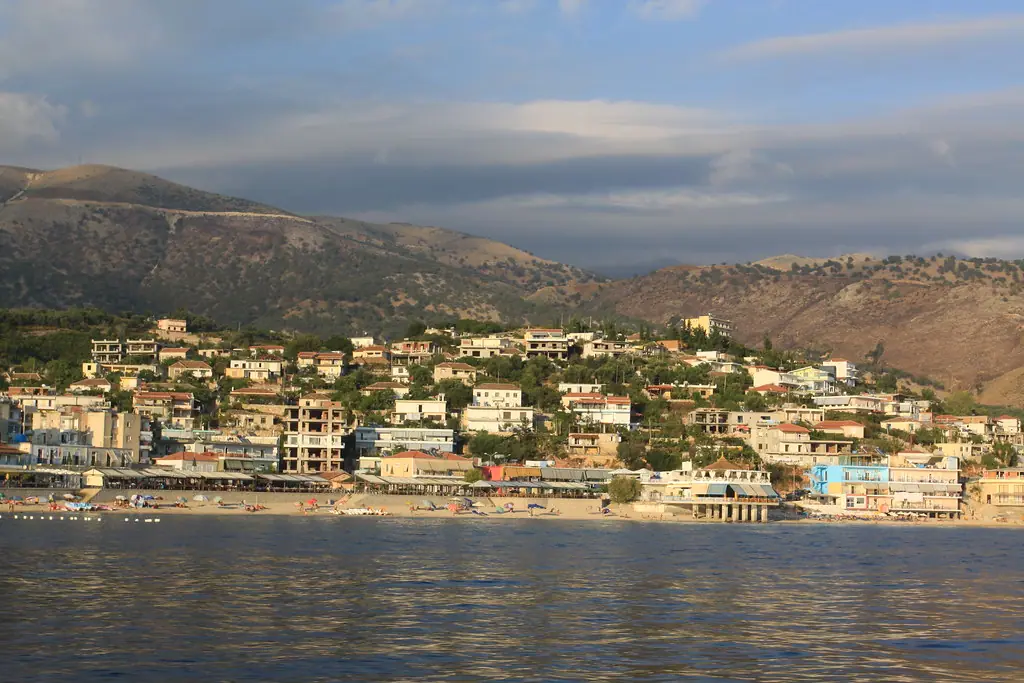
Himara is the perfect base for exploring southern Albania's best attractions. The Albanian Riviera's most dramatic beaches, Ottoman fortress towns, UNESCO World Heritage sites, and natural springs are all within a one-to-two-hour drive. You can wake up to coffee on the promenade, spend the day at a 2,400-year-old archaeological site or a blindingly blue karst spring, and be back for grilled octopus at sunset.
Here's every day trip worth taking from Himara, ranked roughly by how easy they are to pull off.
Compare hotels, apartments, and Vrbo rentals on the map. Powered by Stay22.
Book tours & activities: Compare guided day trips, boat tours, and excursions on GetYourGuide.
Day Trip Summary
| Destination | Distance | Drive Time | Entrance Cost | Highlight |
|---|---|---|---|---|
| Porto Palermo Castle | 15 km south | 15 min | 200 ALL (~2€) | Ali Pasha's triangular fortress over turquoise water |
| Gjipe Beach & Canyon | 15 km north | 25 min + 30 min hike | Free (parking 300 ALL) | Canyon-backed cove, most dramatic beach on the Riviera |
| Borsh Beach | 20 km south | 25 min | Free | 7 km of sand-gravel shore, longest beach on the coast |
| Dhermi & Drymades | 18 km north | 25 min | Free | White pebble beaches, upscale beach clubs |
| Llogara National Park | 22 km north | 25 min | Free | Flag pines, Caesar's Pass, paragliding |
| Blue Eye Spring | 80 km southeast | 1 hour 45 min | 50 ALL (~0€.50) | Vivid blue karst spring at constant 10°C |
| Butrint UNESCO Site | 90 km south | 1.5 hrs (via Saranda) | 700-1,000 ALL (~7€-10) | 2,600 years of ruins from Greek to Venetian periods |
| Gjirokaster UNESCO City | 110 km southeast | 2-2.5 hrs | Castle 400 ALL (~4€) | Ottoman stone city with massive hilltop castle |
Porto Palermo Castle
Distance from Himara: 15 km south | Drive time: 15 minutes | Entrance: 200 ALL (~2€)
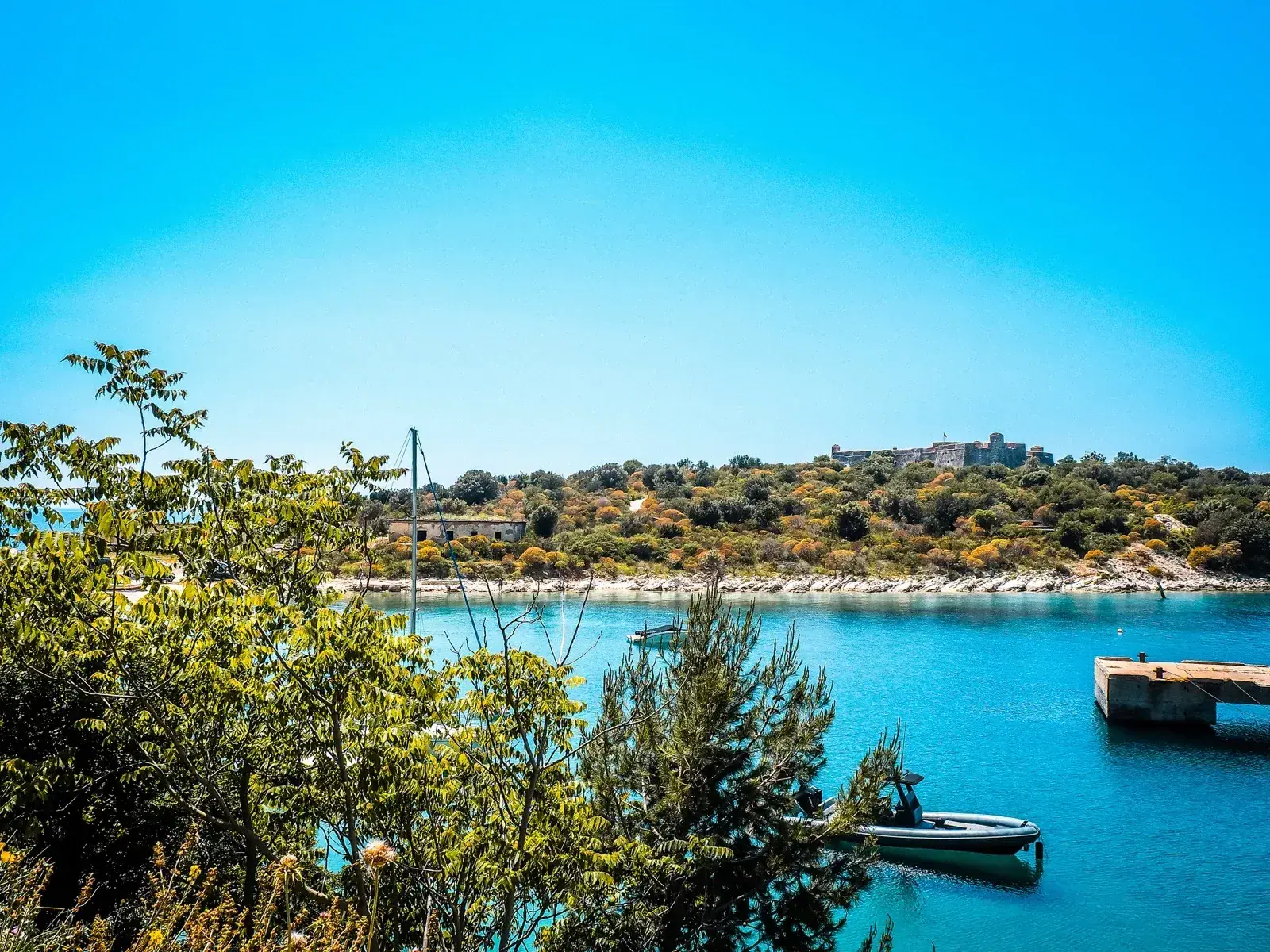
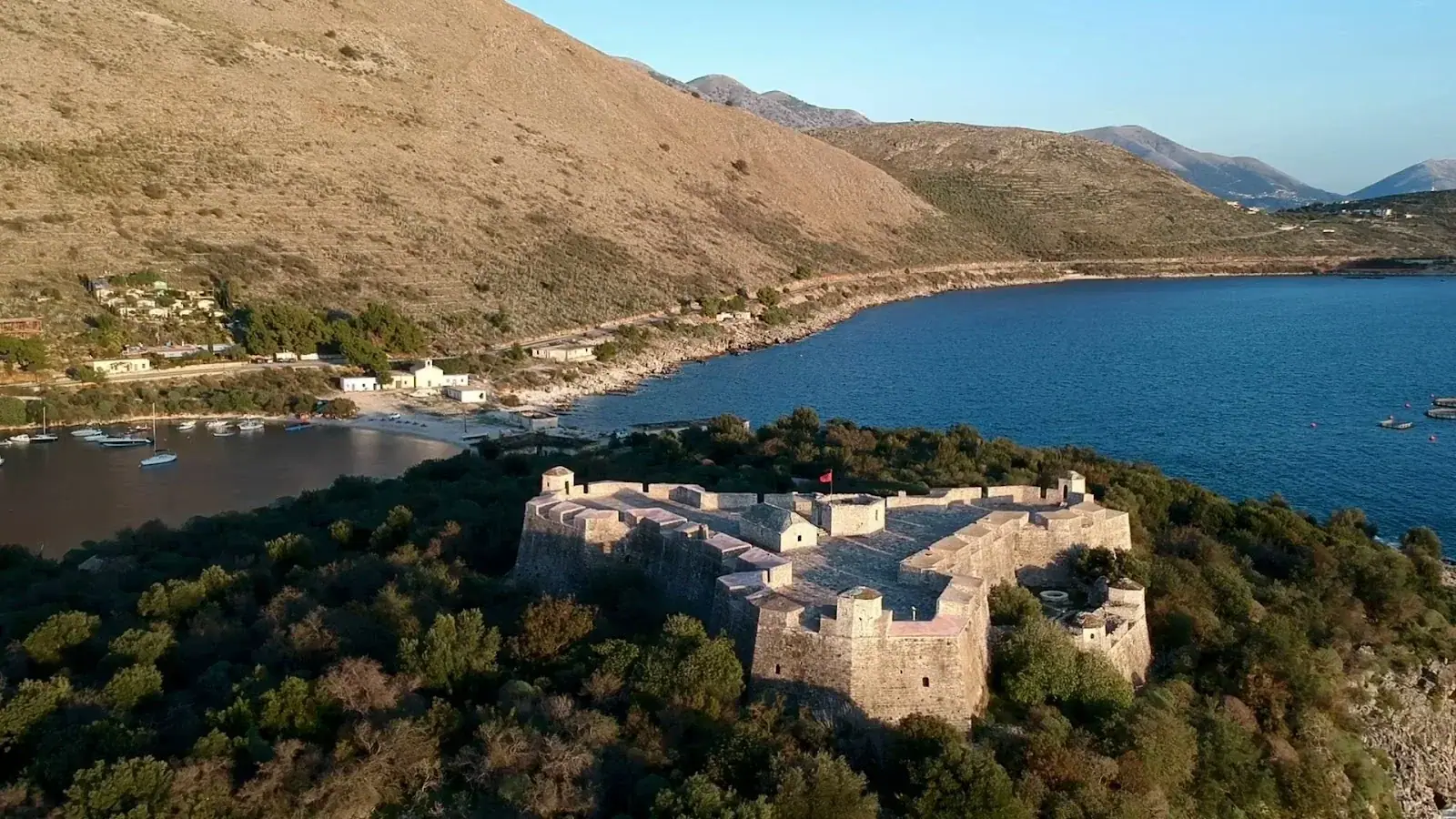
Porto Palermo Castle is the easiest and most rewarding short trip from Himara. Ali Pasha Tepelena built this triangular fortress in the early 19th century on a small peninsula jutting into a sheltered bay. The geometry is unusual, three sides, three gun towers, thick stone walls, and the setting is even better. The bay around it glows a shade of turquoise that looks overexposed in photos but is exactly that vivid in person.
Walk the ramparts for panoramic views of the bay and the surrounding mountains. Inside, the corridors and chambers are atmospheric and mostly empty. On the hillside above the fortress. You can find the entrance to a Cold War-era submarine tunnel carved into the rock, a relic of Enver Hoxha's paranoid military infrastructure. The tunnel is partially flooded and not officially open, but it's visible from the outside and adds another layer of history to the stop.
The beach at Porto Palermo sits just below the fortress. It's small and rocky in places, but the water is noticeably bluer than at most other beaches along this coast, something about the depth and angle of the bay concentrates the colour. Bring a snorkel.
How to combine it: Porto Palermo pairs naturally with Llamani Beach (5 minutes north of the fortress) and Borsh Beach (10 minutes further south). You can hit all three in a half-day loop and be back in Himara for a late lunch.
Getting there: Drive south on the SH8 coastal road. The turnoff to Porto Palermo is well-signed. Parking is free by the fortress entrance. For the full breakdown, see the Porto Palermo day trip guide.
Gjipe Beach & Canyon
Distance from Himara: 15 km north | Drive time: 25 minutes + 30 minute hike | Entrance: Free (parking 300 ALL)
Gjipe Beach is the most dramatic beach on the Albanian Riviera. The beach sits at the mouth of a limestone canyon, with sheer cliff walls rising on both sides, clear blue-green water, and a pebble-sand shore that feels more remote than its distance from Himara would suggest.
Getting there requires effort. Park at the trailhead (300 ALL per day), then hike roughly 2.5 km down through scrubby hillside and into the canyon itself. The trail is exposed and hot in summer. Go early. The final descent through the canyon narrows is the best part of the hike. Alternatively, take a boat from Himara (included in most boat tours or ~15-20€ for a water taxi one way).
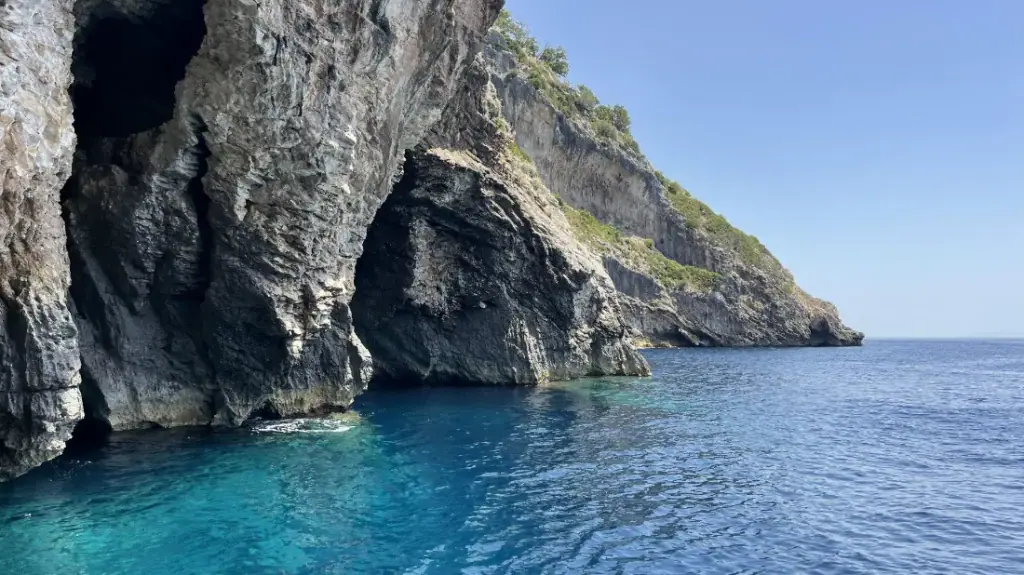
At the beach, facilities are basic: a few drink vendors, umbrella rentals, and that's about it. That's the appeal. The canyon extends inland and is worth exploring on foot for 15-20 minutes. At low tide, small caves at the cliff edges open up along the waterline.
Tip: Take the boat one direction and hike the other. Boat in to skip the hot descent, then hike back through the canyon in the late afternoon when it's cooler.
For the full breakdown on access options, what to bring, and camping, see the complete Gjipe Beach guide.
Borsh Beach
Distance from Himara: 20 km south | Drive time: 25 minutes | Entrance: Free
Borsh Beach is the longest beach on the Albanian Riviera at roughly 7 km. That length means you can always find space, even at peak season when every other beach is shoulder-to-shoulder with sun loungers. The shore is a mix of sand and fine gravel, the water is shallow and warms up quickly, and olive groves climb the hills behind the beach.
The vibe is low-key. A handful of beach bars and simple restaurants line the southern end, but most of the beach is undeveloped. It's a good option for families who want calm water without the crowds, or for anyone who just wants a long, uninterrupted stretch of coastline to walk.
Borsh doesn't demand a full day on its own, which makes it ideal for combining with Porto Palermo on the way back to Himara. Stop at the fortress, swim at Porto Palermo Beach, then drive 10 minutes further south to Borsh for the afternoon.
Getting there: Follow the SH8 south from Himara. Borsh is well-signed. Multiple access points along the beach, all with roadside parking.
Dhermi & Drymades
Distance from Himara: 18 km north | Drive time: 25 minutes | Entrance: Free
Dhermi and its neighbour Drymades sit on the north side of the Llogara Pass and have the most photogenic beaches on the Riviera. White pebble shores, pine trees leaning over the waterline, and water that shifts from emerald to deep blue within a few meters of the shore.
Dhermi proper has the beach clubs and party scene. It's where Tirana's young professionals spend their August weekends. Expect curated music, cocktail menus, and higher prices than anywhere else on the coast. Drymades, a 5-minute drive north, is slightly more relaxed with a mix of upscale beach bars and quieter stretches of shore.
Both beaches are beautiful. Whether you prefer the energy or the quiet, they're worth a half-day trip from Himara. The drive itself is part of the appeal, the SH8 between Himara and Dhermi winds through the Llogara Pass with dramatic mountain-to-sea views the entire way.
For a detailed comparison of both towns, see Dhermi vs Himara.
Llogara National Park
Distance from Himara: 22 km north | Drive time: 25 minutes | Entrance: Free
Llogara National Park sits at the top of the pass between Himara and Vlora, at roughly 1,000 meters elevation. The temperature drops noticeably as you climb, the coastline drops away below you, and the vegetation shifts from Mediterranean scrub to alpine forest. It feels like a different country.
The park is known for its flag pines, ancient Bosnian pines sculpted by relentless Adriatic winds into permanently leaning, flag-shaped silhouettes. Caesar is said to have camped at the pass during the civil war against Pompey, and "Caesar's Pass" is marked with a viewpoint along the road. The panorama from the top. Riviera coastline stretching south, Karaburun Peninsula reaching into the Adriatic, is one of the best views in Albania.
Paragliding launches from Llogara and is one of the most popular adventure activities on the Riviera. Tandem flights cost 99-145€ depending on operator and flight duration, and the descent takes you from mountaintop to beach in about 20 minutes. Conditions are best from June through September.
Hiking trails range from easy walks through the pine forest to more strenuous routes along the ridge. The park is not heavily signed, so download a trail map or ask at one of the mountain restaurants along the road. Several traditional restaurants near the top serve slow-roasted lamb, grilled meat, and mountain herbs, the food is rustic and excellent, and the setting can't be beat.
For driving tips and viewpoint stops, see the Llogara Pass driving guide.
Blue Eye Spring
Distance from Himara: 80 km southeast | Drive time: 1 hour 45 minutes | Entrance: 50 ALL (~0€.50)
The Blue Eye is a natural karst spring where water surges from deep underground through a limestone shaft, creating a pool of vivid, almost electric blue at the centre. The colour comes from the depth, the shaft descends over 50 meters and has never been fully measured, and the water temperature holds steady at about 10°C year-round, regardless of the summer heat above.
The spring is set in a shaded forest. A short boardwalk leads from the parking area to the viewing platform. The pool itself is maybe 15 meters across, not large, but the colour and clarity are genuinely striking. Water flows out from the spring into a stream that feeds the Bistrica River. Swimming in the main pool is officially restricted, though some visitors wade in anyway (it's cold enough to make you regret it).
The Blue Eye works best as a stop on the way to or from Gjirokaster. Both are southeast of Himara, and combining them into a single day trip is the standard approach. Drive to the Blue Eye first (it's on the way), spend 30-45 minutes there, then continue to Gjirokaster for the rest of the day.
Getting there: Take the SH8 south to Saranda, then turn inland toward Gjirokaster on the SH99. The Blue Eye is signed on the right side of the road about 20 km before Gjirokaster. See the dedicated Blue Eye day trip guide for timing and the no-car route. For a hands-off option, browse Blue Eye day tours that include transport from Saranda or Vlora.
Gjirokaster UNESCO City
Distance from Himara: 110 km southeast | Drive time: 2-2.5 hours | Entrance: Castle 400 ALL (~4€)
Gjirokaster is a UNESCO World Heritage Site and one of the most distinctive towns in the Balkans. Built on a steep hillside, the entire old town is constructed from grey stone, stone roofs, stone walls, stone streets, earning it the nickname "City of Stone." The architecture is Ottoman-era, dating from the 17th-19th centuries, and remarkably well-preserved.
The castle dominates the hilltop and is the second-largest castle in the Balkans. Inside its walls you'll find a military museum, a captured American spy plane from the Cold War (the propaganda display is unintentionally fascinating), and panoramic views over the Drino Valley that stretch to the Greek mountains. Budget about an hour for the castle.
Below the castle, the 500-year-old Ottoman bazaar is the heart of the old town. Cobblestone streets lined with traditional stone houses, some converted into small museums, others into cafes and guesthouses. The bazaar is compact enough to explore in an hour or two but atmospheric enough that you'll want to linger. The Skenduli House and Zekate House, both open to visitors, give a window into Ottoman-era domestic life.
How to combine it: The most efficient day trip from Himara pairs Gjirokaster with the Blue Eye Spring. Leave Himara early (7-8 AM), stop at the Blue Eye on the way, spend the late morning and early afternoon in Gjirokaster, and drive back to Himara by evening. It's a long day, roughly 5-6 hours of driving round trip, but both sites are worth it.
Getting there: The most direct route follows the SH8 south toward Saranda, then turns inland on the SH99 through the Muzina Pass to Gjirokaster. The road is in good condition throughout. For a deeper look, see the Gjirokaster day trip guide and the Himara to Gjirokaster transport guide. If you'd rather not drive, you can compare Gjirokaster day tours that bundle transport, castle entry, and old-town walking.
Butrint UNESCO Site
Distance from Himara: 90 km south | Drive time: 1.5 hours (via Saranda) | Entrance: 700-1,000 ALL (~7€-10)
Butrint is Albania's most important archaeological site and a UNESCO World Heritage Site. Occupied continuously from the 8th century BC through the medieval period, the ruins layer Greek, Roman, Byzantine, and Venetian civilisations on top of each other across a forested peninsula surrounded by wetlands and a saltwater lagoon.
The highlights include a well-preserved Roman theatre (still used for performances), Roman baths with intact mosaic floors, a 6th-century baptistery with geometric floor mosaics, Venetian fortification walls, and the remains of a basilica. The site is spread across a manageable loop trail that takes 1.5-2 hours to walk at a comfortable pace. Shaded by old-growth trees, it's one of the more pleasant archaeological sites to visit in summer heat.
The setting is as striking as the ruins. Butrint sits at the tip of a peninsula with the Vivari Channel on one side and Lake Butrint on the other. The biodiversity is rich, turtles, herons, cormorants, and the combination of ancient stone and wild landscape gives the place a quality that more famous Mediterranean sites have lost to over-tourism.
How to combine it: Drive south to Saranda (about 1 hour from Himara), then continue 18 km south to Butrint. On the return, if time allows, detour to Ksamil, a cluster of small islands just north of Butrint with Caribbean-clear water and sandy beaches. Ksamil gets very crowded in August, but in June or September it's excellent. See the dedicated Butrint day trip guide, the Ksamil day trip guide, and the Saranda day trip guide to plan the run south.
Getting there: Follow the SH8 south through Lukova and Saranda. From Saranda, Butrint is 18 km further south, well-signed. The road is straightforward. For a guided alternative, browse Butrint day tours that handle transfers, entry, and pacing.
Practical Tips for Day Trips from Himara
Getting Around
A rental car gives you the most flexibility and is the recommended option for any day trip beyond walking distance. Rates run about 30€ per day from local agencies in Himara or Saranda. Book a day or two in advance in July-August.
A scooter or motorbike works well for shorter trips. Porto Palermo, Gjipe trailhead, Borsh, Dhermi, and costs roughly 15-20€ per day. The coastal road is in good condition but has curves and occasional blind turns, so ride carefully.
Public transport to most day trip destinations is limited or nonexistent. Buses run between Himara and Saranda (from where you can reach Butrint and Ksamil), but service is infrequent and schedules are unreliable. There is no public transport to the Blue Eye, Gjirokaster (without going through Saranda first), Porto Palermo, or Gjipe.
For more on transport options, see getting to Himara.
Timing
For longer day trips (Blue Eye, Gjirokaster, Butrint), leave Himara by 7-8 AM. This gets you to your destination before the midday heat and tourist crowds, and gives you enough time to explore without rushing the drive back.
For shorter trips (Porto Palermo, Borsh, Gjipe, Dhermi). You can leave later, but mornings are still better. Beaches are calmer and emptier before 11 AM, and the afternoon heat on exposed hikes (like the Gjipe trail) can be brutal.
What to Bring
Pack water and snacks for every trip. Facilities at remote stops are limited or seasonal, and you won't always find a shop or restaurant when you need one. Sunscreen, a hat, and sturdy footwear are essential for anything involving hiking. If you're visiting the Blue Eye. Bring a light layer, the forested area around the spring is noticeably cooler than the coast.
Combining Trips
The most efficient combinations:
- Half-day south loop: Porto Palermo Castle + Llamani Beach + Borsh Beach
- Half-day north loop: Llogara Pass viewpoints + lunch at a mountain restaurant + Dhermi or Drymades beach afternoon
- Full-day southeast: Blue Eye Spring + Gjirokaster old town and castle
- Full-day south: Butrint archaeological site + Ksamil beaches (+ Saranda waterfront if time)
- Half-day adventure: Gjipe Canyon hike down + beach time + boat taxi back to Himara
If you have a full day to spare and don't mind the drive, Berat. Albania's UNESCO wine capital, is the longest day trip worth attempting. For trips under 90 minutes ranked by drive time, see the best short day trips from Himara.
For a broader trip planning framework, see the 3-day Himara itinerary or browse all activities.
Frequently Asked Questions
What is the best day trip from Himara?
It depends on what you're after. For history and scale, Butrint is hard to beat, it's one of the most important archaeological sites in the Mediterranean. For a quick, easy win, Porto Palermo Castle delivers the best effort-to-reward ratio: 15 minutes of driving, an intact fortress, and a swim in turquoise water. For natural beauty, the Blue Eye Spring is unlike anything else in the region.
Can I do Gjirokaster and Blue Eye in one day from Himara?
Yes, and this is the recommended way to visit both. Leave early (7-8 AM), stop at the Blue Eye on the way (30-45 minutes there), spend 2-3 hours in Gjirokaster, and drive back to Himara by evening. The round trip is roughly 5-6 hours of driving, so expect a full day.
Do I need a car for day trips from Himara?
For most day trips, yes. Public transport is limited to the Himara-Saranda bus route, and even that runs infrequently. A rental car costs about 30€ per day and opens up every destination on this list. For closer spots like Porto Palermo, Borsh, or the Gjipe trailhead, a scooter (15-20€/day) also works.
Is Butrint worth the drive from Himara?
Absolutely. Butrint is a UNESCO World Heritage Site with 2,600 years of layered ruins in a beautiful natural setting. The 1.5-hour drive south through Lukova and Saranda is scenic, and you can add Ksamil beaches on the way back. Plan for a full day.
How far is the Blue Eye from Himara?
About 80 km, or 1.5 hours by car. The drive goes south along the coast toward Saranda, then turns inland toward Gjirokaster. The Blue Eye is well-signed from the main road. Combine it with Gjirokaster to make the most of the drive.
Can I visit Gjipe Beach without hiking?
Yes. Boat tours from Himara include Gjipe as a stop, or you can arrange a water taxi from Spile Beach (roughly 15-20€ one way). During peak summer, jeep rides from the parking area to the beach are sometimes available for 500-1,000 lek per person. See the Gjipe Beach guide for all access options.
What is the best time of year for day trips from Himara?
June and September offer the best balance of warm weather, manageable crowds, and reliable conditions. July and August are peak season, hotter, busier, and more expensive, but everything is open and running. May and October work for cultural day trips (Gjirokaster, Butrint) but some beach facilities may be closed.
Are the roads safe for driving around Himara?
The main coastal road (SH8) is in good condition and fully paved. It has curves and some narrow sections, especially around the Llogara Pass, but it's manageable for any driver comfortable with mountain roads. Interior roads to the Blue Eye and Gjirokaster are also paved and straightforward. Drive carefully, watch for oncoming traffic on blind corners, and avoid driving the mountain sections at night if possible.