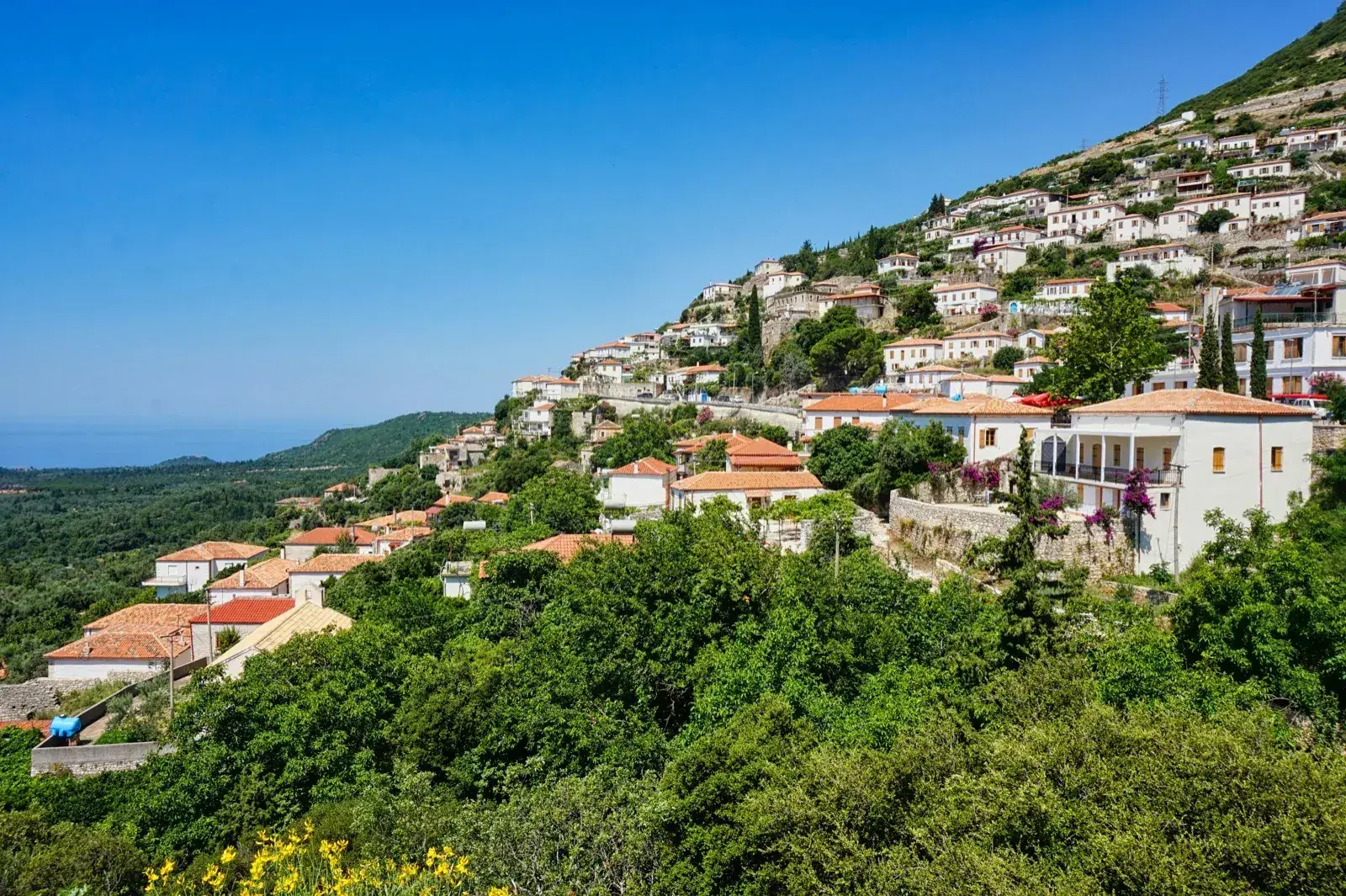
Behind every beach town on the Albanian Riviera. There is a mountain village. These stone-built settlements predate the coastal development by centuries -- some by millennia. Most are partially abandoned, their populations drained by Hoxha-era collectivization and post-1991 migration. What remains is deeply atmospheric: cobblestone paths between roofless houses, churches with faded frescoes, fig trees pushing through collapsed walls, and views stretching to Corfu.
The villages are accessible on foot from the coast, usually within one to three hours of uphill walking. No tickets, no infrastructure. Just trails climbing from sea level into a version of Albania that the beach resorts have erased. If you have spent three days on Himara's beaches and want something different, this is it.
This guide covers five Albanian Riviera village hikes near Himara, with trail details and practical information.
Compare hotels, apartments, and Vrbo rentals on the map. Powered by Stay22.
Book tours & activities: Compare guided day trips, boat tours, and excursions on GetYourGuide.
Quick Facts
| Village | Starting Point | Distance | Elevation Gain | Time (one way) | Difficulty | Water/Services |
|---|---|---|---|---|---|---|
| Old Himara (Kalaja) | Himara center | 0.8 km | ~80 m | 10-15 min | Easy | Cafe at top (seasonal) |
| Pilur | Himara (Potam bridge) | 6.5 km | ~700 m | 2-2.5 hrs | Hard | None |
| Vuno | SH8 turnoff or Jale Beach | 2 km (road) / 8 km (coastal trail from Himara) | ~300 m | 30 min (road) / 3-4 hrs (trail) | Easy (road) / Moderate (trail) | Basic cafe, guesthouse |
| Upper Qeparo | Lower Qeparo | 4 km | ~400 m | 40-50 min | Moderate | None reliable |
| Kudhës | Borsh village | ~8 km | ~600 m | 1.5-2 hrs | Hard | None |
Old Himara (Himara Castle / Kalaja)
Not technically a hike, but the most accessible village walk on the Riviera. The old town of Himara sits on Barbaka hill directly above the modern center -- a fortified settlement with roots stretching back to the 5th century BC.
The walk takes 10-15 minutes from the main road. Follow signs toward "Kalaja" and climb a paved path through stone walls and arched gateways. At the top: Byzantine churches with surviving frescoes, Ottoman-era houses, defensive walls, and a panoramic view over the coast to Corfu on clear days. A seasonal cafe operates near the upper entrance in summer. Free entry, open at all hours. See the Himara Castle visitor guide for the full breakdown.
Who it is for: Everyone. The easiest introduction to Riviera village culture.
Pilur
Pilur sits roughly 700 meters above Himara on the western slope of the Ceraunian Mountains -- a nearly abandoned stone village with castle ruins and one of the widest coastal panoramas on the Riviera. On a clear day, you see from Dhermi to Borsh, the entire Ionian horizon laid out. The village was the starting point of the first South Outdoor Festival in 2017.
The Trail
The route starts at the Potam bridge area on Himara's eastern edge and climbs through olive terraces, macchia scrub, and sparse pine forest. It is 6.5 km one way with ~700 meters of elevation gain -- allow 2 to 2.5 hours up, 1.5 hours down. The trail is not formally marked but traceable on Organic Maps and Maps.me.
The lower half follows old agricultural paths. The upper half gets steeper and exposed. No shade on much of the route, no water at any point. In summer, start before 7 AM or skip it -- the midday heat on this south-facing slope is punishing.
You can also drive on a rough dirt road (high-clearance 4x4 only, ~20 minutes from SH8).
What You Will Find
Almost nothing, and that is the point. Stone houses in various stages of collapse. Castle ruins on the ridge above. Wildflowers covering terraces in spring. Complete silence. Pilur is functionally abandoned as a permanent settlement.
Difficulty: Hard. Significant elevation gain, unshaded. A serious morning hike.
Vuno
Vuno is the most alive of the mountain villages on this list. About 80 people live here year-round, a few guesthouses operate in restored stone houses, and a couple of small cafes serve coffee and simple food in summer. The village sits in a natural amphitheatre on the hillside above Jale Beach, its houses tiered like seats facing the Ionian Sea. The name comes from the Greek word "vouno" (mountain).
The main village street is steep cobblestone -- too narrow for vehicles in most stretches. Stone houses with slate roofs, arched doorways, walled courtyards, and fig trees growing through the cracks. Two churches from the 1770s-1780s (St Spyridon and St Mary) contain well-preserved post-Byzantine frescoes. Vuno is also known as a center of Albanian isopolyphonic singing, a UNESCO-recognized tradition that has been practiced here for centuries.
Getting There
By road: From the SH8 between Himara and Dhermi, a signed turnoff leads 2 km uphill on a narrow paved road. Drivable in a normal car. Walking from the turnoff takes about 30 minutes.
By coastal trail: The Vuno-to-Himara Coastal Trail is one of the best hikes on the Riviera -- 8 km, moderate difficulty, 3-4 hours, marked with red-and-white blazes. Most hikers taxi from Himara to Vuno and walk back south (net downhill). See the hiking guide for full trail details.
From Jale Beach: A steep trail connects Vuno to Jale Beach below in 20-30 minutes. Combine a village visit with a beach day.
What You Will Find
A living village with character, views, churches worth entering, and the possibility of coffee or a meal. Guesthouses run 3,000-5,000 ALL (~30-50 EUR) per night. For a deeper guide, see the Vuno and Qeparo villages guide.
Difficulty: Easy by road, moderate by coastal trail.
Upper Qeparo (Qeparo i Siperm)
Upper Qeparo is the old stone village above coastal Lower Qeparo, roughly 450 meters above sea level. The upper village has been largely emptied since families moved downhill in the mid-20th century. What remains is one of the most atmospheric abandoned settlements on the Riviera -- cobblestone paths between crumbling limestone houses with carved wooden doors and stone arches framing coastal views.
The Trail
An old mule path -- partially paved, partially cobblestone, partially dirt -- climbs from Lower Qeparo through olive terraces to the village above. The walk takes 40-50 minutes, gaining ~400 meters over 4 km. Well-defined and impossible to lose, but steep in places. You can also drive up on a narrow paved road off the SH8 (tight switchbacks, limited parking).
What You Will Find
Ottoman-era stone houses, most abandoned but structurally intact. The Church of Saint Mary (Kisha e Shen Merise) with its 27-meter bell tower. Panoramic terraces with views south toward Borsh Beach and north toward Himara. A handful of old houses have been converted into guesthouses as part of a slow revival. Just northeast, the ruins of Karos Fortress mark a Bronze Age settlement -- an optional 30-minute extension. See the Old Qeparo village guide for the full breakdown.
Difficulty: Moderate. Real elevation gain, but short distance and clear path.
Kudhes
Kudhes is the most remote village on this list -- in the mountains above Borsh, reachable by a trail climbing ~600 meters over 8 km. The hike takes 1.5 to 2 hours one way. No services at any point on the trail or in the village. No cafe, no shop, no water source.
The Trail
Start from Borsh village (the inland settlement, not the beach). The trail follows old shepherd paths up the valley. Not formally marked -- download Organic Maps or Maps.me beforehand, GPS is essential. Lower sections pass through olive groves with partial shade. Upper sections are exposed and rocky. In spring, the wildflowers are outstanding -- poppies, wild orchids, yellow broom. By midsummer, brown and brutally hot.
What You Will Find
Complete isolation. A small cluster of stone houses in a mountain setting disconnected from the resort coast below. You look down over the full 7 km length of Borsh Beach, Ceraunian range behind, Ionian ahead. You may encounter a shepherd. Otherwise, solitude.
Difficulty: Hard. Long approach, significant elevation, no shade, no water, no trail markings. For experienced hikers comfortable with route-finding.
When to Go
The Albanian Riviera village hikes are best in spring and autumn. Summer midday is too hot for sustained uphill walking on exposed trails.
| Season | Conditions | Verdict |
|---|---|---|
| April - June | Mild temperatures (18-28°C), wildflowers in bloom, green hillsides, longer daylight | Best season. April-May for wildflowers, June for warm but manageable heat |
| July - August | 30-35°C by mid-morning, no shade on most trails, intense sun exposure | Only Old Himara (short) and early-morning Vuno are realistic. Avoid Pilur and Kudhes |
| September - October | Temperatures cooling (22-28°C), post-summer calm, fewer visitors | Excellent. Dry trails, comfortable temps, quieter villages |
| November - March | Cool to cold, possible rain, short days, some trails muddy | Possible for Old Himara and Vuno by road. Mountain trails not recommended |
For more on seasonal planning, see the best time to visit Himara guide.
What to Bring
None of these trails have reliable water or services (except Old Himara and Vuno by road).
- Water: 1.5L minimum for short hikes (Qeparo, Vuno); 2.5-3L for Pilur and Kudhes. Double in summer
- Sun protection: Hat, sunscreen, sunglasses -- most trails are fully exposed
- Footwear: Sturdy shoes with grip. Hiking shoes for Pilur and Kudhes; good trainers for Qeparo and Vuno
- Offline maps: Download Maps.me or Organic Maps before leaving Himara. Cell signal is patchy to nonexistent on mountain trails
- Snacks and full phone charge: Nothing to buy above the treeline, and your phone is your map
Cultural Notes
These villages look empty but are not entirely abandoned. Seasonal residents return in summer, and elderly residents live quietly in houses that look closed from outside. If you encounter someone, greet them -- "miredita" (good day) in Albanian, or "kalimera" in the Greek-speaking villages along this coast.
There is a reasonable chance you will be invited for coffee or raki. Accept. This is standard Albanian hospitality, not a tourist performance. Refusing is considered rude. You will get Turkish coffee, a shot of homemade raki, and possibly preserved figs or walnuts.
Do not enter houses that appear abandoned without invitation. Many are still owned by families who visit seasonally.
Safety
- Tell someone your plans before heading to Pilur or Kudhes. Phone signal drops on mountain trails
- Trail markings are sparse. Only the Vuno-Himara coastal trail has red-and-white blazes. Everything else relies on GPS
- Do not hike alone to Pilur or Kudhes. The Vuno coastal trail and Upper Qeparo are fine solo. For remote mountain villages, find a partner or hire a local guide
- Heat is the primary summer danger. Heatstroke on an exposed, shadeless trail with no water and no signal is a real risk. Start before 7 AM or wait for autumn
Frequently Asked Questions
Do I need a guide for these village hikes?
Not for Old Himara, Vuno, or Upper Qeparo -- straightforward walks on established paths. For Pilur and Kudhes, a guide is recommended unless you are experienced with GPS route-finding. Ask at your accommodation -- some guesthouses arrange local guides.
Can I drive to these villages instead of hiking?
Old Himara, Vuno, and Upper Qeparo are reachable by car on paved (if narrow) roads. Pilur has a rough 4x4-only dirt track. Kudhes has no vehicle access from the coast.
Are the villages safe to walk around?
Yes. Watch your footing on collapsed walls and uneven cobblestones, especially in Upper Qeparo and Pilur. Do not climb on ruins or enter structurally unstable buildings.
Is there anywhere to eat or drink in these villages?
Vuno has small cafes and guesthouses serving basic food in summer. Old Himara has a seasonal cafe. Upper Qeparo has a few guesthouses that may serve drinks. Pilur and Kudhes have nothing -- bring everything you need.
Can I combine multiple village hikes in one day?
Old Himara morning plus Vuno by car in the afternoon is comfortable. Combining two mountain hikes (Pilur, Kudhes) in one day is not realistic. Upper Qeparo pairs well with a visit to Borsh Beach afterward.
What is the best single village hike if I only have time for one?
Upper Qeparo offers the best effort-to-reward ratio: a 40-50 minute walk with genuine atmosphere, intact architecture, and coastal views. For a full-day challenge, Pilur delivers the most dramatic panorama. For hiking-plus-village without extreme effort, taxi to Vuno and walk the coastal trail back to Himara.