
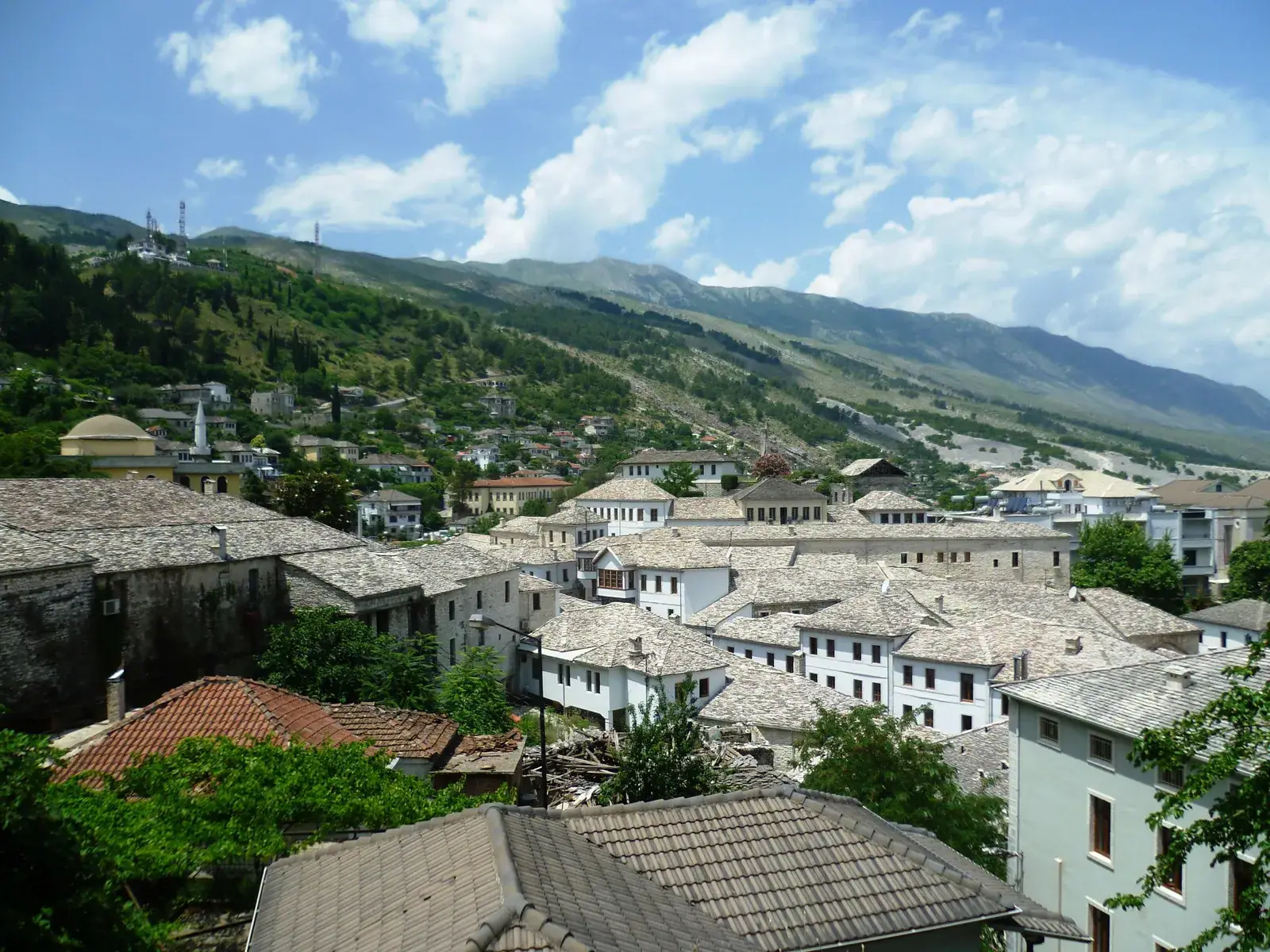
Gjirokastër is the UNESCO stone city of southern Albania: several hundred Ottoman tower houses roofed in grey slate, stacked up a hillside under one of the largest castles in the Balkans. It is also the most rewarding inland day from the south coast, and the place most visitors wish they had given a night instead of an afternoon.
What to do there is less obvious than it looks from the bus. The castle is the headline, but three of the best things in town are inside private houses, one is under the ground, and the old bazaar changes character completely after the day-trippers leave at five. This guide puts them in order, with the 2026 prices we could verify and the ones we could not.
Gjirokastër at a glance
| What it is | UNESCO-listed Ottoman town (2005), seat of Gjirokastër County |
| Population | 16,569 in the town, 23,270 in the municipality (2023 census) |
| Elevation | About 300 m, between the Drino valley and Mali i Gjerë |
| Castle | 400 lek; May–Sep daily 09:00–19:00, Oct–Apr Tue–Sat 09:00–16:00, Sun 09:00–14:00, closed Monday |
| Tower houses | Skenduli and Zekate, about 200–300 lek each |
| Cold War tunnel | Guided visits only, about 200 lek |
| From Saranda | About 53 km, an hour to an hour and a half by bus |
| Time to allow | One full day; one night if you can |
| Pay with | Cash in lek |
The castle prices and hours come from the regional heritage directorate (DRTK Gjirokastër). The house and tunnel prices come from 2026 visitor guides, which disagree by 100 lek here and there, so carry a few 500-lek notes and some coins.
Things to do in Gjirokastër
Here is the walking order we would use for a single day. It starts at the top while it is cool and ends in the bazaar for dinner.
| Order | What | Time | Cost (2026) |
|---|---|---|---|
| 1 | Castle, gun gallery and the American jet | 1.5–2 h | 400 lek, armaments museum about 200 extra |
| 2 | Zekate House | 45 min | About 200 lek |
| 3 | Skenduli House | 45 min | About 200–300 lek, family-led tour |
| 4 | Ethnographic Museum | 30 min | About 200 lek (one site lists 500) |
| 5 | Cold War tunnel | 30 min | About 200 lek, guided only |
| 6 | Old bazaar, then dinner | Evening | Free |
1. Gjirokastër castle
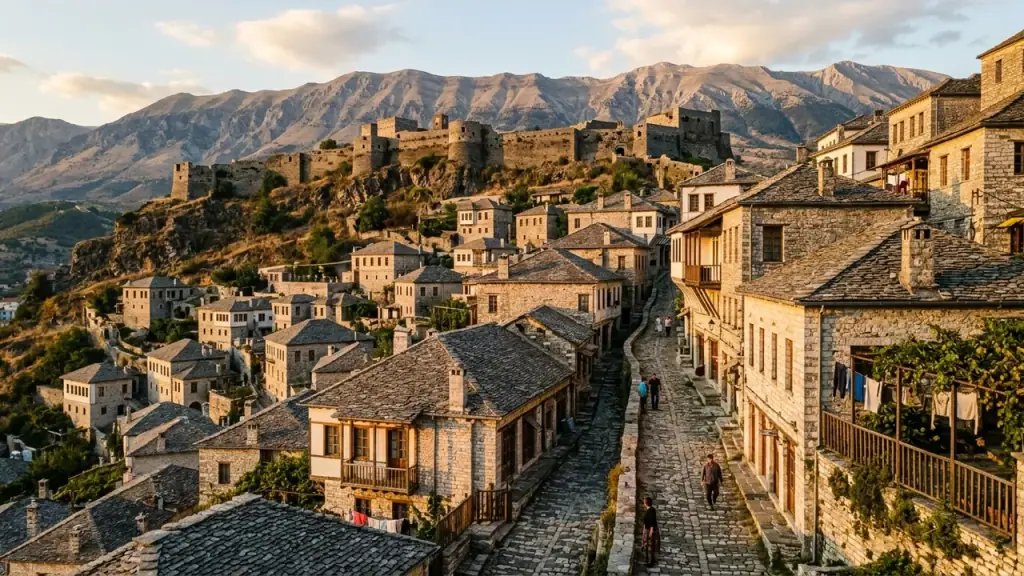
The castle runs along the ridge above the bazaar, and nothing else in town makes sense until you have stood on it. Inside are a long vaulted gallery of Ottoman, Italian and German artillery, the armaments museum, a prison used by King Zog and then by the communist regime, the Gjirokastër Museum on the region's history, a US Air Force T-33 jet that came down in Albania in 1957, and Ali Pasha's clock tower. Our Gjirokastër castle guide has the full route, ticket details and the Monday closure.
2. Zekate House
The most impressive of the tower houses from outside: twin towers joined by a double-arched upper facade, built in 1811 to 1812 for Beqir Zeko, an official under Ali Pasha. It sits high in the Palorto quarter, a steep 10 to 15 minutes above the bazaar, and the view back over the town is the best reason to make the climb. There is no electric light inside, so go before 16:00.
3. Skenduli House
Still owned by the Skenduli family, who show visitors round themselves on a 30 to 45-minute tour. It is the best-preserved interior in town: painted reception rooms, carved wooden ceilings and the separate men's and women's spaces of a well-off Gjirokastër household. Hours are loose; if the door is shut, come back in half an hour.
4. The Ethnographic Museum
Built in 1964 to 1966 on the site of the house where Enver Hoxha was born in 1908, after the original burned down. It was put up as a model Gjirokastër house rather than a replica of Hoxha's, and it shows traditional household life, not the dictator. Visit it if you only have time for one house and want furniture and costume; skip it if you have seen Skenduli.
5. The Cold War tunnel
Under the town, a long tunnel built for the communist government in case of nuclear attack, with dozens of rooms. Visits are guided only and start from the tourist information office near Çerçiz Topulli square, where staff tell you when the next group goes. 2026 guides give about 200 lek and a 20-minute tour; hours vary by season and source, so ask at the office in the morning. It is cool inside even in August.
6. The old bazaar and the old quarters
The bazaar, Pazari i Vjetër, is the town's centre: a crossroads of steep cobbled streets lined with two-storey stone shops, first built in the 17th century and rebuilt in the 19th after a fire. The Gjirokastër Mosque, from 1757, stands at its edge. By day it is souvenir stalls, embroidered textiles and carved stone; after 17:00, when the coaches leave for Saranda, it becomes the town's living room. From the bazaar, lanes climb into the old residential quarters, Palorto towards Zekate, Dunavat and Manalat on the other side, and just off the bazaar stands the Obelisk of Education memorial.
More things to do if you stay longer
- A free walking tour. Several tip-based tours meet in the bazaar or at Çerçiz Topulli square, in the morning and late afternoon, including one listed in Spanish on GuruWalk. Times change between listings, so message the guide the day before.
- The Ismail Kadare house. The novelist was born here in 1936, and Chronicle in Stone is set in the town. His restored family house in the Palorto quarter is open to visitors.
- Viroi lake. A spring-fed lake about 3 km north of town beside the Tepelenë road, protected as a natural monument since 1983, with walking paths and a café on a small island. A promenade runs out from town if you want to walk. In very dry summers the water drops a long way.
- Antigonea. The hilltop city founded by Pyrrhus is across the Drino valley; see our Antigonea guide.
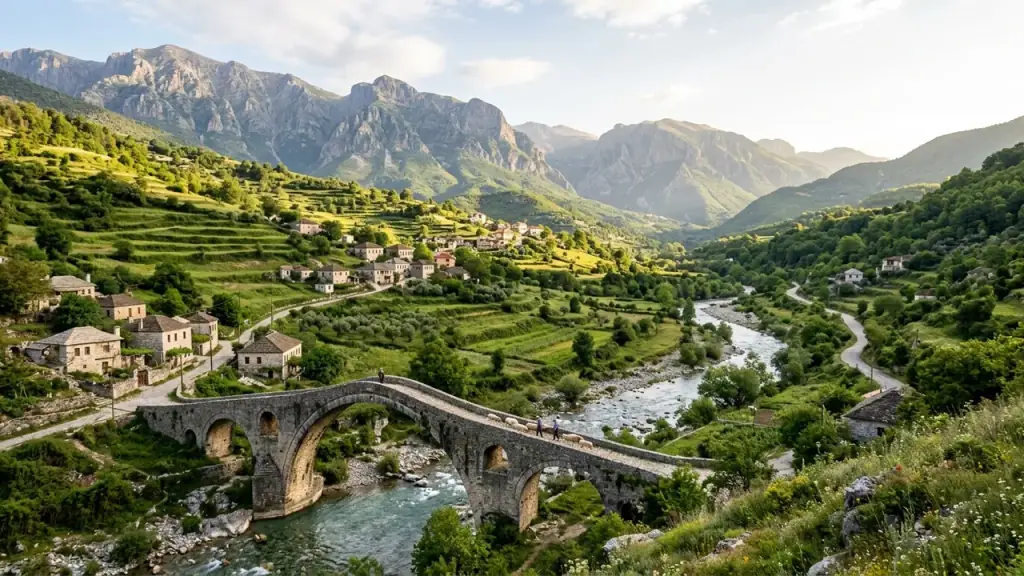
- Zagoria. Stone villages and Ottoman bridges in the mountains to the east, best on foot; see the Zagoria valley guide.
- Rafting and hot springs at Përmet. About 60 km away, covered in the Përmet travel guide and the Vjosa rafting guide.
Gjirokastër and the Blue Eye
The Blue Eye spring, Syri i Kaltër, is the obvious pairing, on the way between Gjirokastër and Saranda. Gjirokastër to the Blue Eye is about 36 km, but the last stretch is slow, and most drivers take 45 minutes to an hour. Do the Blue Eye in the morning and Gjirokastër in the afternoon and evening, or the reverse on your way back to the coast. Tours from Saranda that combine the two are on GetYourGuide's Gjirokastër page, and our Blue Eye day trip from Himara covers the spring itself.
How to get to Gjirokastër
| From | Distance by road | Typical time | Notes |
|---|---|---|---|
| Saranda | 53 km | 1–1½ h by bus | Several buses a day; see Saranda to Gjirokastër |
| Ksamil | 64 km | About 1½ h | Change in Saranda by bus |
| Himara | 102 km | About 2 h by car | Direct bus in summer; see Himara to Gjirokastër |
| Përmet | 61 km | About 1 h by car | Via Tepelenë |
| Vlora | 123 km | About 2–2½ h by car | Inland via Tepelenë |
| Ioannina (Greece) | 89 km | About 1¾ h by car | Via the Kakavia border crossing |
| Tirana | 218 km | About 4 h by bus | 1,200–1,400 lek; Tirana to Gjirokastër bus guide |
| Berat | 147 km | 2½–3 h by car | See Berat or Gjirokastër |
Distances are by road from the routing engines; times are what we would plan on, not what the map promises. Buses arrive at Gjirokastër's bus station in the lower, modern town, about 1 km north of the bazaar on the main road; local companies such as Lengo Tours sell tickets there. The old town is uphill; take a taxi for the short ride up if you have luggage.
Parking. If you drive, park in the lower town or in one of the small paid car parks near the bazaar, and walk up. The cobbled lanes are steep, narrow and in places one-way, and the area right under the castle fills early in summer.
Where to stay in Gjirokastër
Stay in the old town if you can. The restored tower-house guesthouses are the reason to spend the night, and the bazaar at night, with the castle floodlit above, is the part day visitors never see. Below the old town, the newer hotels on the main road are easier to reach by car but leave you a steep walk to everything worth seeing.
Compare hotels and guesthouses in Gjirokastër on the map. Powered by Stay22.
Some names travellers search for: Resort Kërculla, a four-star hotel with a pool on the hill above the old town (4.7 from 794 Google reviews), the best choice in July heat if you do not mind a taxi to the bazaar; Rose Garden Hotel (4.8 from 172) and Hotel Bar Restaurant Kodra (4.5 from 956) in the old town; Hotel Argjiro Traditional by the bazaar; and Inn Cloud, a small homestay on Rruga Partizani. Furra, in the restaurant table below, also lets rooms.
Many of the small guesthouses close or cut back from November to March. For hotels by area and budget, see where to stay in Gjirokastër. Check that yours is open, and that it has heating, before a winter visit.
Where to eat in Gjirokastër
Gjirokastër food is mountain food: lamb, cheese, rich pies and qifqi, fried balls of rice bound with egg and herbs, which you will not find on the coast. Eat it at least once.
These are the places people search for by name most often, with the Google rating and review count when we pulled them in October 2026.
| Place | What it is | Where | Google rating |
|---|---|---|---|
| Furra Restaurant & Rooms | Restaurant with guest rooms | By the bazaar | 4.8 (2,973) |
| Grill House 13 | Grill and barbecue | In the bazaar | 4.9 (2,087) |
| Edua | Albanian dishes | Rruga Gjin Bue Shpata, bazaar | 4.6 (856) |
| Hotel Bar Restaurant Kodra | Hotel restaurant | Old town | 4.5 (956) |
| Bar Restaurant Kujtimi | Albanian dishes, below the castle | Old town | 4.2 (812) |
| Kalimera Patisserie | Cakes and coffee, a second branch in the new town | Old town | 4.7 (379) |
| The Barrels (te Fuçitë) | Restaurant outside town, best by car | Rruga Valere, about 4.5 km north | 4.9 (1,537) |
| Pizza Me Gusta | Pizza | New town, Rruga Rauf Fico | 4.5 (203) |
| Pizza 'N' Burger Wide | Burgers and pizza | New town | 4.3 (98) |
Ratings move; read the table as a snapshot, not a ranking. Our Gjirokastër restaurants guide has the longer list. Order qifqi as a starter, and look for oshafa, a pudding of dried figs and milk, which is the town's dessert.
Gjirokastër weather by month
We pulled 20 years of ERA5 climate reanalysis (2006–2025) for Gjirokastër through Open-Meteo. The model smooths out extremes, so read these as typical, not record, values.
| Month | Average high | Average low | Rain | Rainy days |
|---|---|---|---|---|
| January | 11°C | 3°C | 231 mm | 13 |
| February | 12°C | 3°C | 175 mm | 12 |
| March | 15°C | 5°C | 180 mm | 14 |
| April | 18°C | 9°C | 111 mm | 12 |
| May | 22°C | 12°C | 106 mm | 13 |
| June | 27°C | 17°C | 57 mm | 8 |
| July | 31°C | 19°C | 19 mm | 5 |
| August | 31°C | 20°C | 28 mm | 4 |
| September | 26°C | 16°C | 118 mm | 9 |
| October | 21°C | 12°C | 170 mm | 10 |
| November | 16°C | 8°C | 299 mm | 13 |
| December | 12°C | 4°C | 228 mm | 12 |
Rainy days are days with at least 1 mm. Two things stand out. Gjirokastër is wet from October to March, far wetter than the coast, and November is the wettest month of the year. And July and August are hot on an exposed castle ridge. May, June and September are the months we would pick. The Gjirokastër weather by month guide has more on each month.
Frequently asked questions
What is Gjirokastër known for?
It is known as the stone city: an Ottoman town of tower houses roofed in grey slate, under a castle that runs the length of the ridge above. UNESCO listed it in 2005. It is also the birthplace of the novelist Ismail Kadare and of the dictator Enver Hoxha, and the home of Albania's National Folklore Festival.
Is Gjirokastër worth visiting?
Yes. It is the most rewarding inland day trip from Saranda or Ksamil, an hour away, and better as an overnight. The castle, two tower houses, the Cold War tunnel and the bazaar fill a day. Day-trippers leave by about 17:00, so staying the night gets you the old town at its best.
How do you pronounce Gjirokastër?
Roughly "jee-ro-KAHS-ter", with the "gj" softer than an English j, close to the "dj" in "adjust". Locals also say Gjirokastra, the definite form of the name. The Greek name is Argyrokastro, which means silver castle, and that is where the name comes from rather than from the legend of Princess Argjiro.
What is Lazarat, near Gjirokastër?
Lazarat is a village just south of Gjirokastër, now part of its municipality, that was notorious as the centre of Albania's cannabis trade. In June 2014 about 800 police took the village after a four-day standoff and destroyed tens of thousands of plants. It is a quiet village today and not a sight in itself.
Is there a beach near Gjirokastër?
No. Gjirokastër is inland, and the nearest sea is at Saranda, about 53 km away, an hour or more by road. For water closer to town, the Blue Eye spring is about 45 minutes to an hour away, and the Benjë thermal pools near Përmet are a bit over an hour.
How many days do you need in Gjirokastër?
One full day covers the castle, two tower houses, the Cold War tunnel and the bazaar. Stay one night for the evening and an early start before the day-tour coaches arrive. Add a second day for Antigonea, the Zagoria valley, or the Blue Eye on the way back to the coast.
The bottom line
Do the castle first, the tower houses second, the tunnel when the next tour leaves, and the bazaar last. Bring cash, wear shoes that grip on wet limestone, and stay the night if your trip allows it. If you are also weighing up Berat, read Berat or Gjirokastër first, and if you are coming from the coast for the day, our Gjirokastër day trip from Himara has the timings.
Cover photo: Radosław Botev, CC BY 3.0 pl, via Wikimedia Commons.
.jpg)