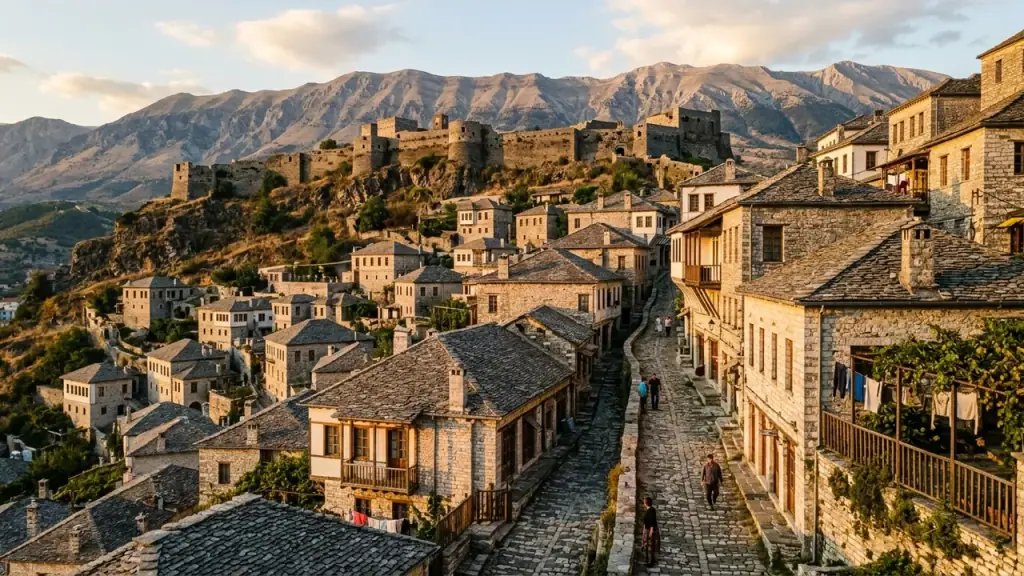
Berat castle is the reason most people climb the hill above Berat, and it surprises nearly all of them. You expect a ruin with a ticket booth. What you get is a neighbourhood: cobbled lanes, washing lines, a woman selling lace from her doorstep, and Byzantine churches tucked between the houses, all inside walls that have been rebuilt by Romans, Byzantines and Ottomans on the same rock.
That also makes it confusing to plan. Is there a ticket? When does it close? Which of the twenty-odd churches can you actually get into? The answers below come from the Berat museums' own price list, the culture ministry, and guides updated in 2026, and where they disagree we say so.
Berat castle at a glance
| Name | Kalaja e Beratit, also called Kala |
| Where | On the rock above the Mangalem quarter, about 214 m up, right bank of the Osum |
| Walk up from Mangalem | About 1 km, 15–20 minutes, steep cobbles |
| Castle ticket | 300 lek, cash, at the main gate, 09:00–18:00 |
| Gate booth hours | Usually staffed about 09:00–18:00. The quarter itself never closes, people live there |
| Onufri icon museum | 400 lek, 500 with audio guide, free under 12 |
| Onufri hours | Daily until 31 October 2026; from 1 November to 30 April Tue–Sat 09:00–16:00, Sun 09:00–14:00, closed Monday |
| Time to allow | 2–3 hours with the museum |
| Best light | Late afternoon into sunset, from the southern walls |
The single thing to plan around is the Onufri museum, the only part with fixed hours. In winter it is shut on Mondays, so a Monday visit from November to April gets you the walls and the views but not the icons.
Berat castle tickets and opening hours
Entry to Berat castle is 300 lek (about €3), paid in cash at the booth by the main gate, which is staffed from 09:00 to 18:00. That is the figure AlbaniaVisit, The Endless Travellers and Salt in our Hair all give for 2026. Bring the exact amount, because the booth rarely has change. The castle is still a lived-in neighbourhood and the walls have smaller gates, so outside booth hours, and on quiet off-season days when nobody is in the booth, you walk in without paying.
The museum prices are not in doubt. The Berat museums centre, which runs both the Onufri and the Ethnographic museum, lists:
| Ticket | Onufri museum | Ethnographic museum |
|---|---|---|
| Adult | 400 lek | 300 lek |
| Adult with audio guide | 500 lek | n/a |
| Students and ages 12–18 | 120 lek | 90 lek |
| Under 12 | Free | Free |
| Reduced (50%) | 200 lek | 150 lek |
The Onufri museum opens 09:00–19:00 every day until 31 October 2026. From 1 November to 30 April it is Tuesday to Saturday 09:00–16:00 and Sunday 09:00–14:00, closed on Mondays. The centre's site also gives a 09:00–18:00 line for 15 May to 30 September, which overlaps the other schedule, so if you are cutting it fine, ring them on +355 32 232 224. Tickets can be bought online through the national culture tickets site or at the door.
How to get up to Berat castle
From the Mangalem side of town, walk up Rruga Mihal Komneno, the cobbled road that starts near the King Mosque and zigzags up to the main gate on the north side. It is about a kilometre and most people take 15 to 20 minutes, longer in July heat. The cobbles are polished smooth and slippery after rain, so wear shoes with grip.
 Photo: Wolfgang Sauber, CC BY-SA 4.0, via Wikimedia Commons.
On the slope between Mangalem and the walls, a lookout marked on Google Maps as Viewing Platform (4.9 from 340 reviews) is a good place to catch your breath and look down on the rooftops. A taxi will take you to the gate if the climb is too much, and drivers can reach it too, though parking near the top is tight and the lanes inside are not for cars. The museums centre itself notes that you can drive as far as the castle gate and that the museum has no parking of its own.
Coming down, take a different line through the Mangalem lanes and you end up at the river near the boulevard, which is where the evening walk starts. Our Berat old town guide covers that side.
What to see inside the walls
Berat castle is bigger than it looks from below. Go in through the main gate and work roughly south, towards the point of the rock above the river.
The lived-in quarter
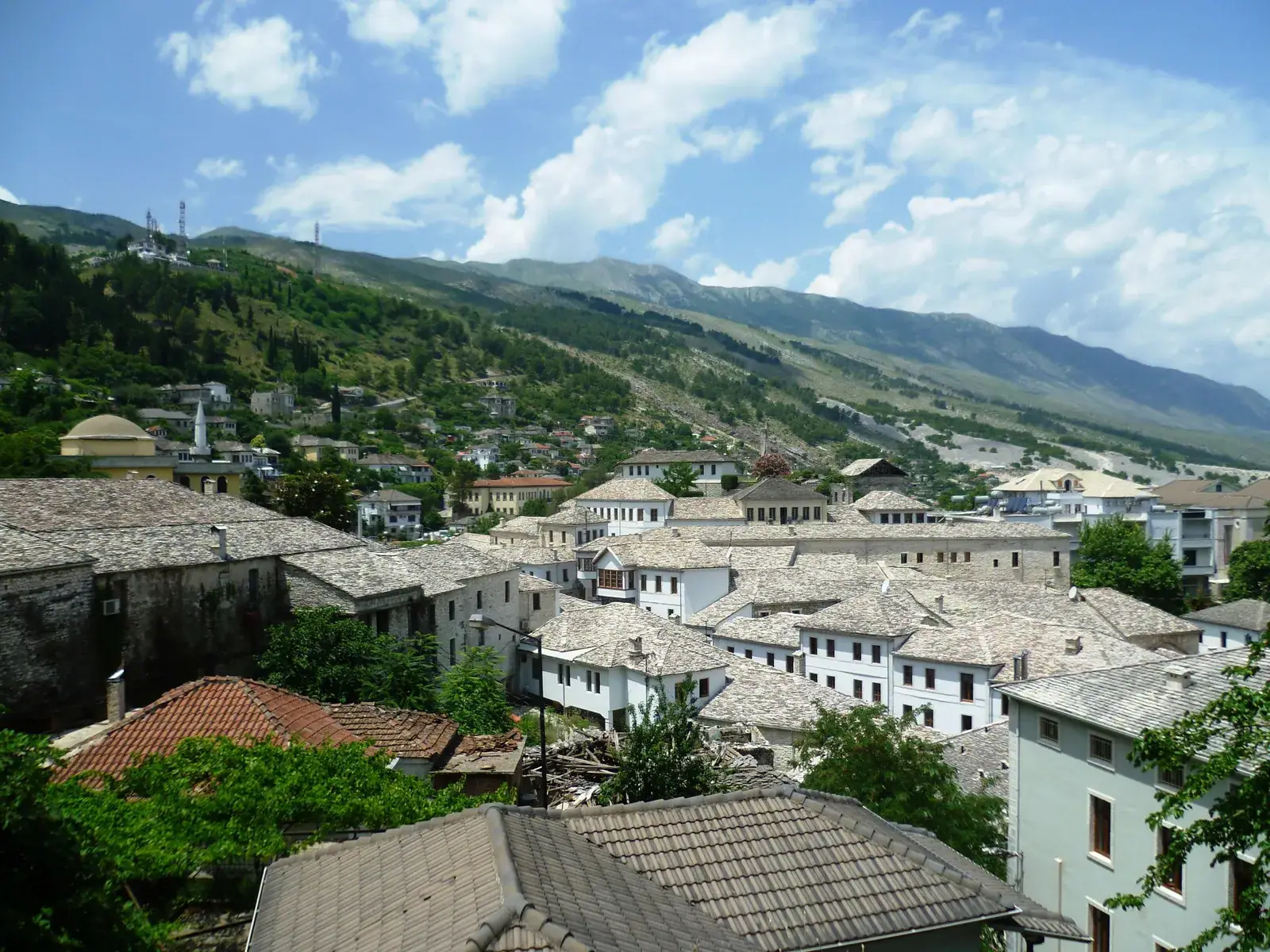
Wikipedia's article on the castle counts about 20 churches inside the walls historically, most from the 13th century, and only one mosque, for the Ottoman garrison. Guides disagree on how many people live there now, with figures from about 200 to 400. Whatever the number, it is a real neighbourhood with houses, small guesthouses and cafés, and the residents are used to visitors walking past their gates. Keep your voice down and your lens out of open doorways.
 Photo: Shkelzen A. Rexha, CC0, via Wikimedia Commons.
Holy Trinity church
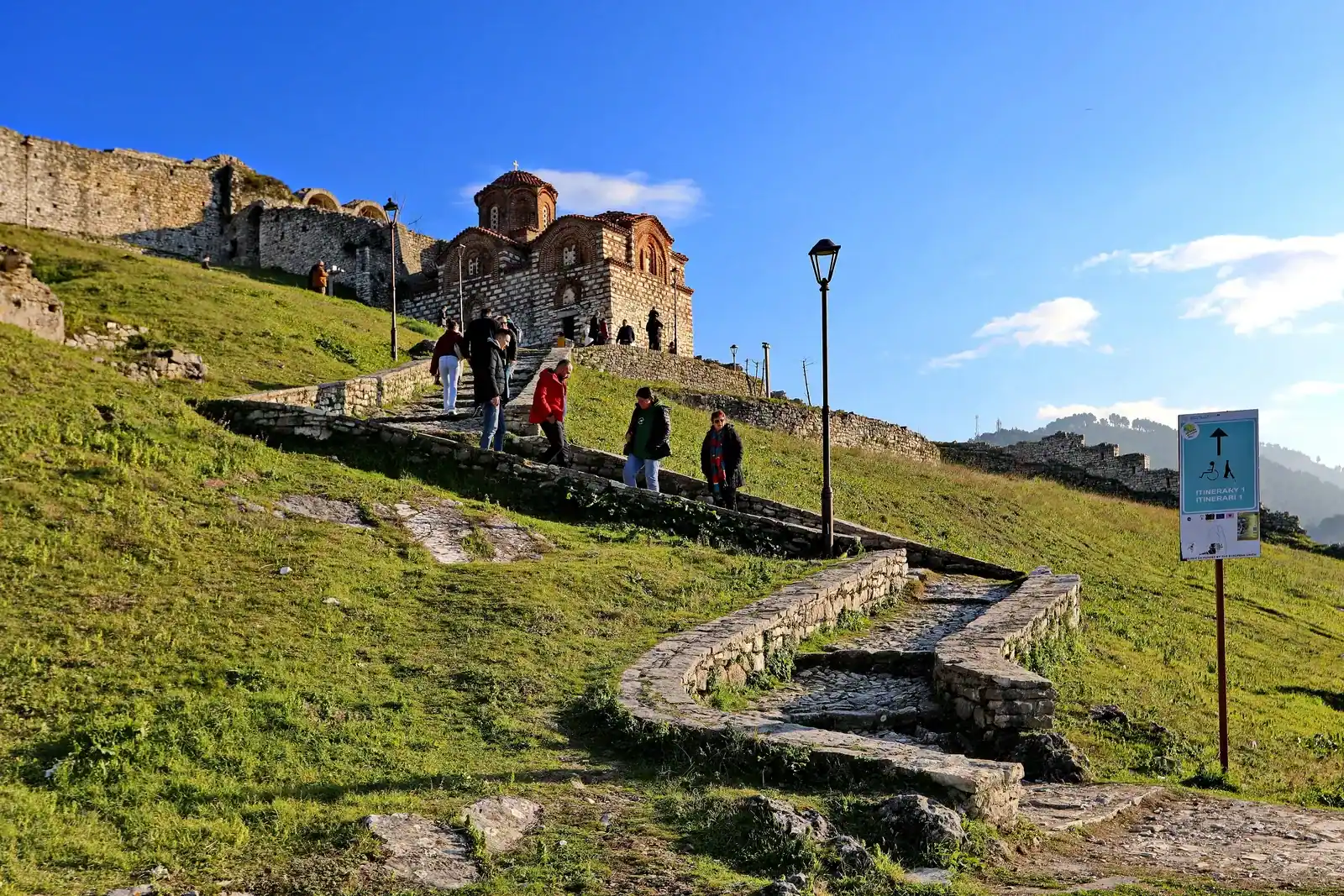
Just outside the inner walls, on the slope, the small Holy Trinity church dates from the 13th or 14th century and is the most photographed building in the castle, red brick and stone in a cross shape with a dome. The interior is often closed for restoration, so treat it as an exterior visit.
St Mary of Blachernae
Named after the church of the same name in Constantinople, this one dates mainly from the 13th century. Its 16th-century frescoes and icons are largely the work of Nikolla, son of Onufri, the painter the town's icon museum is named after. Opening is irregular. If the door is shut, ask in the nearest house; someone usually knows who holds the key.
Onufri National Iconographic Museum
The museum sits in the Cathedral of the Dormition of St Mary, built in 1797 on the foundations of an older church at the highest point of the old metropolitan complex. Albania's national tourism agency puts the collection at about 200 icons and liturgical objects from the 14th to the 20th century. The two reasons to go in are the icons by Onufri himself, the 16th-century painter known for the deep red now called Onufri red, and the carved and gilded iconostasis, made around 1806 to 1807.
The church is also where the Berat codices were found. The Purple Codex of Berat, a 6th-century gospel book, and the 9th-century Golden Codex of Anthimos turned up under the apse floor in 1968. The originals are in the National Archives in Tirana; what you may see in Berat are copies.
We would give the museum 45 minutes. The audio guide is worth the extra 100 lek if icons are new to you.
The Red Mosque and the White Mosque
Near the southern walls, a red-brick minaret is all that stands of the Red Mosque, usually dated to the 15th century, after the Ottomans took Berat. The White Mosque nearby is in worse shape, with low walls and the base of a stair. Neither is a building you enter, but together they explain why a mostly Christian quarter has a minaret on its skyline.
The inner citadel, the cistern and the view
At the southern end, the inner citadel holds the remains of the old acropolis, including a large underground cistern. Visitors who have looked in describe a dark room with water at the bottom and an open hole in the roof with a long drop, so keep children close and do not climb on it.
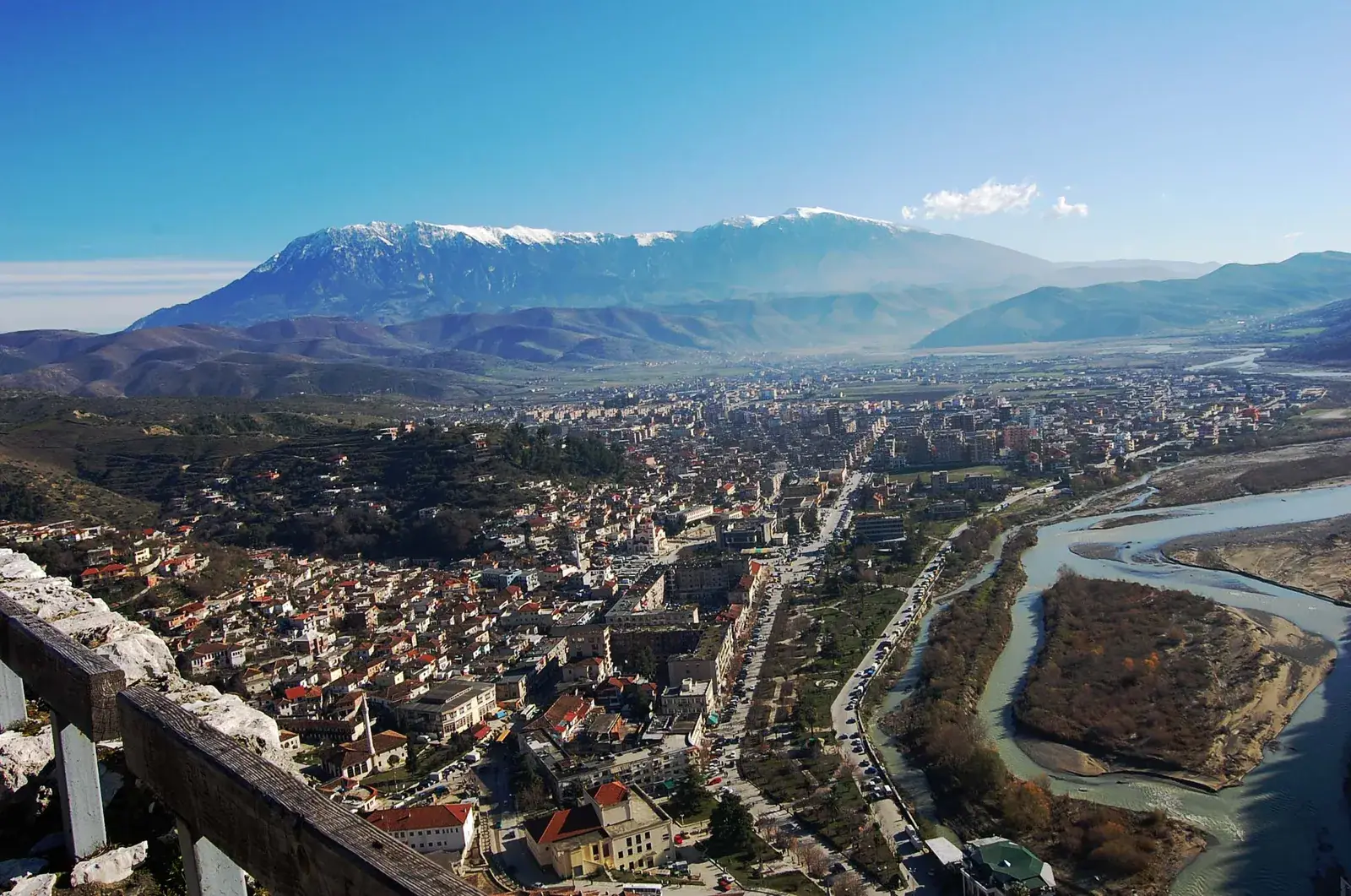
Beyond it is the reason to stay until sunset: the southern walls look straight down on the Osum, across to the Gorica quarter and its stone bridge, and east to Mount Tomorr. Late afternoon light turns the white houses below gold, and it is the best view in town.
A short history of Berat castle
The rock has been fortified for a very long time. Wikipedia's castle article, drawing on Albanian sources, dates the first fortress to the 4th century BC. Romans burned it in 200 BC, and the walls were rebuilt under the Byzantine emperors Theodosius II in the 5th century and Justinian in the 6th.
Most of what stands now is 13th century, from a rebuild under Michael I Komnenos Doukas, Despot of Epirus. Look for his monogram picked out in red bricks in one stretch of wall. The castle held out through a siege by the Angevins of Naples in 1280 to 1281 and another by Skanderbeg in 1455, which ended in defeat for the Albanian forces. Ottoman rule began in the early 15th century, which is when the garrison mosque went up.
Two modern footnotes. The castle is on the back of Albania's 10-lek coin. And in 2008 UNESCO extended the listing it had given Gjirokastër in 2005, so the two towns now share one World Heritage site, the Historic Centres of Berat and Gjirokastra. If you are deciding between them, our Berat or Gjirokastër comparison does the arithmetic, and the Gjirokastër castle guide covers the other fortress.
Sleeping inside Berat castle
A handful of family guesthouses operate inside the walls, and staying in one is the best way to see the castle without day visitors: the lanes are almost empty before 09:00 and after dark. The trade-off is the climb. Every arrival, every dinner in town and every bus departure starts or ends with that 15-minute hill, and a taxi can only drop you at the gate.
 Photo: Sharon Hahn Darlin, CC BY 2.0, via Wikimedia Commons.
Two small places pinned inside the walls, Vila Art Berat Castle (5.0 from 95 Google reviews) and Kitarat Berat Castle (4.9 from 27), were among the best-reviewed stays in town when we pulled Berat's listings in September 2026. Both are small, so book ahead in summer. Compare prices across the castle and Mangalem on the map below; anything pinned on the hilltop is inside or just below the walls.
Compare hotels, guesthouses and apartments on the map. Powered by Stay22.
Tips we would give a friend
- Go up in the late afternoon. The climb is easier when the sun is lower, the light from the southern walls is better, and the booth may already be closed.
- Carry cash. Coins or small notes for the gate, and the guesthouse cafés rarely take cards.
- Check the day. From November to April the Onufri museum is closed on Mondays.
- Wear grippy shoes. The cobbles are smooth limestone, and wet ones are treacherous.
- Book a guide if you want the churches open. Local guides know which keys are where. Berat tours on GetYourGuide include castle walks with a guide.
Frequently asked questions
Is Berat castle free to enter?
No. Entry is 300 lek in cash at the main gate between 09:00 and 18:00. Outside those hours the booth is closed and you can walk in, since people still live inside the walls. The Onufri museum inside is a separate 400 lek ticket, and the Ethnographic museum below is 300 lek.
How long do you need at Berat castle?
Two to three hours covers the walk up, the lanes, Holy Trinity from outside, the Onufri museum and the view from the southern walls. Allow longer if you want to sit for sunset or have a coffee at one of the guesthouse cafés. Add 30 to 40 minutes for the climb up and back from Mangalem.
Do people still live in Berat castle?
Yes. The castle quarter is a working neighbourhood with houses, guesthouses and cafés inside the walls, which is why it never fully closes. Estimates of the population range from about 200 to 400 people. It is one of the few castles in Europe that is still lived in, so be respectful of private doors and gardens.
Can you drive up to Berat castle?
You can drive or take a taxi as far as the main gate, but parking at the top is limited and the lanes inside the walls are pedestrian. Most visitors walk up Rruga Mihal Komneno from Mangalem, about a kilometre and 15 to 20 minutes. In summer, take a taxi up and walk down instead.
What is the best time to visit Berat castle?
Late afternoon is best, for softer light, a gentler climb and sunset from the southern walls. Spring and autumn are the most comfortable months; July and August afternoons regularly pass 32°C in Berat. In winter, avoid Mondays if you want the Onufri museum, which is closed that day from November to April.
The bottom line
Berat castle is a neighbourhood first and a monument second, and that is the point of it. Pay the 300 lek if asked, give the Onufri museum its 45 minutes, and stay for the view from the southern walls. Then walk down through Mangalem for the evening. For everything else in town, from wineries to the Osumi canyon, see our guide to things to do in Berat, and if you are arriving by bus, the Tirana to Berat bus guide has the timetable.
Cover photo: Shkelzen A. Rexha, CC0, via Wikimedia Commons.