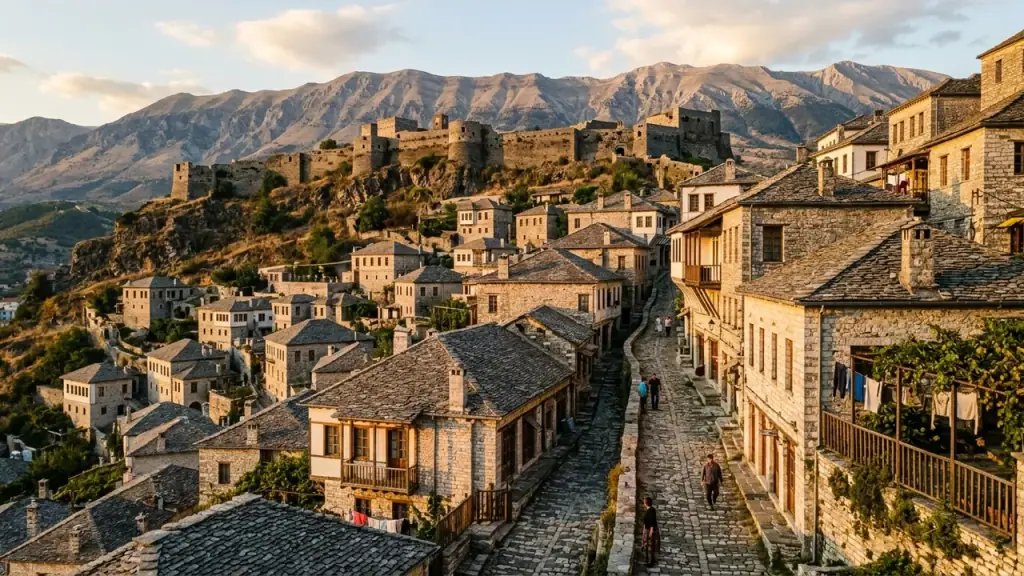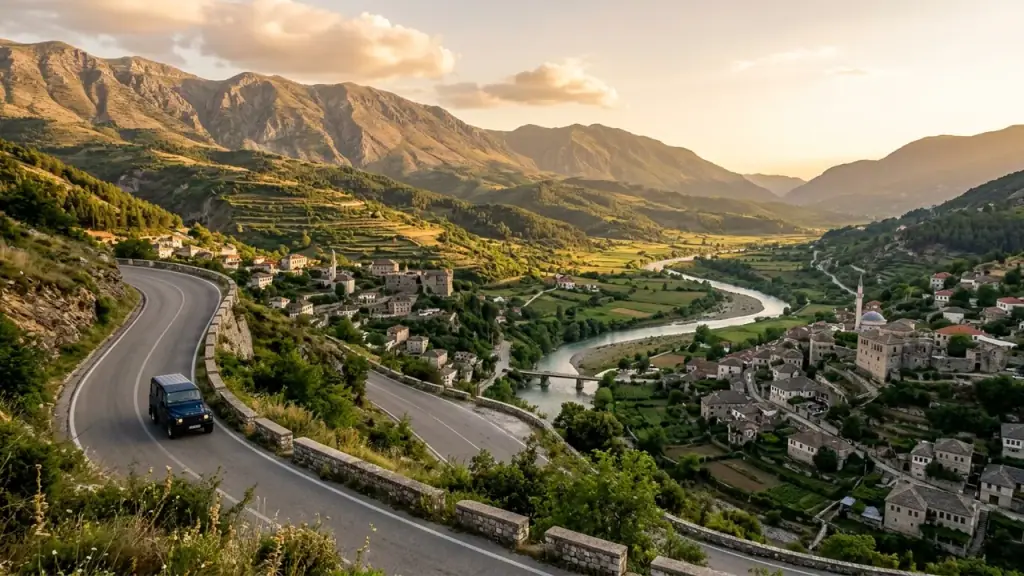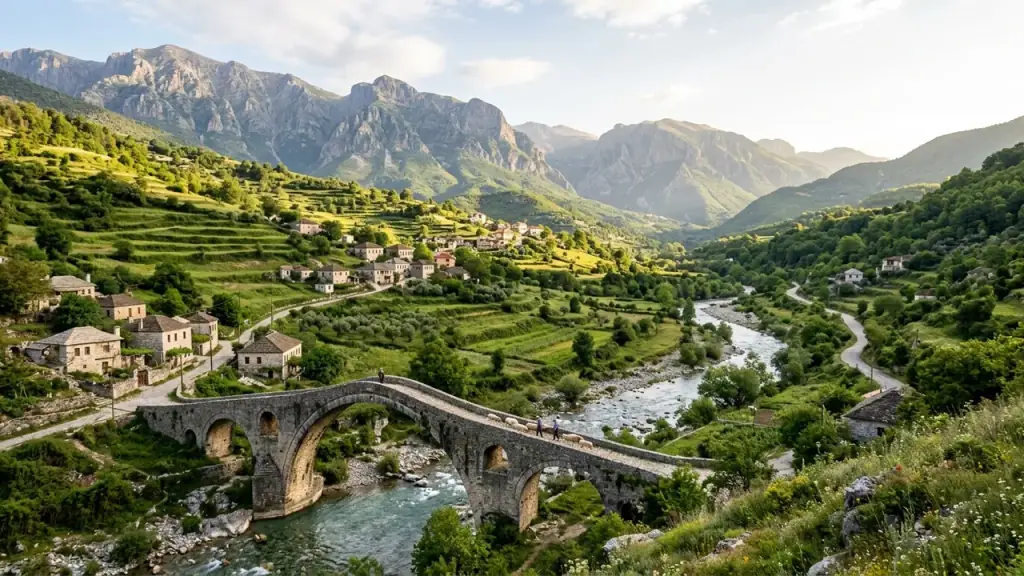
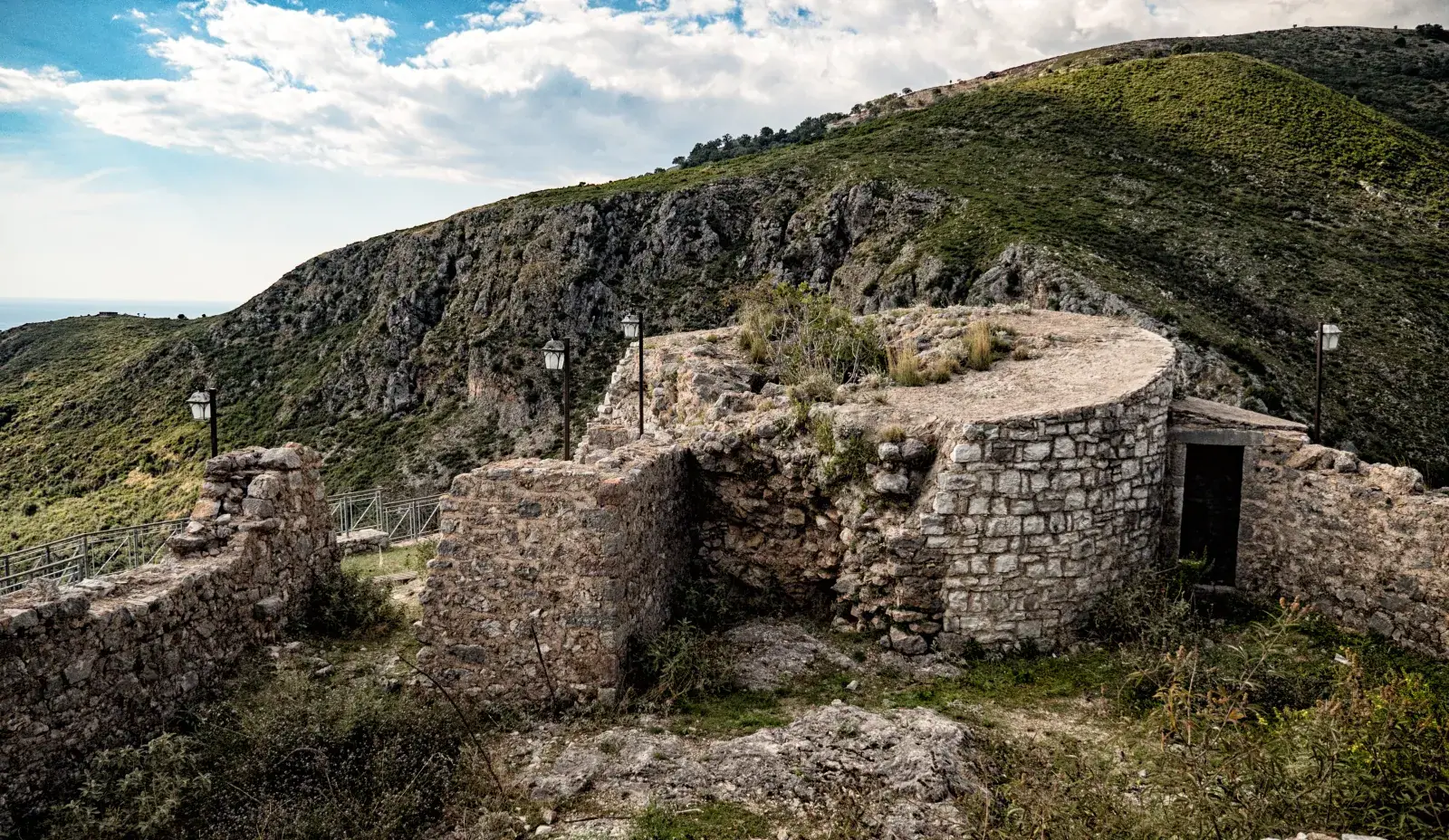
Gjirokaster (Greek: Αργυρόκαστρο, Albanian: Gjirokastër) is one of two UNESCO World Heritage cities in Albania, the other being Berat, and it's the single richest cultural day trip or overnight stop reachable from the southern Albanian Riviera. The reason it earns its UNESCO listing is not one building but a whole townscape: roughly 500 Ottoman-era traditional stone houses on a hillside, an Old Bazaar street that's one of the few surviving examples of an Ottoman commercial district in the Balkans, and a castle sitting above all of it that contains a small museum and panoramic views over the Drino Valley. The 2026 visit decision is essentially "day trip from Saranda/Ksamil, or overnight", both work, and below we lay out the case for each, the per-attraction pricing and hours that change year to year, and the cross-border context for travelers connecting Greek-island trips to southern Albania.
For the transport-only logistics from Himara, see Himara to Gjirokaster Transport Guide. For the day-trip format specifically, see Gjirokaster Day Trip from Himara. This page is the entity anchor that adds the destination context those two utility pages don't carry.
Why Gjirokaster Earns Its UNESCO Status
UNESCO awarded the inscription in 2005, jointly with Berat, citing "rare examples of a well-preserved Ottoman town built by farmers of large estate." The technical claim breaks down into three observable facts on the ground:
| UNESCO factor | What you actually see |
|---|---|
| Townscape coherence | ~500 traditional Ottoman houses, mostly intact, mostly still inhabited |
| The Old Bazaar | Two-storey stone arcade buildings on a cobbled street; silver workshops, traditional clothing, cafés, artisans |
| Defensive architecture | Castle on the hilltop; one of the largest in the Balkans; controls the Drino Valley pass |
| Stone construction tradition | Distinctive grey-stone roofing slates give Gjirokaster its "stone city" epithet |
The visit-decision implication: Gjirokaster is a walking-and-photography destination first, a museum destination second. Allow time to wander rather than ticking off attractions.
The Quick Facts Block (2026)
| Detail | 2026 status |
|---|---|
| Castle entry | 400 lek (~€4); 200 for pensioners, 120 for students, free under 12 |
| Castle hours | 09:00-19:00 daily (May-Sep); Oct-Apr Tue-Sat 09:00-16:00, Sun 09:00-14:00, closed Monday |
| Museum inside castle | Separate 200 lek ticket; closes ~1 hour before castle |
| Ethnographic Museum (Skenduli House) | Separate ticket; usually 200-300 lek |
| Best time to visit | April-June and September-October (warm, uncrowded) |
| Avoid | July-August midday (heat + cruise-ship day-trippers) |
| From Saranda | 1 hour 15 minutes by car |
| From Himara | 2 hours by car via SH8 + SH99 |
| Currency | Albanian Lek (ALL); EUR widely accepted at tourist sites |
Prices change year to year. The castle price and hours are from the regional heritage directorate's own page, read 2026-10-02; the other figures were checked 2026-05-17. If the gate price has shifted, the increment is usually 50-100 lek per ticket.
Day Trip vs Overnight. The Decision
This is the single question Gjirokaster visitors most often get wrong. Honest framing:
Day trip works if:
- You're already in Saranda or Ksamil (1h 15m drive each way)
- You can leave by 08:30 and you don't mind a 20:00 return
- Your interest is "tick the UNESCO box and see the castle"
- It's April-June or September-October (manageable temperatures)
Overnight (1-2 nights) is better if:
- You want the cobblestone evening. Gjirokaster's lit-up old town at night is the experience day-trippers miss
- You're traveling with kids and want the rhythm without a 6-hour driving day
- You want to add a Saturday or Sunday morning bazaar wander (mornings are quieter)
- It's July-August (heat-and-crowds make a day trip exhausting)
- You want to combine with the Blue Eye spring on the return
Our recommendation for most travelers: overnight if you have 7+ days in Albania, day trip if you have 4-5.
What to See. Walking Order
The natural circuit starts at the castle and works downhill. Allow 4-5 hours minimum for a focused visit, 6-8 for a thorough one.
1. Gjirokaster Castle (90-120 min)
The town's anchor. Hilltop position, panoramic views, military and ethnographic museums inside. The clock tower at one corner is the photograph. The interior galleries hold artillery and aviation displays (including a US-spy-plane fragment that the castle's mythology has built into a tourist talking point, the actual provenance is debated, but the artifact is real and visible).
- Entry: 400 lek for the castle; the museum inside has been a separate 200 lek ticket
- Photography: allowed; tripods OK in most areas
- Accessibility: cobbled, uneven, partly stair-only, limited mobility access
2. The Old Bazaar (60-90 min)
A 17th-century commercial street, rebuilt after a late-19th-century fire. Today's bazaar is a working tourist commercial district, silver, kilims, the local "qeleshe" felt caps, and increasingly polished cafés. Browse rather than shop unless you have time to bargain. Cafés on the bazaar street are good for a sit; the back-street cafés one block off the main strip are cheaper.
3. Skenduli House (45-60 min)
The best-preserved of Gjirokaster's traditional Ottoman houses open as a museum. Period furnishings, the distinctive interior wood-panelling, a guide that lives on site (verify Greek/English availability). One of two or three "tower house" interiors you can actually walk through.
4. Cold War Tunnel / Bunker (30-45 min)
Underground Hoxha-era tunnel beneath the city, retrofitted as a tourist visit. Worth it for the Cold War context; thin if you've already done the Tirana BunkArt experience.
5. Zekate House (45 min)
A second tower-house museum, often less crowded than Skenduli. If you can only do one, Skenduli has the better-preserved interior; Zekate has the better view.
How to Get to Gjirokaster
The transport options break down by starting point:
| From | Best option | Time | Cost |
|---|---|---|---|
| Tirana | Bus | 4 h | €10-15 |
| Saranda | Bus or rental car | 1 h 15 m | €5-8 bus / €40/day car |
| Ksamil | Taxi to Saranda then bus, or rental car | 1 h 30 m | €15-20 + bus / €40/day car |
| Himara | Bus or rental car | 2 h | See transport guide |
| Greek border (Kakavija) | Taxi or bus connection | 45 min | €15-25 taxi |
GetYourGuide offers organized day tours from Saranda that combine Gjirokaster with the Blue Eye spring on the same itinerary, see the canonical Gjirokaster GetYourGuide page for currently-listed options. From Tirana, longer multi-day tours that include Gjirokaster + Berat + Saranda are common.
Where to Stay
Gjirokaster's lodging stock has expanded significantly since 2020. The traditional-house guesthouses are the differentiated experience.
Three lodging tiers:
- Traditional-house guesthouses (recommended): historic Ottoman-house properties converted to small inns. 3-8 rooms each, breakfast included, often family-run. €50-90/night shoulder season, €70-120 in July-August. The differentiated Gjirokaster stay.
- Mid-range hotels (newer construction): standard 3-star comfort, mostly on the edges of the old town. €60-100/night.
- Apartments: for stays of 3+ nights or family groups. Limited inventory in the old town itself.
The walkability sweet spot is anywhere inside the UNESCO old town boundary. Anything 1km+ downhill from the bazaar is "below the old town", fine for the night but a steep climb back up to the attractions.
Food in Gjirokaster
Gjirokaster cuisine is distinct from coastal Albania, heavier, lamb-and-cheese-heavy, with the regional specialty qifqi (rice balls with herbs and egg). The recommended approach:
- One meal at a traditional-house restaurant inside the old town for the atmosphere
- One meal at a back-street local-priced spot for the value
- Skip the obviously-tourist-priced bazaar-street terraces unless the view is the point
Wine: the Gjirokaster area produces some of southern Albania's better whites; ask for local-region rather than national brands.
Combining With the Blue Eye and Other Day Trips
Gjirokaster pairs naturally with two adjacent attractions:
- The Blue Eye (Syri i Kaltër), 40 minutes south on the return drive to Saranda. Adds 90 minutes. See Blue Eye day trip from Himara for the spring visit details.
- Greek border at Kakavija, 45 minutes east. The natural exit point for travelers continuing to Ioannina or western mainland Greece. See Himara to Kakavia border guide for the crossing.
The classic 2-day southern-Albania loop is Saranda/Ksamil base → Gjirokaster overnight → Blue Eye → return. This is also the loop our Saranda-Ksamil split-stay itinerary recommends as the "Day 3 Option B" variant.
When to Visit
April-June and September-October are the optimal months, warm enough for comfortable walking, cool enough that the uphill cobblestones don't punish. July-August is hot (the inland location at 300m elevation is cooler than the coast but still 28-31°C midday); the castle is exposed and offers limited shade. Winter is genuinely cold (highs of 10-13°C, occasional snow); the castle stays open but many traditional-house guesthouses close.
For US travelers: Gjirokaster's UNESCO context is closer to Williamsburg or San Antonio than to a European cathedral city, it's an entire preserved townscape, not a single monument. Budget 5-7 hours for a focused visit, full day for an unhurried one. Cash is preferred at the smaller bazaar shops; ATMs are available in the lower town. US-issued credit cards work at most hotels.
For UK travelers: Direct flights to Tirana from London (Wizz Air, Ryanair, British Airways at points in the season) put Gjirokaster within a one-stop, two-day reach from the UK. Combined with a Greek-island add-on (via Saranda-Corfu ferry, see ferry guide), Gjirokaster becomes the "cultural anchor" in an Albania-Greece week. UK GHIC does not work in Albania; buy travel insurance.
Practical Tips We Wish We'd Known the First Time
- Wear actual walking shoes. The cobblestone slope to the castle defeats flip-flops and most flat sandals.
- Cash for ticket booths. Card payment at the castle and museums is inconsistent; ALL or EUR cash is always accepted.
- Photography from the castle roof. The clock tower view is the postcard shot; arrive in the last 90 minutes before closing for low-angle light.
- Don't book a guided tour for both the castle and Skenduli house. A single guide for both is overkill; one guided + one self-guided is the sweet spot.
- Skip the cold-war tunnel if you've already done Tirana's BunkArt. It's the same Cold War narrative in a less impressive setting.
FAQ
Is Gjirokaster worth visiting from Saranda?
Yes. Gjirokaster is the single best cultural day trip from Saranda or Ksamil. 1h 15m drive each way; UNESCO old town; castle; Old Bazaar. Allow 5-7 hours on site. Pair with the Blue Eye on the return drive for a full day. Worth an overnight stay if your trip is 7+ days.
How much does it cost to visit Gjirokaster?
Castle entry is 400 lek (€4), the castle museum has been another 200 lek, and the Skenduli or Zekate traditional house museums are 200-300 lek each. Total entry costs for the main attractions are 800-1,200 lek (€8-12) per person, depending on whether you visit one house museum or both. Restaurants and cafés add modestly to that.
Can I visit Gjirokaster as a day trip from Tirana?
Possible but tight. Tirana to Gjirokaster is 4 hours each way by bus, leaving 4-5 hours on the ground. An organized tour does this routinely; independent travel makes it a long day. Overnight from Tirana is much more comfortable, and a 2-night Saranda + 1-night Gjirokaster loop is more rewarding.
What's the best month to visit Gjirokaster?
April-June and September-October. Comfortable walking temperatures, smaller crowds than peak summer, and the inland location at 300m elevation means evenings are pleasant even in shoulder months. Avoid July-August midday (heat + day-trip groups) unless you can structure visits around early morning or late afternoon.
Is Gjirokaster the same as Berat?
No, both are Albania's two UNESCO World Heritage cities. Both are stone-Ottoman towns, but they're separate cities 200km apart. Gjirokaster is in the south (near the Greek border), Berat is in central Albania. Most travelers visit one rather than both; Berat or Gjirokaster covers how to choose and how to see both on one north-south journey.
Bottom Line
Gjirokaster is Albania's strongest single-day cultural visit within reach of the southern Riviera. Day-trip from Saranda or Ksamil if your trip is 4-6 days; overnight if it's 7+ and you want the cobblestone evening that day-trippers miss. Visit April-June or September-October; carry cash for ticket booths; wear real walking shoes; and if you want Berat as well, make the two towns stops on one journey rather than separate day trips.