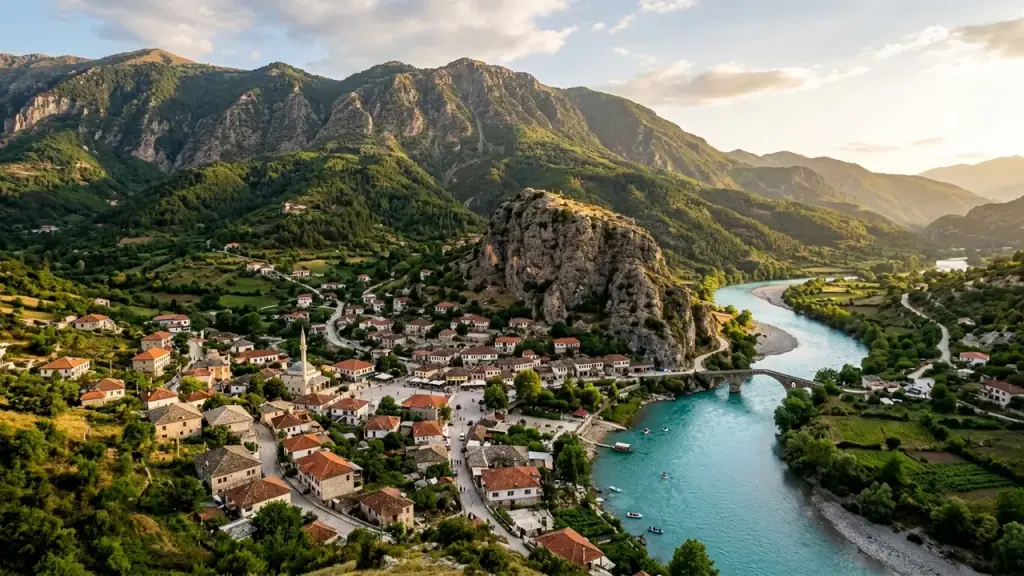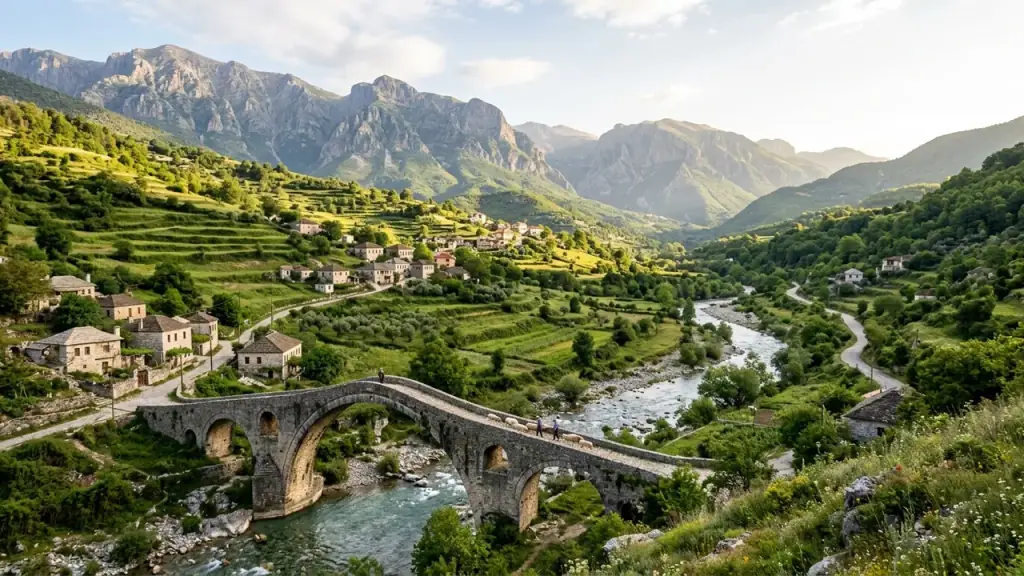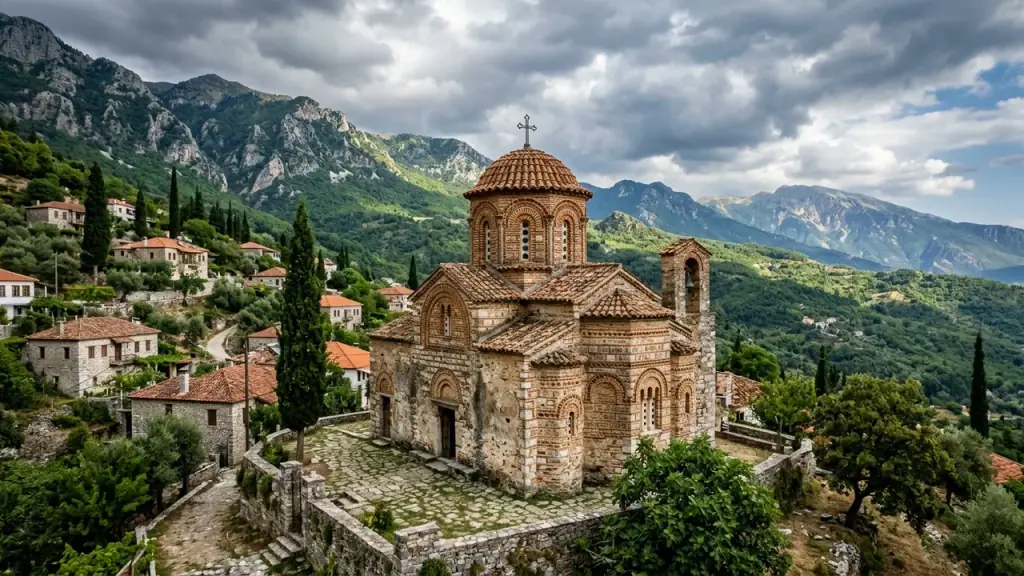
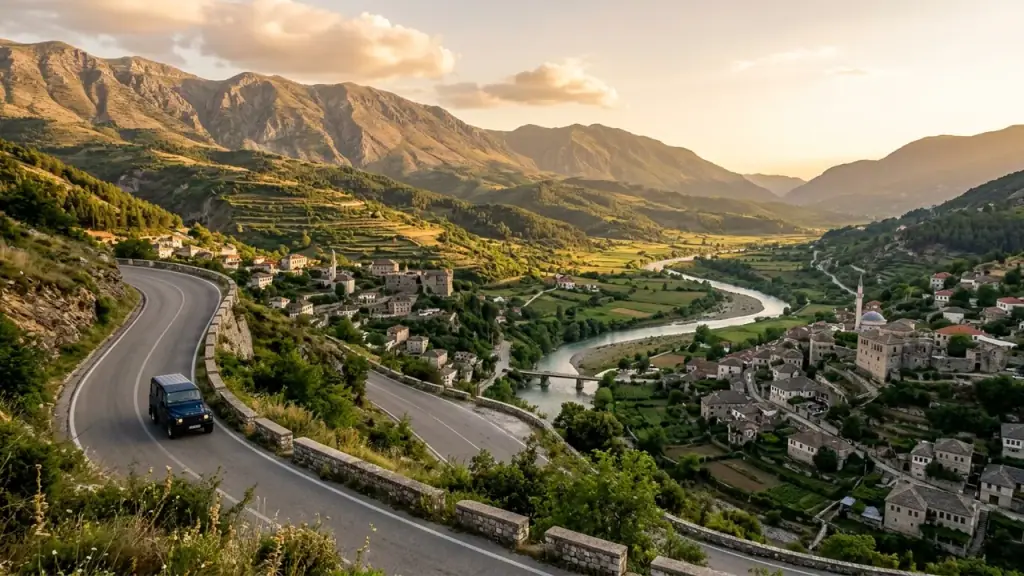
Most travelers do southern Albania as a beach trip and never turn inland, and they miss half the country. Behind the Riviera lies a different south: a UNESCO stone city, Europe's last wild river, thermal baths in a canyon, ancient Greek and Roman ruins, and stone villages linked by Ottoman bridges. The question isn't whether the inland is worth it, because it overwhelmingly is. The question is how to string it into a loop that fits between beach days without feeling rushed. This is that loop: a 3–4 day inland circuit you can run from the coast, built around Gjirokastër and the Vjosa valley, with honest notes on what to keep and what to skip.
The loop at a glance
| Day | Base | Highlights |
|---|---|---|
| 1 | Gjirokastër | UNESCO old town + Antigonea & Hadrianopolis ruins |
| 2 | Përmet | Vjosa rafting + Benjë thermal baths & Langarica canyon |
| 3 | Përmet / Gjirokastër | Tepelena, Libohovë & the great plane tree, or a Zagoria / Nivica day |
| 4 | Toward the coast | Blue Eye, Mesopotam, Phoenice on the way back to Saranda |
This isn't a forced march. It's a flexible loop. Three days covers the essentials (Gjirokastër + Vjosa); a fourth lets you add the Saranda-hinterland heritage on the way back to the beaches. The single thing to get right is don't over-pack the days. The valleys are slow, the roads are mountainous, and the point is to absorb, not to tick.
The loop in numbers
Every leg, every fee. Nothing on this route is expensive; the cost is the driving.
| Leg | Distance | Time |
|---|---|---|
| Himara → Gjirokastër | 100 km | 2h (2h 30m in August) |
| Saranda → Gjirokastër | 60 km by the direct road | 1h 15m |
| Gjirokastër → Antigonea | ~14 km | ~30 min |
| Gjirokastër → Hadrianopolis | ~14 km | 20–25 min |
| Gjirokastër → Libohovë | ~20 km | 25 min |
| Gjirokastër → Tepelena | ~30 km | 35 min |
| Gjirokastër → Përmet | ~55 km | 1h |
| Përmet → Benjë baths | ~14 km | n/a |
| Përmet → Tepelena | ~40 km | 50 min |
| Saranda → Blue Eye | n/a | ~20 min |
| Saranda → Mesopotam | ~16–18 km | n/a |
| Berat → Saranda | ~209 km | ~4h |
| What you pay | 2026 |
|---|---|
| Gjirokastër Castle entry | 200 lek (~€2); 09:00–18:00 May–Sep, 09:00–16:00 winter |
| Museum inside the castle | Separate 200 lek ticket, closes about an hour before the castle |
| Skenduli House (Ethnographic Museum) | Usually 200–300 lek |
| Blue Eye entry | 50 lek (~€0.50) per adult, cash only at the car park |
| Blue Eye parking | 100–200 lek per car, 800 lek per camper |
| Hadrianopolis, Antigonea, Benjë | Free or minimal |
| Vjosa rafting | From ~€35 per person, 2–3 hours on the water, roughly April–October |
| Fuel | ~210 ALL/litre |
| Tolls on this loop | None. The 250 ALL (~€2.50) Llogara Tunnel toll only applies if you approach from north of Vlora |
One distance worth flagging: the drive-time matrix puts Saranda–Gjirokastër at 60 km by car, while the bus route data lists ~120 km for the same pair at 400–500 ALL (€4–5), roughly three services a day in high season. The bus takes the longer valley road; 60 km is the driving figure this itinerary uses.
A few things to know before you set off. The Blue Eye car park is about 2 km from the spring, a 20-minute walk unless you rent an electric scooter at the entrance. Swimming there is officially not allowed and the water is 10°C. Phoenice is closed on Mondays, and the church interior at Mesopotam is usually locked outside services.
Day 1: Gjirokastër and the ancient Drino valley
Base in Gjirokastër, the UNESCO "stone city", and spend the morning in its old town and castle. It has roughly 500 traditional Ottoman houses, most of them intact and most still lived in. Entry to the castle is 200 lek (~€2), open 09:00–18:00 from May to September; the museum inside is a separate 200 lek ticket and closes about an hour earlier.
In the afternoon, drop into the Drino valley for two ancient sites most visitors skip. Antigonea is a Hellenistic hilltop city ~14 km out, about 30 minutes, with walls tracing the ridge and minimal facilities. Bring water. Hadrianopolis is a semi-excavated Roman theatre in a field near Sofratikë, ~14 km and 20–25 minutes the other way, free to walk into. Sleep in Gjirokastër.
Day 2: Përmet and the wild Vjosa
Drive the ~55 km up the Vjosa valley to Përmet, the "City of Roses", about an hour. This is the adventure day: raft the Vjosa, Europe's last free-flowing wild river, in the morning, from around €35 per person for 2–3 hours on the water, with guide, raft, helmet, life jacket and usually a wetsuit included. Spring runs high and fast; summer is the beginner and family window.
In the afternoon, drive the 14 km out to the Benjë thermal baths: natural hot-spring pools at 23–32°C, free to soak, open year-round, beside the Ottoman Katiu bridge. The Langarica canyon starts directly behind them. It is 7 km long, with walls up to 150 m. Sleep in Përmet.
Day 3: choose your adventure
Three good options depending on your pace:
- History: Tepelena, ~30 km and 35 minutes from Gjirokastër or ~40 km and 50 minutes from Përmet, for Ali Pasha's citadel above the Vjosa–Drino confluence; then Libohovë, ~20 km and 25 minutes from Gjirokastër, for the 1796–98 castle Ali Pasha built for his sister Shanisha and the plane tree beside it, roughly 560 years old, with a trunk about 7 m across and a canopy over 1,100 m². The Labovë church is a short hop on.
- Hiking: a day in the Zagoria valley's stone villages and Ottoman bridges, reached from Gjirokastër or via the Vjosa from Përmet.
- Canyon adventure: the wild Nivica Canyon in Kurvelesh, cliffs up to 250 m and over 800 m in places, with a short trail to a swimmable waterfall pool. Tepelena is the nearest town.
Day 4: heritage on the way back to the coast
Loop back toward Saranda and the beaches. The Blue Eye is about 20 minutes from Saranda: 50 lek (~€0.50) entry, 100–200 lek to park, open roughly 07:00–19:00, and a 2 km walk from the car park to the spring unless you rent one of the electric scooters at the entrance. Go early. July and August midday is rough. Then the Mesopotam monastery, 16–18 km inland from Saranda, where the grounds are open in daylight but the church interior is usually locked outside services; the Phoenice ruins on a hilltop 10–12 km from Saranda, open Tuesday to Sunday and closed Mondays; and the Ottoman town of Delvinë. It's a string of quiet heritage stops that bridges the inland and the coast.
Where to stay and how to plan
A car is essential. This loop simply doesn't work on public transport. Gjirokastër and Përmet are the two natural bases; book a night or two in each.
Getting to the start without a car is possible; getting round the loop is not. Himara has one direct bus a day to Gjirokastër at 12.50€, taking 2–3 hours. From Saranda there are about three a day in high season at 400–500 ALL (€4–5). From Tirana, many run between roughly 05:00 and 20:30 at 1,200 ALL (€12) over about four hours. If you're coming down from Berat, the furthest north this guide covers, it's ~209 km and about four hours to Saranda, roughly three departures a day with the first around 08:00 and the last around 13:15.
Planning notes:
- Connectivity: mountain coverage is patchy. Download offline maps, and an eSIM helps. Saily is our top pick for Albania (instant QR, transparent pricing) so you're not hunting for signal in the valleys.
- Driving: roads are mountainous and slow; see Albania road conditions and driving rules.
- Tours: if you'd rather not self-drive, Gjirokastër- and Përmet-based day tours cover much of this. See GetYourGuide Gjirokastër and Përmet.
- When to go: spring and autumn are the best months, green or golden and comfortable; summer works but pair the inland heat with the Vjosa and the baths.
This loop slots neatly onto the front or back of a coast trip. See the South Albania Itinerary and the Albanian Riviera Road Trip for the beach side.
FAQ
How many days do you need for inland southern Albania?
Three days covers the essentials: Gjirokastër, the Vjosa valley (rafting from ~€35 plus the free Benjë thermal baths), and a day of castles or hiking. A fourth adds the Saranda-hinterland heritage on the way back: Blue Eye, Mesopotam and Phoenice. Total driving is modest: Gjirokastër to Përmet is ~55 km and an hour, and nothing on the loop is more than about 30 km from one of the two bases.
What is the best inland route in southern Albania?
A loop from the coast via Gjirokastër (UNESCO old town + Antigonea/Hadrianopolis ruins), up to Përmet for Vjosa rafting and the Benjë thermal baths, a day for Tepelena/Libohovë or the Zagoria valley, then back to Saranda via the Blue Eye, Mesopotam and Phoenice. Three to four days.
Can you do inland southern Albania without a car?
It's very difficult. The valleys are spread out and public transport is sparse and slow. The realistic options are renting a car or joining guided day tours from Gjirokastër or Përmet, which cover the rafting, baths, and main sites. Self-driving gives by far the most freedom.
Is inland southern Albania worth it over more beach time?
Yes, if you have 3+ days to spare. The inland gives you a UNESCO stone city, Europe's last wild river, thermal baths, ancient ruins and stone villages, a completely different and arguably richer experience than another beach day. The best trips combine both: beaches plus this inland loop.
Bottom line
Inland southern Albania is the half of the south most travelers miss, and a 3–4 day loop from the coast captures it: Gjirokastër, the wild Vjosa, the Benjë baths, ancient ruins and stone villages, with a heritage trail back to Saranda. Rent a car, don't over-pack the days. Go in spring or autumn, and bolt it onto your beach trip. It's the most rewarding detour in the south, and the through-line that connects every inland corner of this region.