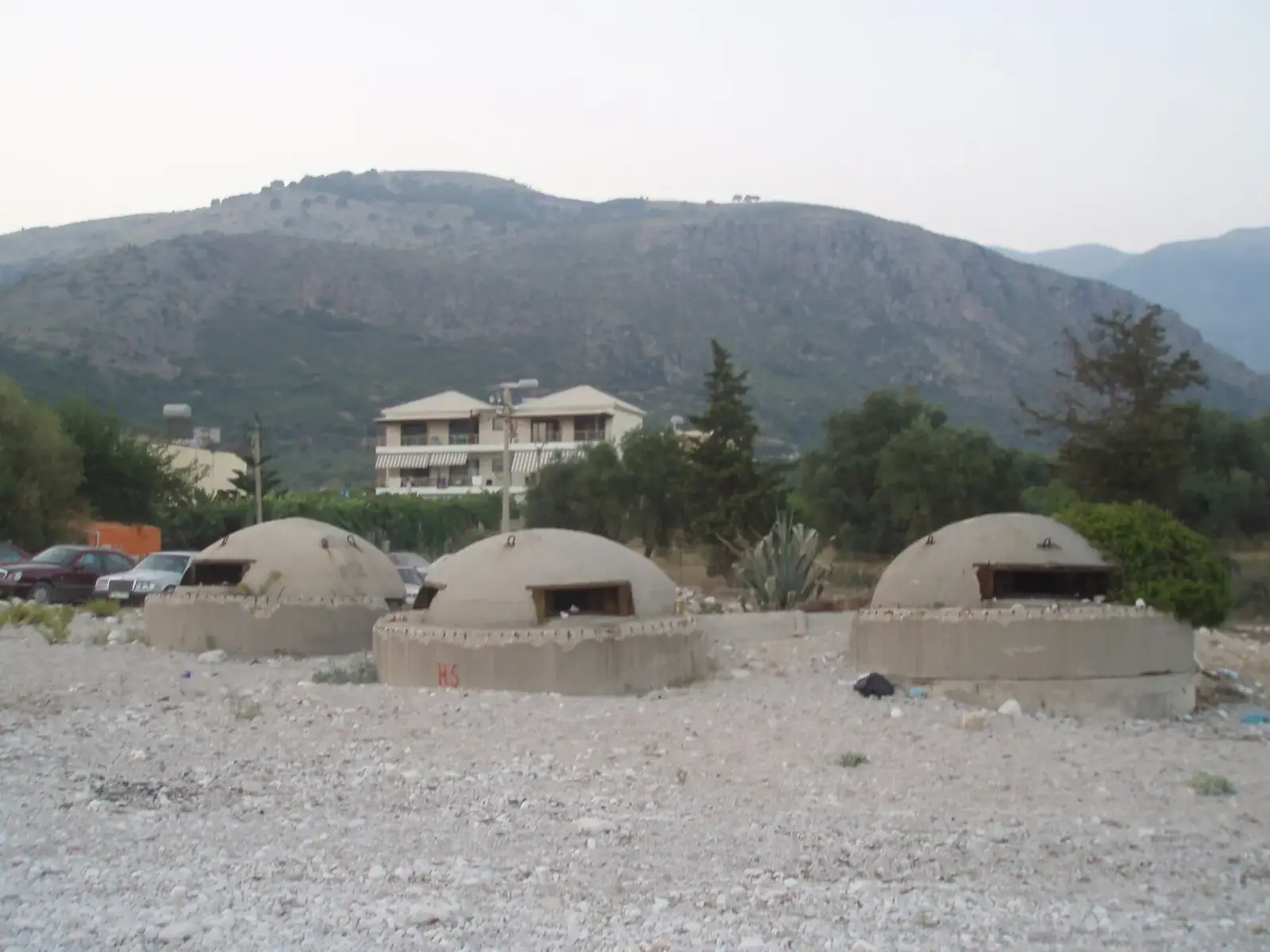
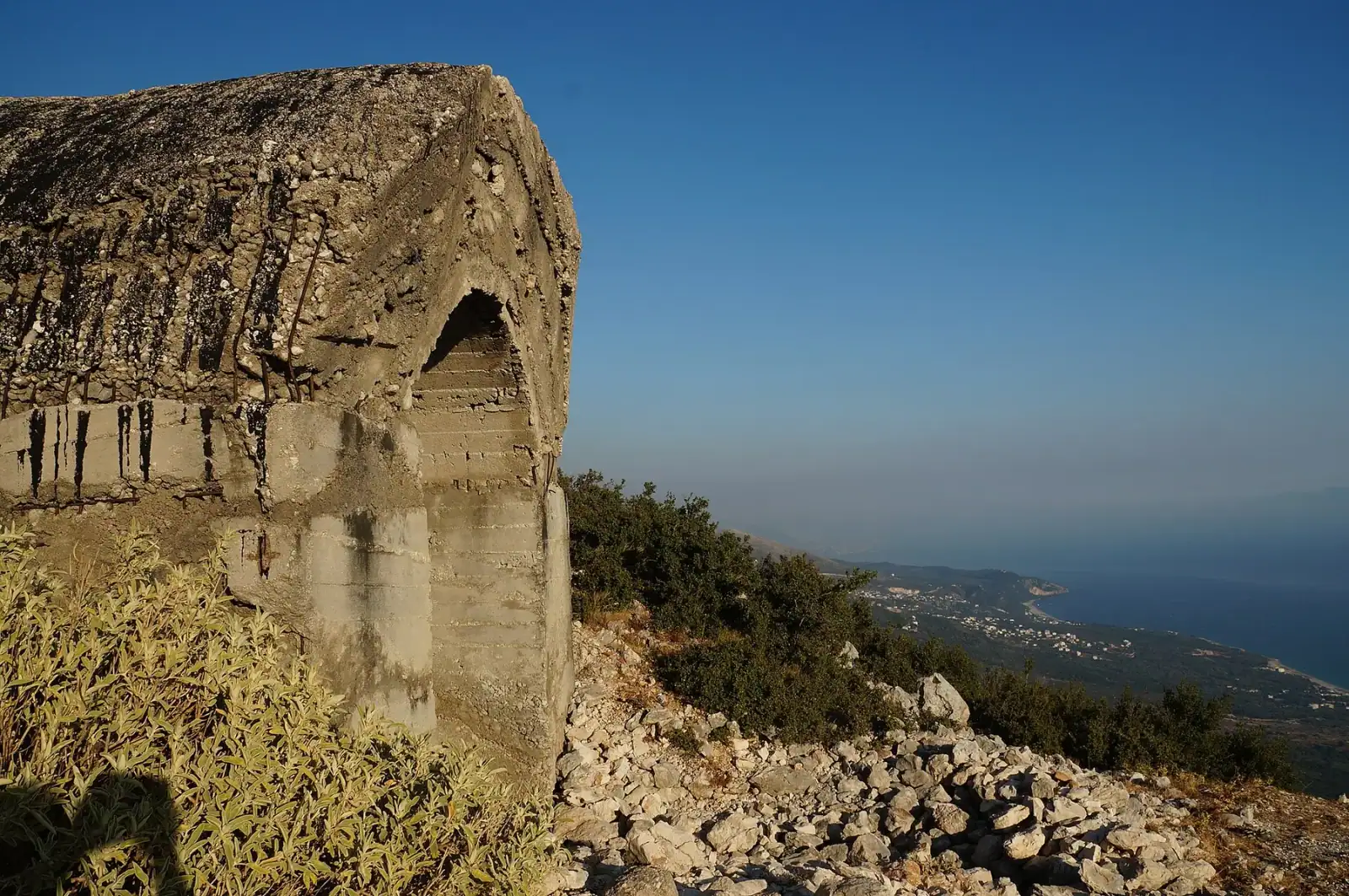
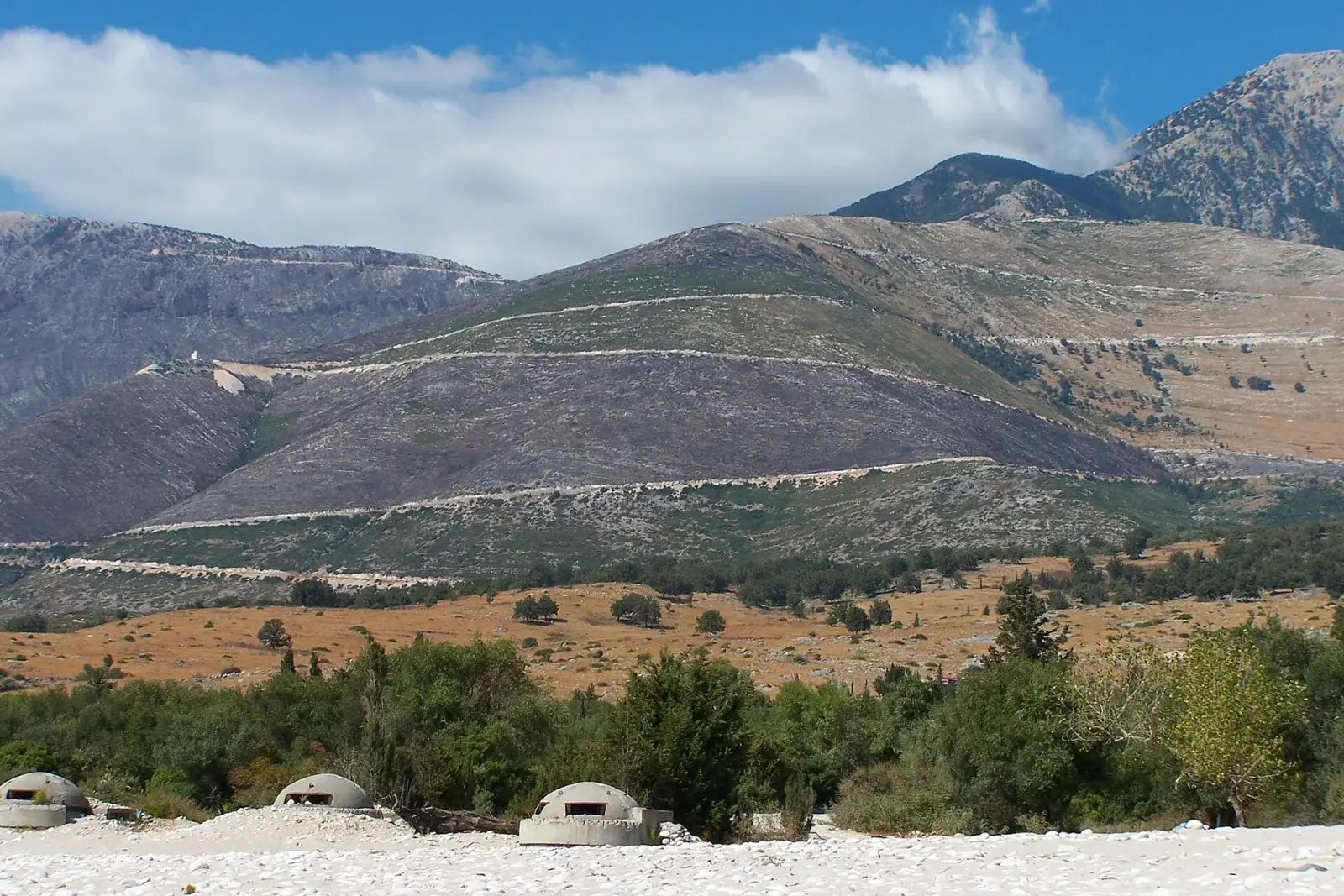
Three concrete dome bunkers standing in a row on the shingle at Himara, with houses and the Ceraunian hills behind them.

Bunkers

Concrete domes on the shingle, on the ridge, in the olive terraces. 30 positions mapped between the Llogara pass and the cliffs above Kakome — what they were built for, and where to find them.

Why the coast is full of concrete

The bunkers are the residue of a defence doctrine. In 1971 the 12th Plenum of the Party of Labour's Central Committee, chaired by Enver Hoxha, took up the theses on military art and the plans for fortifying the country's defensive lines. Albania had walked out of the Warsaw Pact in 1968 and would break with China a decade later. The working assumption was that it would fight a two-front war alone — against Yugoslavia, NATO or the Soviet bloc — with the entire population armed.

The building programme ran from 1975 to 1983. The Bunk’Art museum in Tirana puts the plan at 221,143 bunkers and the number actually completed at 173,371: an average of more than 21,000 a year, or roughly one bunker for every eleven people then living in Albania. Not one of them was used in the war it was built for.

The cost was structural. Prefabricated bunkers alone are estimated to have absorbed around two percent of net material product, and the programme as a whole swallowed more concrete than the Maginot Line. That came out of housing and roads, both of which Albania was desperately short of.

The dome that ended up as a national symbol was designed by Josif Zagali, a military engineer who had fought with the partisans and trained in the Soviet Union. His insight was that a hemisphere deflects artillery instead of absorbing it. Hoxha made him chief engineer at the Ministry of Defence, then had him purged in 1974 and jailed for eight years on fabricated charges of sabotage.

The two you will actually see

QZ — Qendër Zjarri, “firing position”

The small one. A prefabricated concrete dome roughly three metres across with a firing slit, built for one or two people and set into a poured concrete collar. These are the ones on the beaches, in the fields and along the cliffs. By Zagali's own account, twenty of them cost about as much as a kilometre of road.

PZ — Pikë Zjarri, “firing point”

The command version. Eight metres across, assembled on site from concrete slices of eight or nine tonnes apiece and weighing 350 to 400 tonnes finished. There are far fewer of them, and they are what people mean when they say a big bunker you can walk into.

Albanian accounts of the programme describe positions being sited in rings so that neighbouring bunkers covered each other, which would explain why they so often turn up in twos and threes rather than singly. The triple set at Qeparo is the clearest example of that pattern on this coast.

Where they are

15 locations and 30 positions, from the top of the Llogara pass down to the cliffs above Kakome. A numbered pin is a cluster. This is not every bunker on the Riviera — it is the ones with a published location, from Google Maps listings and OpenStreetMap survey data.

The sites, north to south

Ratings are the Google Maps listing as read in September 2026. Entries without one are mapped in OpenStreetMap and have no listing, so there is nothing published about their condition.

Smiley Bunker

1 bunker

Beside the SH8 at the top of the Llogara Pass

A single dome painted as a smiling face, right where the coast road crests. Reviewers note the paint is already badly weathered.

Getting there: Roadside. Pull off the SH8 where the pass levels out; no walking needed.

Bunker on Çika Mountain

1 bunker

On the Çika slopes above the Llogara Pass

The best-rated of the Llogara positions, and the one people climb to for the view rather than the concrete.

Getting there: Off-road. Reviewers describe the approach as hard going; it is a scramble above the pass, not a roadside stop.

Llogara ridge pair

2 bunkers

On the ridge south of the Llogara Pass, above Palasë

Two positions recorded on OpenStreetMap between the pass and the descent to Palasë.

Getting there: No marked path. Mapped positions only — treat them as something you see from the ridge, not a destination.

Big Bunker

1 bunker

Beside the SH8 on the Llogara descent above Palasë

A large abandoned position you can walk into, covered in graffiti. Reviews are consistent about the smell inside and the goats outside.

Getting there: Roadside, walk-in. The most visited bunker on the coast road.

Smile Albania bunker

1 bunker

Beside the SH8 above Dhërmi

A dome on the coast road above Dhërmi, mapped under the name of Albania's tourism campaign. It is a separate position from the Smiley Bunker, 2.7 km north at the pass.

Getting there: Roadside.

Ilias bunker line

9 bunkers

On the slope above Jale, below Ilias village

The densest run on this stretch of coast: nine positions strung along the hillside in two short lines, covering the approach to Jale.

Getting there: No path. Visible from the SH8 and from the sea; the pins sit on open hillside.

Bunker above Spile

1 bunker

On the headland above Spile, Himara

A sea-facing position on the cliffs. Visitors use the rocks below it for cliff jumping, and locals fish off them.

Getting there: Short walk from the coast path above the beach.

Two old bunkers above Spile

2 bunkers

On the headland above Spile, Himara

Two positions with the remains of a connecting trench, and a good view down over the beaches. Campers have been sleeping in them, and recent reviews complain they are being used as a toilet.

Getting there: Short walk up from the coast. Both are open and you can get inside.

Old bunker in the sand

1 bunker

On the shore at Spile, Himara town

A dome sitting straight on the shingle, mapped under that name. Himara's shoreline bunkers are the ones that turn up most often in photographs of the programme.

Getting there: On the beach itself, north of the promenade.

Bunkers by the Himara shoreline

2 bunkers

Spile, at the southern end of Himara town

Two more positions recorded inside the built-up edge of Himara, now hemmed in by buildings.

Getting there: Roadside and shoreline, in among the town.

Small bunker at Livadhi

1 bunker

Behind the shore at Livadhi, 1 Maji

One small dome set back from the bay. No reviews yet, so there is nothing published on its condition.

Getting there: Walk-up from the Livadhi beach road.

Two bunkers at Livadhi

2 bunkers

At the southern end of Livadhi beach, Sera

Two positions right above the water. One has been cleared out inside; the other is full of litter and graffiti and you cannot get in.

Getting there: Easiest from the beach — walk to the end of the shingle and scramble up.

Old Bunker at Potam

1 bunker

On the coast at Potam, south of Himara

A sea-facing position on the stretch below Potam, listed as a historical landmark and photographed by the few visitors who reach it.

Getting there: Off the coast track between Potam and the Filikuri path.

Triple bunker at Qeparo

3 bunkers

Beside the road at Qeparo

Three linked domes a few metres off the road, the classic 'triple series' arrangement in which neighbouring positions cover each other.

Getting there: Visible from the road. Fenced — the land is private, and reviewers report no public access behind the barbed wire.

Bunkers above the Kakome coast

2 bunkers

Nivicë-Bubar, on the coast above Kakome and Krorëz

Two positions on the cliffs above the bays that the Saranda boat circuit swims in.

Getting there: No road. Seen from the deck on boat tours running the Lukovë coast.

Before you climb into one

  • They are unlit, unmaintained and often full of rubble. Nobody owns the problem if you hurt yourself in one.
  • Several of the Himara positions are being slept in and used as open toilets by campers. Reviewers are blunt about the smell; take the warning before you crawl in, not after.
  • The triple bunker at Qeparo is on private land behind a fence. Look at it from the road.
  • Sea-facing positions sit on cliff edges. People jump off the rocks below the Spile bunker; they know the depth and you do not.
  • Nothing here is signposted, ticketed or staffed. Bring a torch and proper shoes, and leave it as you found it.

What we could not confirm

You will read almost everywhere that Albania has 700,000 or 750,000 bunkers. We could not find an archival basis for it. The figure released from the state archives is 173,371 built by 1983, and the bunker files held at the Ministry of Defence went missing in 1992, so the larger number can no longer be checked against anything.

No individual position on this coast has a documented build date, so none of the entries here carries one. Where the type is not obvious from the listing photographs we have left it unstated rather than guess between QZ and PZ.

Bunker questions

Why does Albania have so many bunkers?

Enver Hoxha's government expected to be invaded and to fight alone. Albania left the Warsaw Pact in 1968 and broke with China in 1978, leaving it without an ally in any direction. The answer was a doctrine of armed popular war in which every village had firing positions, and a construction programme that ran from 1975 to 1983.

How many bunkers are there in Albania?

173,371 were built by 1983, out of 221,143 planned, according to the archive figures published by the Bunk'Art museum. The 700,000-plus figure repeated in most travel writing has no archival source we could find. How many still stand is unknown; many have been buried, broken up or built over since 1990.

Can you go inside the bunkers near Himara?

Some of them. The two positions above Spile are open and you can get in, and the large one on the Llogara descent is walk-in. Others are sealed, full of rubble or on private land — the triple bunker at Qeparo is fenced off. None is maintained or lit, so treat every entry as your own risk.

Which bunker is easiest to visit on the Albanian Riviera?

Big Bunker, on the SH8 as it drops from the Llogara pass toward Palasë. It is right beside the road, it is large enough to walk into, and it is the most reviewed bunker on this coast. The Smiley Bunker at the top of the pass is the other no-effort stop.

Were the bunkers ever used in a war?

No. Not one was used for the purpose it was built for. Some saw improvised use during Albania's 1997 unrest and around the 1999 Kosovo war, and since 1990 they have been turned into everything from cafés to animal shelters, but the invasion they were built against never came.

Are the bunkers on the beaches at Himara the same as the ones in the mountains?

Mostly, yes — the small domes on the shore and the ones scattered through the terraces are the standard QZ firing position, about three metres across. The exception is the large walk-in position on the Llogara road, which is a different and much heavier class of structure.