Himara Castle & Old Town
In town, 15–20 min walk uphill from the promenade
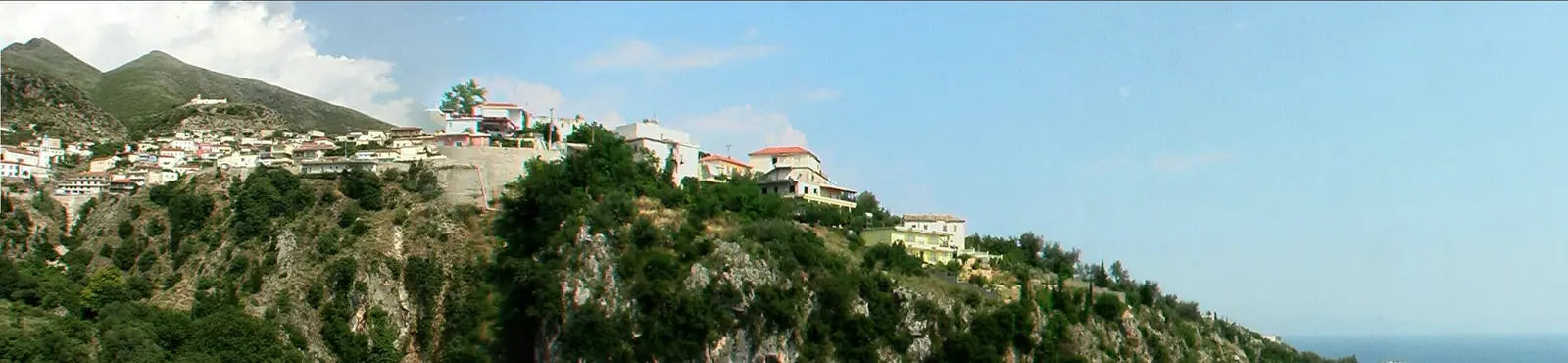
Hilltop above Dhermi village, 257 m elevation
Panagia Drymadon Monastery (Albanian: Manastiri i Shën Mërisë, Greek: Παναγία Δρυμάδων), also called the Monastery of Saint Mary, sits on a hilltop at 257 m elevation above Dhermi village. Built in the 13th–14th century, it is a Cultural Monument of Albania and one of the best-preserved examples of Byzantine-era religious architecture on the Albanian Riviera. The monastery operated continuously for over 600 years, through Byzantine decline, Ottoman rule, and Italian occupation, until 1967, when the communist regime forced the last nun to leave.
The basilica was founded in the 13th–14th century during the late Byzantine period. The Himariot population maintained Orthodox practice through 500 years of Ottoman rule, and Panagia Drymadon remained operational throughout. In 1781, the Archbishop of Himara and Delvina commissioned a fresco programme that still survives in the church interior, one of the best-preserved fresco cycles on the coast. The monastery functioned without interruption until 1967, when Hoxha's regime forced the closure of all religious institutions in Albania. The last nun was expelled. Restoration began in the early 1990s.
The 13th–14th century basilica with original Byzantine masonry; the 1781 fresco programme commissioned by the Archbishop of Himara and Delvina, one of the most complete fresco cycles on the Riviera; the surviving monastic cells around the church; panoramic views over Dhermi village below, the Ionian Sea to the west, and the coastline extending north to Llogara and south to Himara.
Drive north from Himara on SH8 (~15 km, 20 min) and continue into Dhermi village. From the upper village, follow Rruga Vlladas or ask locally for directions; the monastery is signed and visible on the hillside above. A short 10–15 minute walk uphill from the upper village leads to the monastery. The path is paved but steep in places.
Late morning for best light on the frescoes inside the church (when the doors are open). The hilltop position is exposed; afternoon visits in summer can be hot. Major Orthodox feast days (Assumption, 15 August) draw the largest local gatherings.
History, practical tips, and route notes in long form. The article that goes deeper than this page.
Drive north from Himara on SH8 to Dhermi (~15 km, 20 min). From the upper village, follow Rruga Vlladas; the monastery is signed and visible on the hillside above. A 10–15 minute walk uphill from the upper village leads to the site. The path is paved but steep in places.
The hilltop and church exterior are accessible any time during daylight. The interior, including the 1781 frescoes, is generally locked outside services. Ask at the village, or plan your visit for a major Orthodox feast day (Assumption on 15 August draws the largest crowds and the church will be open).
Yes. The monastery was restored after 1990 and Orthodox services resume on major feast days. It is no longer a permanent monastic community (the last nun was forced out in 1967), but it functions as an active church and pilgrimage site. Services and gatherings happen most reliably on the Assumption (15 August).
The fresco programme dates to 1781, commissioned by the Archbishop of Himara and Delvina. It is one of the best-preserved post-Byzantine fresco cycles on the Albanian Riviera. The basilica itself is older, 13th–14th century, but the surviving paintings inside are the late 18th-century commission.
Compare live hotel, apartment, and guesthouse prices near Panagia Drymadon Monastery on the map. Filter by your dates and budget.
Something missing or incorrect? Email us at info@himara.net