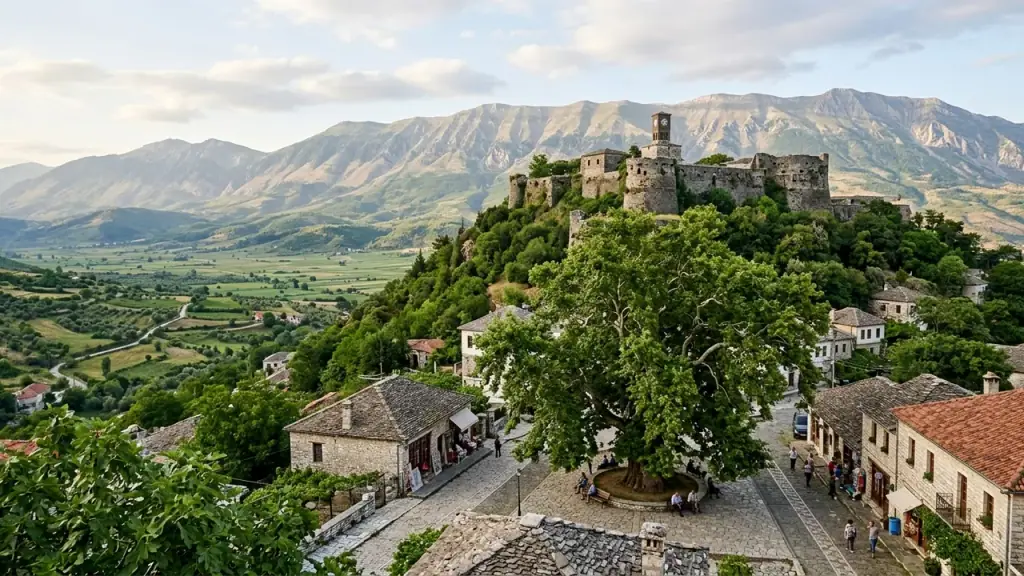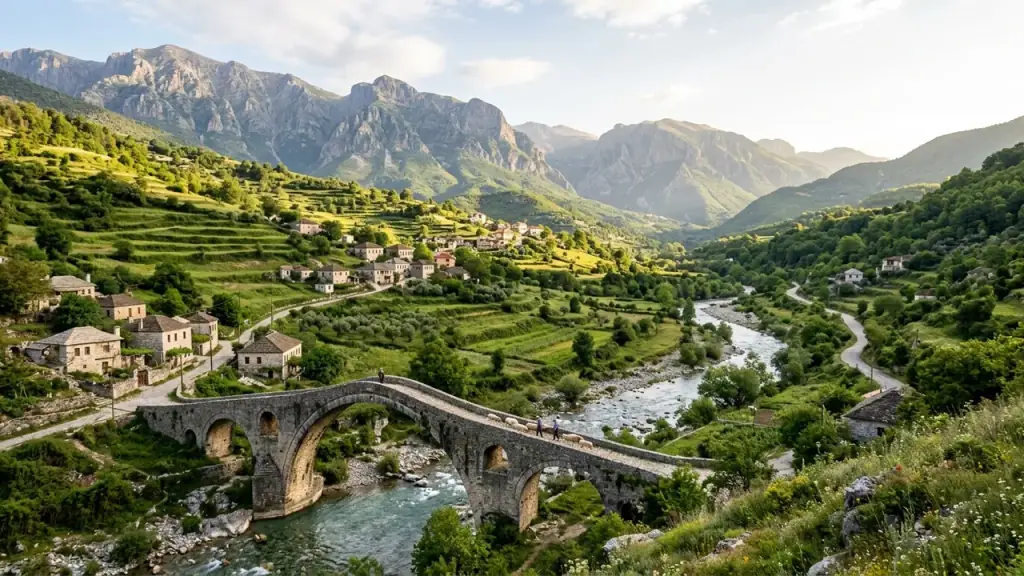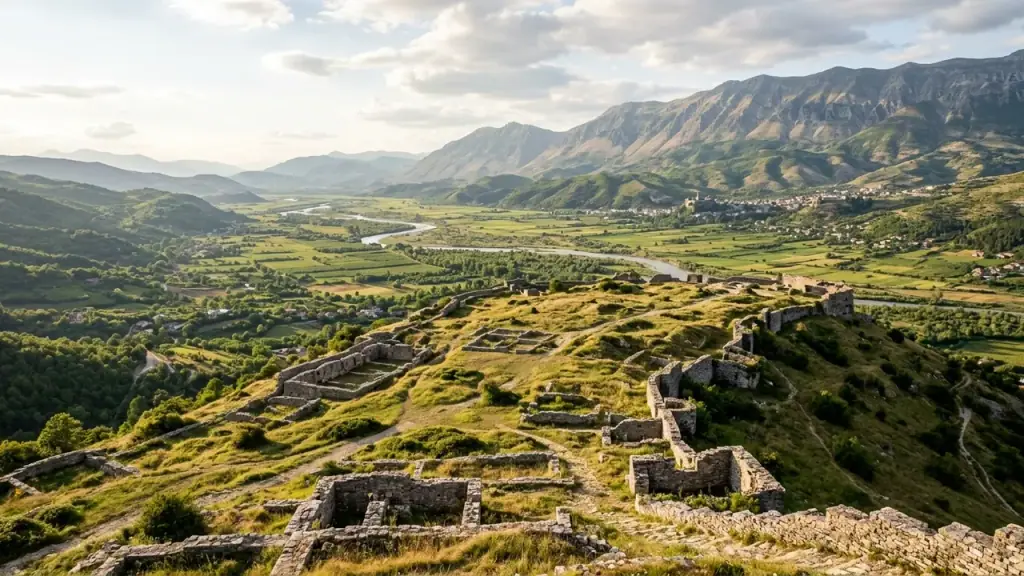
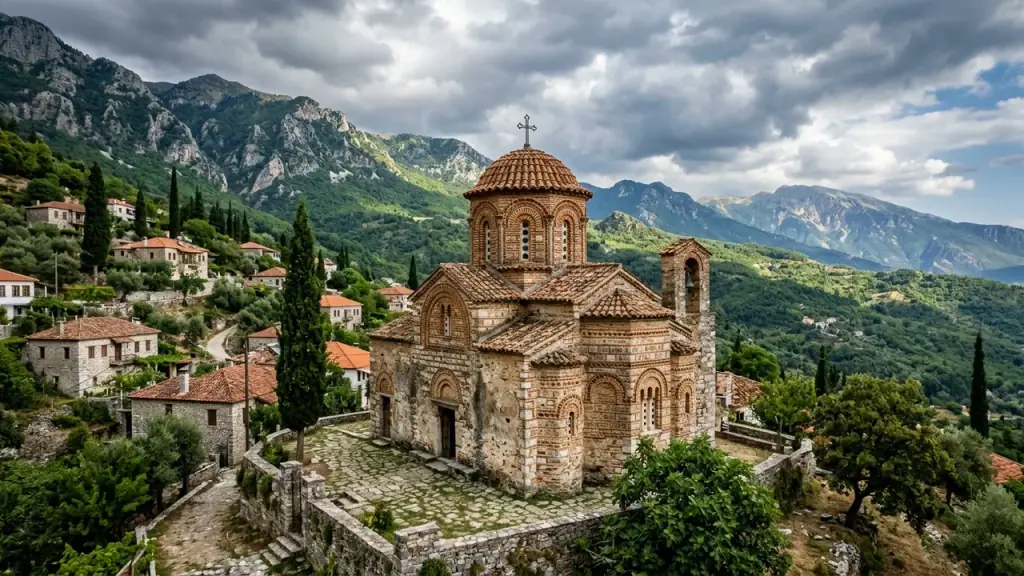
Labovë e Kryqit hides one of Albania's most remarkable churches in a quiet mountain village above the Drino valley. The church is dedicated to the Dormition of the Theotokos (Kisha e Fjetjes së Shën Mërisë), but everyone knows it by the village, and the village is named for the relic: a fragment of the True Cross that the church held until 1989 ("e Kryqit" = "of the Cross"). It is one of the oldest Byzantine churches in the country, traditionally linked to Emperor Justinian. It's a detour for travelers who want their southern Albania trip to reach past the beaches and the obvious ruins into something genuinely sacred and old. Pair it with Libohovë and you have one of the south's finest off-the-trail half-days.
The key facts
| Detail | Figure |
|---|---|
| Dedication | Dormition of the Theotokos; the village, not the church, carries "of the Cross" |
| Foundation tradition | 6th century, under Justinian (r. 527–565), reputedly in memory of his mother |
| Standing fabric | 10th century by one reading, 13th century (Despotate of Epirus) by another |
| Plan | Middle-Byzantine cross-in-square, circular dome on a peristoon, a tribelon into the narthex |
| Claim to fame | The oldest circular dome known in the Epirus region |
| True Cross fragment | Lost in 1989; Albanian press reported it stolen |
| Status | Cultural Monument of Albania |
| Entry | No managing authority publishes a fee or opening hours |
| Coordinates | 40°04′26″N 20°17′25″E, per the church's Wikipedia entry |
Two things to flag rather than smooth over. First, the standing building is not Justinian's. The sources that carry the 6th-century foundation tradition also date the fabric you see to the 10th or the 13th century, and they do not agree with each other. Second, this site's own map-pin resolution for the church came back inconclusive twice (one query landed on a different Shën Mëri church several kilometres away, another on the village centre), so the coordinates above are Wikipedia's and there is deliberately no pin for it on our landmarks map. Navigate to the village, not to a dropped point.
The history
The church's origins are traditionally tied to the 6th-century reign of Justinian (r. 527–565), who is said to have raised it in memory of his mother. That would place the foundation among the oldest in Albania. It's a domed, cross-in-square Byzantine structure whose exterior alternates stone and brick, including a fishbone course, in a manner scholars link to the Byzantine churches of western Macedonia; the circular dome on its peristoon is described as the oldest of its kind in Epirus. A triple arched passage, a tribelon, opens the central aisle to the side aisles and narthex.
Over the centuries it became a major pilgrimage site, because it held a fragment of the True Cross, donated by a Byzantine emperor and brought (by tradition) from Constantinople. That relic is gone. It disappeared in 1989, in the last months of the communist state, and the Albanian press reported it stolen; nothing has publicly replaced it. Travelers arriving expecting to see the Cross the village is named after will not.
What to see
| Feature | Detail |
|---|---|
| The church exterior | Domed Byzantine form, stone-and-brick patterning |
| The setting | A mountain village above the Drino valley |
| The history | Justinian-era origins; True Cross relic tradition |
| Nearby | Pairs with Libohovë castle & the Melan tekke |
The interior may be locked outside services, so much of the reward is the building itself and its setting. Like many of southern Albania's sacred sites, it rewards a quiet, unhurried visit; this is a place for atmosphere, not crowds.
How to visit
| Detail | Info |
|---|---|
| The route | SH4 south from Gjirokastër ~11 km, then east on SH96 toward Libohovë, village a few km on |
| From Libohovë | ~6 km; drivable, and walkable as a hike with the Melan tekke |
| From Gjirokastër | ~30–40 min by car (Libohovë itself is ~20 km) |
| From Saranda | ~1.5 hr via the Drino valley |
| From Himara | The far edge of day-trip range. Gjirokastër alone is 100 km and 2–3 hours |
| Getting inside | The door is usually locked; ask in the village and someone will call the caretaker |
| Pair with | Libohovë, the Melan tekke |
A car is the practical way in, and the last stretch only regains asphalt shortly before the village. Assume the church is shut when you arrive. It is not staffed, there are no posted hours, and the reliable method is to ask a local to phone the keyholder rather than to wait. No entrance charge is published by anyone, and none is reported; if the caretaker comes out for you, a note in the candle box is the courtesy.
Labovë e Kryqit is most naturally visited together with Libohovë, from a Gjirokastër base. The castle, the ~560-year-old plane tree, and the church make one rich Drino-valley half-day. From Himara it is a stretch: the drive-times table puts Gjirokastër at 100 km and two hours in clear conditions, and the church is another half-hour past that, which is why it belongs in the Inland South Albania Road Trip rather than in a day out from the coast.
FAQ
Why is Labovë e Kryqit church famous?
It's considered one of the oldest Byzantine churches in Albania, traditionally founded under Justinian in the 6th century, and it carries the oldest circular dome recorded in Epirus. It held a fragment of the True Cross, which gives the village its name, until the relic vanished in 1989.
How do you visit Labovë e Kryqit?
By car: SH4 south from Gjirokastër for about 11 km, then east on SH96 toward Libohovë, roughly 30–40 minutes in all. Libohovë is about 6 km away. The door is usually locked and nobody staffs it, so ask a villager to call the caretaker.
Is Labovë e Kryqit worth the detour?
For travelers interested in Byzantine history and quiet sacred sites, yes. It's one of Albania's oldest churches in a dramatic mountain setting, almost never crowded. It's best as part of a Libohovë and Drino-valley day rather than a standalone trip.
Bottom line
Labovë e Kryqit is a deep-heritage detour: one of Albania's oldest Byzantine churches, wrapped in Justinian and True-Cross tradition, in a quiet mountain village above the Drino. Pair it with Libohovë and the Melan tekke from a Gjirokastër base. Go for the atmosphere and the history, and add a genuinely ancient, sacred layer to your southern Albania trip.