Himara (Himarë) has over 2,500 years of continuous recorded history, one of the deepest timelines of any settlement on the Albanian coast. Founded as ancient Greek Chimaira by the Chaonian tribe of Epirus. It was mentioned by Julius Caesar, fortified by Byzantium, never fully subdued by the Ottomans, and contested at the drawing of modern borders. The stone evidence of all of it is still standing on Barbaka hill, in Himara's old town and castle.
This is the full story, era by era.
Timeline at a glance
| Period | What happened |
|---|---|
| 5th-4th century BC | Chaonians fortify Barbaka hill; the oldest surviving walls date to this era |
| 48 BC | Julius Caesar mentions Chimaera as a waypoint in his civil-war campaign against Pompey |
| 4th-15th century | Byzantine fortified Christian community; the old town's churches take their surviving form |
| 15th century-1912 | Ottoman era: repeated revolts buy Himara rare privileges and semi-autonomy |
| 1912-1914 | Albanian independence; Himara's status contested between Greek and Albanian claims |
| 1939-1944 | Italian occupation, then liberation; wartime fighting reaches the old town |
| 1944-1991 | Communist rule; the hilltop old town empties as families move to the coast |
| 2015 | Territorial reform merges Himarë, Horë-Vranisht, and Lukovë into today's Bashkia Himarë |
| Today | 8,328 residents (2023 census) across the municipality; tourism drives a quiet old-town revival |
Ancient Chimaira: the Chaonian fortress (5th century BC)
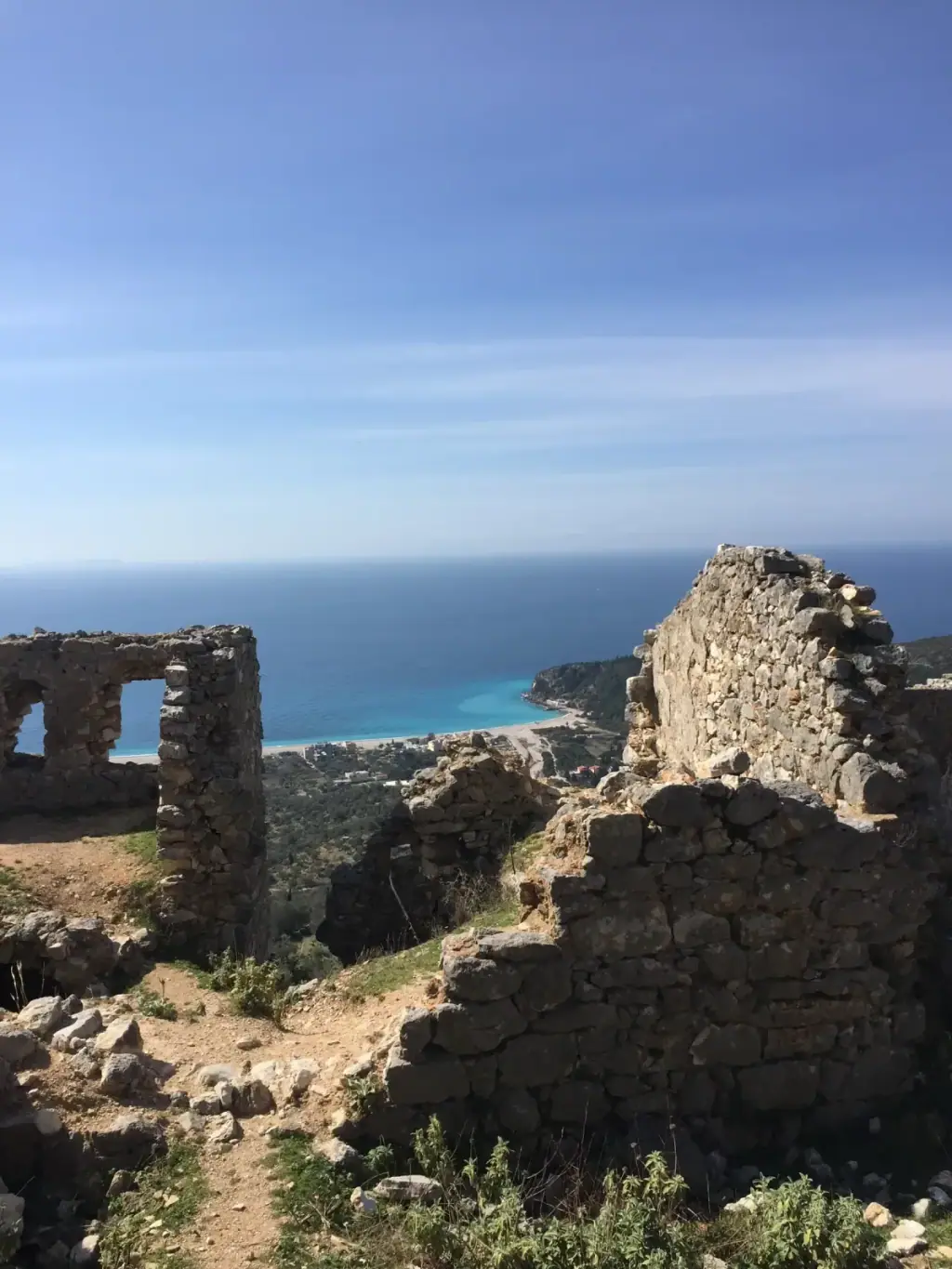
The earliest fortifications on Barbaka hill were built by the Chaonians, the ancient Greek tribe that controlled much of the Epirus coast. The hill was an obvious stronghold: steep approaches on three sides, clear sightlines across the Ionian, and a position controlling the coastal route between the Greek colonies to the south and Illyrian territory to the north. Sections of these megalithic walls survive at the base of the castle's later masonry. You can trace the construction eras with your own eyes.
The town's original name was Χίμαιρα (Chimaira), the same word as the fire-breathing monster of Greek myth, but here meaning "she-goat," a description of the precipitous, goat-grazed cliffs. An ancient inscription found at the site reads "ΦΟΙΒΟΣ ΑΠΟΛΛΩΝ ΧΙΜΑΙΡΑΝ ΕΠΟΛΙΣΕΝ", meaning "Phoebus Apollo founded the city of Chimaira." The full etymology, from Chimaira through Byzantine Cheimarra to modern Himarë, is traced in what the name Himara means.
Rome passes through (2nd century BC - 4th century AD)
By the 2nd century BC Rome had absorbed Epirus. Himara's brush with world history came in 48 BC, when Julius Caesar mentioned the town (as Chimaera) in his account of the civil war against Pompey. Roman troops moved along this coast during the campaign, and the town was a waypoint on the coastal route through Epirus.
The Byzantine centuries (4th-15th century)
This is the era that gave Himara the character you can still see. Under Byzantine rule, the settlement on Barbaka hill became a fortified Christian community. The stone churches inside the castle walls, small, domed and narrow-windowed, date primarily to this period. The most significant, the Church of the Panagia, still holds fragments of medieval frescoes: Christ Pantocrator in the dome, saints along the nave, dimmed by centuries but legible.
The Byzantine period also cemented Himara's Greek-speaking Orthodox identity. Shielded by mountains and walls, the community maintained its language, religion, and customs with a continuity that most of the region's towns did not, the deep background to the Greek heritage you encounter in Himara today.
Ottoman era: the town that wouldn't submit (15th century - 1912)
When the Ottoman Empire swept the Balkans in the 15th century, most towns submitted or fell. Himara was the exception. Using its mountain fortress and a fighting population, the town revolted repeatedly and extracted privileges that were nearly unique in the empire: lower taxes, the right to bear arms, and exemption from the devshirme, the child levy that took Christian boys for the Janissary corps.
This semi-autonomy was never a gift; it was renegotiated at gunpoint across centuries of contested control. Throughout, Himara remained predominantly Greek Orthodox, with the walled old town as its spiritual and defensive core. The stone houses and narrow lanes you walk today were built and rebuilt through this long standoff.
Borders, war, and the 20th century (1912-1944)
When Albania declared independence in 1912, Himara sat in a region claimed by both the new Albanian state and Greece. In November 1912 local forces under Spyros Spyromilios, a Himara-born officer, expelled the Ottoman garrison and raised the question of the town's future; the great powers' border settlement ultimately placed Himara inside Albania, a decision that remained politically sensitive for the rest of the century.
Italy occupied Albania in 1939. Himara was among the first Albanian towns liberated when Italian forces retreated in 1943, and the fighting reached the old town itself. The community's wartime resistance became part of local identity.
Communism and decline (1944-1991)
Under communist rule, the hilltop old town emptied. The government pushed modernization and discouraged traditional communities; families moved down to the new town growing along the coast at Spile. By the fall of communism in 1991, old Himara, Himara e Vjetër, was largely abandoned, its houses collapsing around the churches that had anchored the community for a millennium.
Himara today (1991-present)
The post-communist decades brought emigration, then tourism, then an administrative reshaping: the 2015 territorial reform merged the former Himarë, Horë-Vranisht, and Lukovë municipalities into today's 571.94 km² Bashkia Himarë, stretching from Palasë to Lukovë along the Riviera. The 2023 census counted 8,328 year-round residents, up 45% on the same boundary since 2011, one of the largest gains of any Albanian municipality. The full numbers are in Himara facts & figures.
The old town, meanwhile, is seeing a quiet revival. Restoration is slow but real, a cafe now sits on the castle walls, and the site is free and open to anyone willing to walk 20 minutes uphill. For what to see up there and how to visit, use the Himara Castle & old town guide; for the broader entity picture, see About Himara.
Frequently asked questions
How old is Himara?
Over 2,500 years old. The earliest fortifications on Barbaka hill date to the 5th century BC, built by the Chaonians of ancient Epirus, and the site has been continuously inhabited since, through Roman, Byzantine, Ottoman, and modern eras.
What was Himara called in ancient times?
Chimaira (Χίμαιρα), the same Greek word as the mythological Chimera, meaning "she-goat," describing the goat-grazed cliffs. Byzantine scribes later respelled it Cheimarra, and it became Himarë in modern Albanian. See the full name history.
Was Himara ever part of Greece?
No. Himara has been inside Albania's borders since they were drawn after 1912, though the town has a historic Greek-speaking Orthodox community and its status was contested in the border settlements of 1912-1914. The cultural picture is covered in Is Himara in Greece or Albania?
Why was Himara autonomous under the Ottomans?
Repeated armed revolts plus defensible geography. The Ottomans found it cheaper to grant privileges, lower taxes, the right to bear arms and exemption from the devshirme child levy, than to permanently garrison a fortified hilltop backed by mountains.
Where can you see Himara's history today?
In the old town (Kastro) on Barbaka hill: 5th-century-BC wall sections, Byzantine churches with surviving frescoes, Ottoman-era stone houses, and panoramic ramparts. Entry is free. The castle and old town guide covers the walk up, what to see, and when to go.