The forum advice on riding the Albanian Riviera tends to land in one of two places: glowing reviews that compare the SH8 to Croatia's coast at one-third the price, or panicked warnings about goats and aggressive overtakers. Both contain truth and both leave the actual rider unprepared. We ride the SH8 monthly out of Himara. Llogara Pass, Porto Palermo, the Borsh stretch, the Saranda descent, in everything from a 125cc scooter to a 650cc twin. What follows is what we'd tell a friend who emailed asking whether to bring their bike, rent locally, or skip Albania entirely. It's structured by segment and bike size, because those are the two variables that actually determine whether your ride is a highlight or a slog.
For the supporting context: Albania road conditions 2026, SH8 segment-by-segment drive guide, Llogara Pass driving guide, petrol stations near Himara.
Our 2026 Segment Ratings (Rider's Perspective)
Different from a car driver's perspective. On a motorcycle, surface quality matters more, gravel placement matters more, sight lines matter more, and the trade-off between riding pleasure and survival probability shifts. Here's how we score each segment.
| Segment | Bike that fits best | Our 2026 score | The honest one-liner |
|---|---|---|---|
| A2 Tirana → Fier | Anything 250cc+ | 7 / 10 | Highway warm-up. Boring but functional |
| SH4 Fier → Vlora | Any bike | 7 / 10 | Wide, straightish; trucks are the variable |
| Vlora → Llogara base (foothills) | Any bike | 7 / 10 | Olive groves, gentle climb. Ease into the road |
| Llogara climb (north side) | 250cc+ ideal; 125cc OK but slow | 9 / 10 | The single best 25 km of riding in Albania |
| Llogara summit and crosswind zone | 250cc+ for stability | 8 / 10 in dry, 4 / 10 in fog or wet | Spectacular when clear; we don't ride it in fog |
| Llogara descent → Dhermi | 250cc+ ideal | 9 / 10 | Tighter and steeper than the climb. Engine-brake or fade your discs |
| Dhermi → Himara | Any bike | 7 / 10 | Fast clifftop sweepers. Watch for tour buses |
| Himara → Porto Palermo | Any bike | 7 / 10 | Best 20 km coastal ride; perfect on a 125cc scooter |
| Porto Palermo → Borsh | Any bike | 6 / 10 | Cliff cuts narrow; one rough section |
| Borsh → Saranda | Any bike | 5 / 10 | The least interesting third of the SH8. Inland, hot, slower |
| Saranda → Gjirokastër (SH99) | 250cc+ for the climb | 7 / 10 | Mountain riding, scenic, surface inconsistent |
| Gjipe Beach access track | Adventure / dual-sport only | 2 / 10 | Don't take a road bike down here |
| Pilur / Vuno mountain spurs | Adventure / dual-sport ideal | 5 / 10 | Some pavement, some dirt; gorgeous if you're equipped |
The headline insight: on a 125cc scooter rented in Himara, the riding ranges from "perfect" (Himara → Porto Palermo) to "miserable and dangerous" (Llogara climb in 35°C heat, fully-loaded with luggage, behind a tour bus). Most rental scooters in Himara are 50-125cc, appropriate for beach-hopping, marginal for the pass. If the pass is your main goal, rent in Tirana on something with at least 250cc.
What's Different in 2026
Three updates from earlier guides we've published.
The Llogara Tunnel still isn't open. Despite repeated announcements, the tunnel has not entered service as of May 2026. Riders looking forward to the tunnel as a bad-weather alternative will be disappointed; for now, the old pass is your only Llogara option. We'll update this guide the day it opens. See our Llogara tunnel guide for what we know.
SH8 sections south of Porto Palermo got patched in March 2026. The worst sections we'd been complaining about were finally repaired. The asphalt is fresh but unmarked through three roughly 200m stretches, no centerline yet. On a bike, treat unmarked stretches as if they're single-lane.
A2 toward Fier is fine; A2 extension toward Tepelenë is heavy construction. If you're riding in via Gjirokastër. Expect lane shifts, unmarked detours, and 30-60 minutes of construction-zone crawl through April-October 2026.
Llogara Pass: What Riders Actually Need to Know
Most coverage of Llogara Pass treats it as one entity. From a rider's seat, it's three distinct sections, each with its own demands.
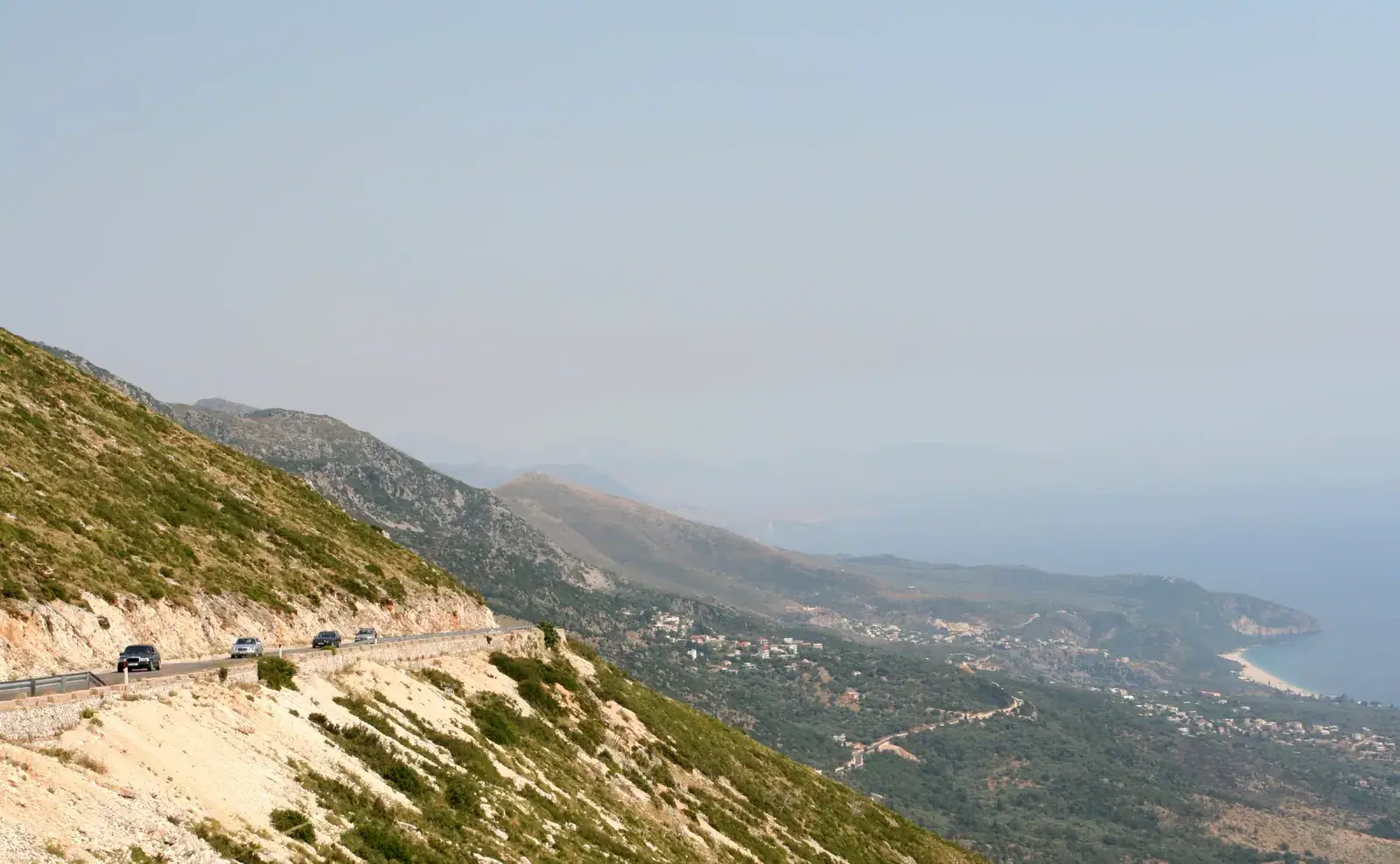
The climb (north side, Vlora → summit). Roughly 12 km of switchbacks gaining 1,000 m. Surface is good. The challenge is sight lines, every blind hairpin can hide a tour bus on the wrong side of the line. We ride this in 2nd or 3rd gear, never trail-braking into the apex on cold tires, and we sound the horn at every blind right-hand turn (most likely place to meet oncoming traffic crossing the line). Crosswinds pick up about two-thirds of the way up; lighter bikes feel them.
The summit zone (around 1,027 m). The road levels briefly through black-pine forest. Cooler air, typically 8-12°C cooler than sea level. Fog forms most mornings April-October and usually clears by 11:00. We don't ride the summit in fog; visibility drops to 30 m and the pass is unguardrailed in places.
The descent (south side, summit → Dhermi). Tighter and steeper than the climb. Switchbacks drop hard. Use engine braking, not your discs alone. We've seen rentals stopped at the lay-bys with smoke off the rotors. Don't be that bike. Specific advice: stay in 2nd gear, let the engine hold the speed, brake into the corner entry not through the apex, accept that you'll be slow. The descent is not a place to make time.
Bike Sizing: What Actually Works on This Coast
| Bike size | Where it works | Where it struggles | Honest verdict |
|---|---|---|---|
| 50cc scooter | Town runs, beach hops within 5-10 km of Himara | Llogara Pass (won't make the climb), highway | Don't take this on the pass |
| 125cc scooter | Riviera coastal sections (Himara-Porto Palermo, Dhermi-Himara) | Llogara climb in heat or with luggage; long distances | Rent locally; ride locally |
| 250-400cc | Most Riviera + Llogara comfortably; A2 highway tolerable | Multi-day touring with full panniers | The sweet spot for the SH8 |
| 600cc+ touring | Everything | Tight Himara town parking | Best ride; hardest to find as a rental |
| Adventure / dual-sport | Everything including Gjipe access, Pilur spurs, Albanian dirt | Top speed (vs touring) | If you have one. Bring it |
The mistake we see most often: a couple flies into Tirana, rents a 125cc scooter at the Riviera, and tries to do the full Vlora-Saranda loop including the pass. The 125cc handles the coast fine. It does not handle the pass with a passenger and luggage in summer heat, you'll be in low gear at 30 km/h with ten cars stacked behind you, riding a hot engine on a steep climb. Either rent a bigger bike in Tirana or skip the pass and ride the coast only.
Fuel and Fluid Strategy
Fuel availability is good with one critical gap: no functioning station between Vlora and the Dhermi/Himara area. That's a 40-50 km stretch covering the entire Llogara Pass. Always tank up in Vlora before heading south.
| Where | Stations (May 2026) | What to do |
|---|---|---|
| Vlora | Multiple, well-stocked | Fill before leaving. Check tire pressure |
| Vlora → Llogara → Dhermi | None | Don't try to push it |
| Dhermi to Himara | A small station near Drymades, plus Himara | Fill again before any longer ride |
| Himara | Multiple, including 24h | Best place to refuel before Saranda or any inland trip |
| Borsh and south | Small stations, sometimes closed | Don't depend on them |
| Saranda | Multiple | Fill before any inland or Gjirokastër ride |
Mainstream fuel chains: Kastrati, EKO, Europetrol. All take cash; cards work at chain stations in larger towns. Price (May 2026): roughly 250 ALL/litre gasoline, 245 ALL/litre diesel, about €2.50/litre, ~$2.65/litre, £2.15/litre.
Rider Hazards: Ranked by How Often They Bite
In rough order of how often these come up in conversations with visitors who've crashed or had close calls.
Aggressive overtaking on blind corners. The single biggest hazard on the SH8. Locals overtake in places no European rider would consider. Solution: hug your edge of the lane. Expect oncoming traffic in your lane on every blind right-hander, never assume the centerline holds.
Gravel migrating into the riding line. Road shoulders are loose; gravel works its way into the inside of curves, especially after rain. Most common where minor side-roads meet the SH8. Stay off the shoulder; widen your line slightly through known curves.
Livestock on the road. Goats and sheep cross secondary roads daily. The herd usually moves in 30-60 seconds; stop, wait, don't honk. Most likely places: lower Llogara, the Pilur spur road, anywhere south of Borsh.
Diesel and oil patches near junctions. Trucks leak; intersections are slick. Approach junctions like wet pavement.
Tour buses on Llogara Pass. They take the hairpins at 15 km/h and can't pull over. You will be queued behind one for 5-15 minutes at a time. Plan to overtake only at the marked pull-outs, never on a blind corner.
Crosswinds at the summit. A 125cc gets pushed sideways. A 600cc tourer barely notices. Account for it.
Unlit vehicles after dark. Tractors with no taillights. Mopeds with no headlights. We don't ride the SH8 at night. Period.
For US riders: US passports get visa-free Albania entry up to 1 year. Bring a US-issued International Driving Permit alongside your home license. Albanian police occasionally check, and not having one can result in a fine. US insurance won't cover a rental bike here; either take the rental's CDW upgrade or carry a separate motorcycle travel policy that names Albania. Distance/temp: ~80 mi from Vlora to Himara via the pass; sea-level temps in July often above 95°F, summit ~10-15°F cooler.
For UK riders: UK driving licenses with motorcycle entitlement are accepted directly without IDP. Wizz Air, Ryanair, BA, easyJet to Tirana from London. Tirana motorcycle rental is limited but improving. Book 4-6 weeks ahead in summer for a 250cc+. UK home contents/travel insurance often does not cover motorcycle rental abroad; check before assuming.
For German and Dutch riders: Direct flights from major DE/NL hubs. Best Riviera-suitable rental motorcycles are out of Tirana, not on the Riviera itself; Riviera shops mostly stock 125cc scooters. EU green-card insurance covers Albania for own-bike riders. Many regional clubs run organized rides through Albania spring and autumn.
Renting on the Riviera vs Renting in Tirana
| Factor | Himara scooter rental | Tirana motorcycle rental |
|---|---|---|
| Bike size available | 50-125cc | 125cc up to 650cc |
| Daily price | 2,000-4,000 ALL (~€20-40) | €25-60 |
| Helmet quality | Open-face, often poor | Better, ECE-rated common |
| Insurance scope | Third-party, limited | Better coverage available |
| Riviera radius | Excellent (Dhermi → Borsh) | Anywhere |
| Llogara Pass capability | Marginal | Comfortable |
| Multi-day touring | Not really | Yes |
| Booking ahead needed | Walk-in usually fine | 4-6 weeks in summer |
If you're flying into Tirana for a Riviera-only trip and the pass is the priority, rent in Tirana on a 250cc+. If you're already on the Riviera and just want beach-to-beach mobility, the local Himara scooter is fine. See our Himara car & scooter rental guide for current providers.
Best Time to Ride
| Month | Surface | Crowds | Weather | Our take |
|---|---|---|---|---|
| May | Dry, sometimes wet patches in shoulder rain | Light | 15-26°C sea level | Best month overall |
| June | Dry | Moderate | 22-30°C | Strong second pick |
| July-August | Dry, but heat melts asphalt softness in some patches | Heavy tour-bus traffic | 28-37°C | Ridable but crowded |
| September | Dry | Lighter | 22-29°C | Tied with May for best |
| October | First rains return mid-month | Light | 17-25°C | Last good window |
| November-March | Wet, fog, occasional ice on summit | Empty | 5-18°C | Don't ride the pass |
Morning rides through Llogara in late May or September, cool air, empty road, sharp visibility, are as good as European motorcycle touring gets. Mid-afternoon in August behind tour buses is the opposite.
Frequently Asked Questions
Can I really ride the full Vlora-Saranda route on a 125cc scooter?
Yes, but it will be slow on Llogara. The 125cc handles the coastal SH8 fine. Himara to Saranda is enjoyable. The pass climb is the problem: sustained 30-40 km/h with cars stacked behind you, hot engine, working brakes hard on the descent. Doable solo on a cool morning; miserable in July with a passenger and luggage. If the pass is your priority, rent a 250cc+ in Tirana.
Is the SH8 actually safe for motorcycles in 2026?
The road surface is mostly good and improving, patched sections south of Porto Palermo were repaired in March 2026. The hazards come from traffic behavior, not pavement: aggressive overtaking, gravel on corners, livestock crossings, unlit night vehicles. Riders comfortable on Italian, Greek, or Croatian coastal roads will find the SH8 manageable. Urban-only riders will find Llogara Pass demanding.
Should I take the Llogara Tunnel or the pass road?
As of May 2026, the tunnel isn't open, there is no choice. When the tunnel does open (best estimate late 2026 or 2027), motorcyclists should ride the pass anyway, the pass is the reason you came. Save the tunnel for bad-weather days, or for the return leg when you've already ridden the pass once.
Where should I base myself for multi-day Riviera riding?
Himara, by a mile. It's geographically central. Llogara is a 25-minute ride north, Porto Palermo 10 minutes south, Saranda 60 minutes further down. Best restaurant scene on the coast (see our Himara restaurants guide), good range of hotels by budget, and most guesthouses have secure parking. From a Himara base you can ride a different route every day for a week without repeating.
Can I ride to Gjirokastër and back from Himara in a day?
Yes, comfortably. The round trip is roughly 200 km (~125 mi) and 4-5 hours of riding. Take the SH8 south to Saranda, then SH99 inland through the Drino Valley to Gjirokastër. Spend 2-3 hours in the UNESCO old town, return same way. Leave by 8:00 AM in summer to avoid the worst heat at sea level. See our Gjirokastër day trip for the route.
Do I need an International Driving Permit for a motorcycle rental in Albania?
If your home license isn't EU/EEA-issued, yes, the IDP is technically required and Albanian police do check at roadside stops, especially on the SH8 in summer. UK and EU licenses are accepted directly. US, Canadian, Australian, and other non-EU riders should carry an IDP from their national auto association. Costs ~€15-20 at home, takes minutes. Without one, you risk a roadside fine and potential rental-insurance void if you crash.
Can I cross from Albania into Greece with my rental motorcycle?
Often yes, but not by default. Most Albanian motorcycle rentals require pre-authorization for cross-border travel and may charge a daily fee (€5-15) or impose mileage/territory restrictions. Get the cross-border permission in writing before you go, border officers can ask, and unauthorized crossing voids your insurance. For the route logistics, see our border crossing by car guide, same rules apply to motorcycles.