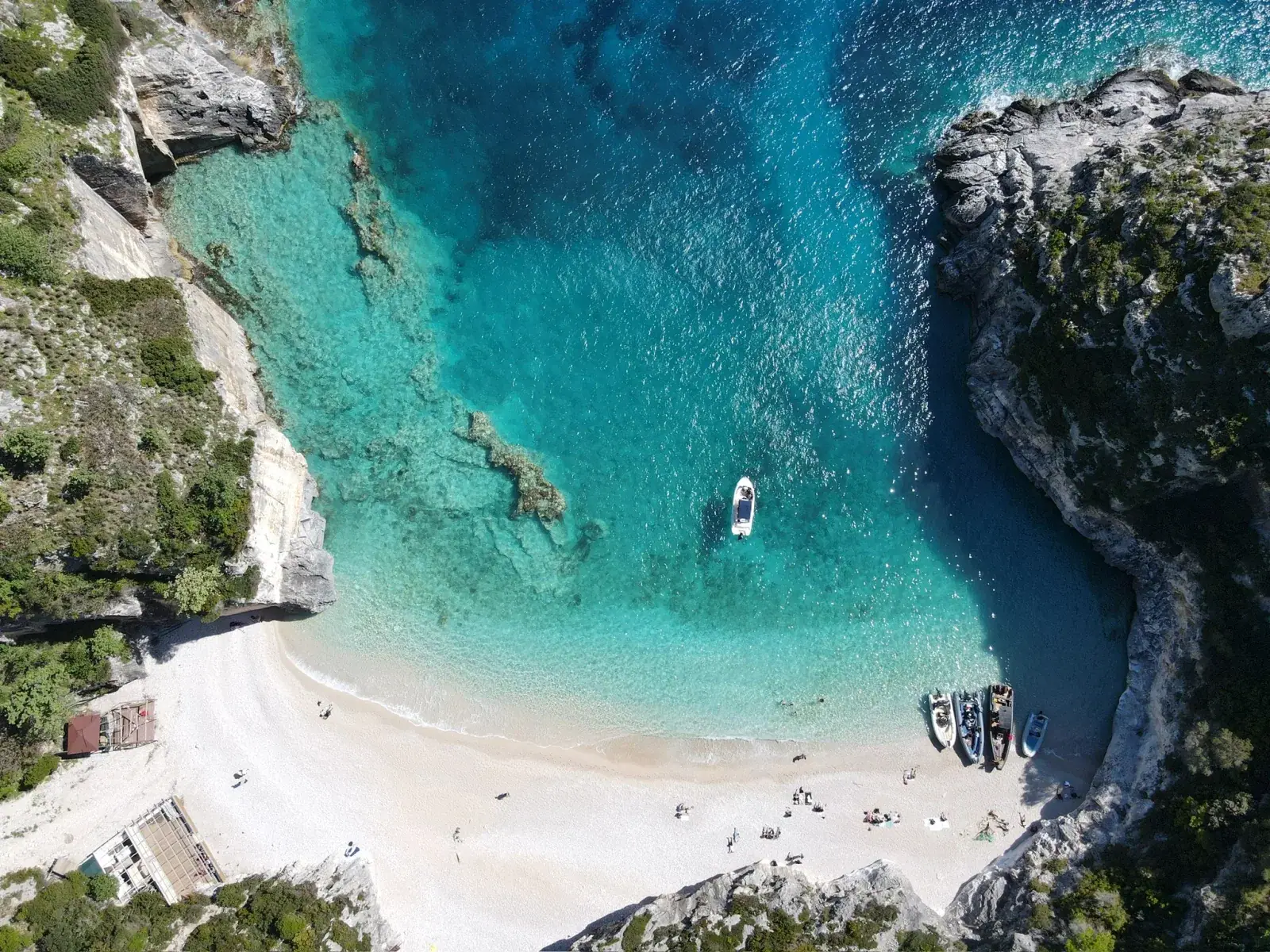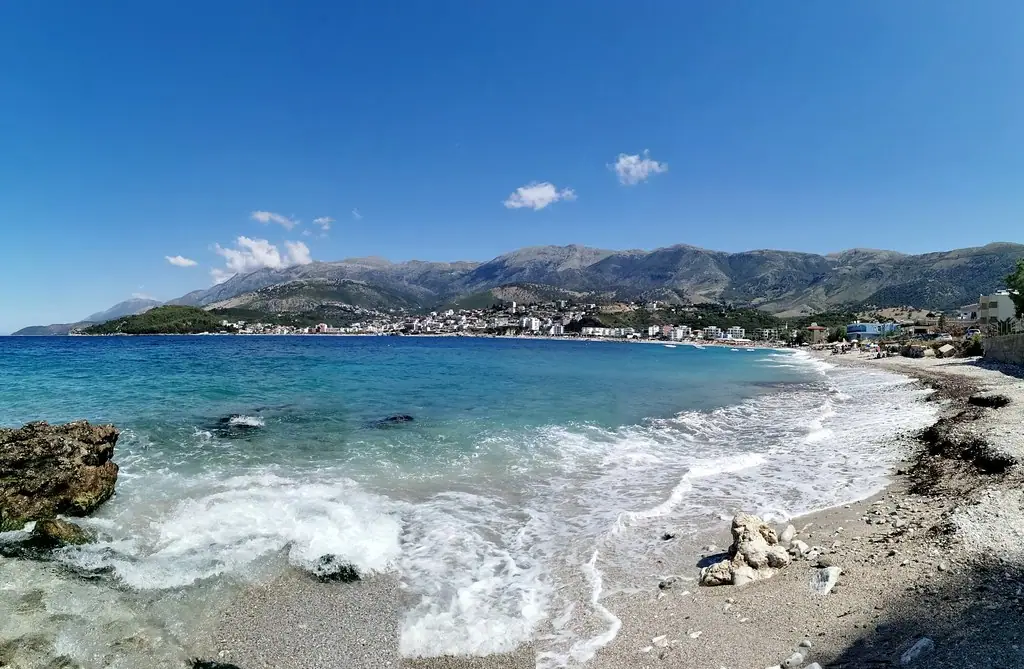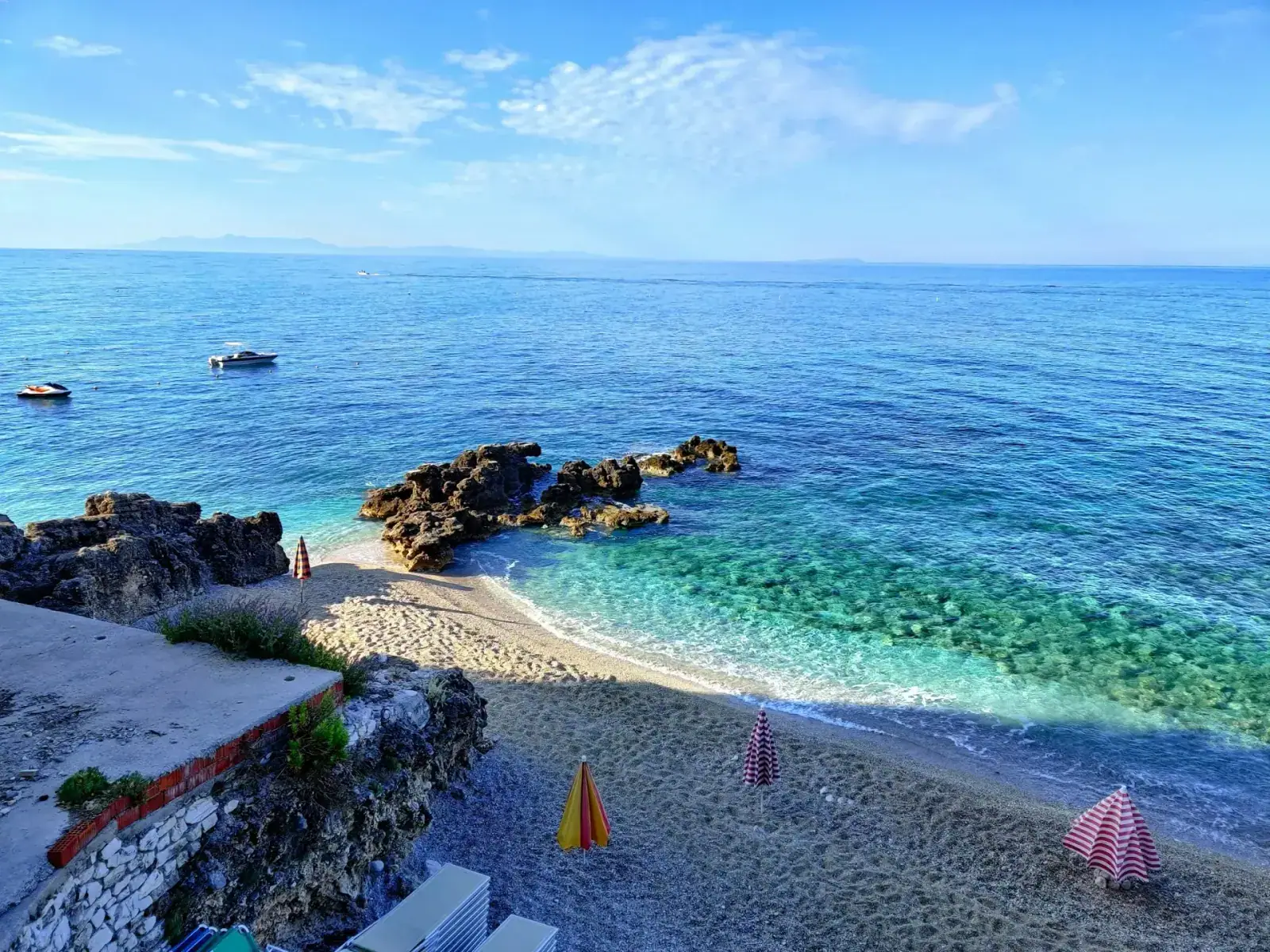
Traveling Albania without a car is entirely possible, widely done, and cheaper than most visitors expect. The country runs on a patchwork of intercity buses, shared minivans called furgons, city buses in Tirana, taxis, ride-hailing apps, and a single international ferry route. None of it is centralized. There's no national transit authority, no unified timetable, and no online booking system for most routes. But the pieces fit together once you understand the logic: buses and furgons cover the main corridors, taxis fill the gaps, and flexibility replaces precision.
This guide covers every transport mode available to car-free travelers in Albania, with specific routes, prices, and timing for the Albanian Riviera (Greek: Αλβανική Ριβιέρα, Albanian: Riviera Shqiptare). Some people are backpacking the coast on a tight budget. Others just don't want to drive Albanian mountain roads. Here is how to do it without a car.
Compare hotels, apartments, and Vrbo rentals on the map. Powered by Stay22.
Quick Facts
| Detail | Info |
|---|---|
| Main intercity transport | Furgons (shared minivans) and buses |
| Online booking | Not available for most routes |
| Payment | Cash only (Albanian lek) on nearly all buses and furgons |
| Taxi apps | Bolt and InDriver work in Tirana; not available on the Riviera |
| Tirana to Himara | ~6 hours, 1,500-2,000 ALL (15-20 EUR) |
| Tirana to Saranda | ~5-6 hours, 1,500-2,000 ALL (15-20 EUR) |
| Tirana to Vlora | ~2.5 hours, 500-800 ALL (5-8 EUR) |
| Riviera without a car | Feasible in summer; limited in off-season |
| Essential phrase | "Ku shkon?" (Where does this go?) |
Types of Transport in Albania
Albania doesn't have a single unified public transport system. Instead, you'll use a combination of four modes, each serving a different purpose.
Municipal Buses (Tirana Only)
Tirana is the only Albanian city with a functioning municipal bus network. Routes cover the city center, suburbs, and key destinations like the bus terminal and university area. Fares are around 40 ALL (under 0.50 EUR) per ride. Buses run roughly 6 AM to 9 PM. Outside Tirana, there are no city bus systems worth mentioning.
Intercity Buses
Larger coaches operate on Albania's main corridors: Tirana to Vlora, Tirana to Saranda (Greek: Άγιοι Σαράντα, Albanian: Sarandë), Tirana to Gjirokaster (Albanian: Gjirokastër), and Tirana to Berat. These are proper 40- to 50-seat buses with fixed departure times, air conditioning (usually), and assigned or first-come seating. They're the most comfortable option for longer distances and the closest thing Albania has to conventional public transit. For the Tirana-Saranda corridor specifically, see the Tirana to Saranda bus guide.
Furgons (Shared Minivans)
Furgons are the backbone of Albanian transport outside the main cities. A furgon is a shared minivan, typically a Mercedes Sprinter or similar, carrying 8 to 15 passengers between towns. There's no ticket office, no app, no printed timetable. You find the departure point, tell the driver where you're going, wait for the van to fill, pay in cash, and ride.
Furgons leave when full, not on a schedule. Morning departures (7:00-9:00 AM) are the most reliable. In summer, vans fill quickly on popular routes. In winter, you might wait an hour or find no service at all. For an in-depth breakdown of how furgons work, routes, and tips, see the Albania furgon guide.
Taxis
Taxis are available everywhere in Albania, but the experience varies sharply between Tirana and everywhere else.
In Tirana: Bolt and InDriver are widely used. You get upfront pricing, GPS-tracked rides, and card payment. Yellow metered taxis also exist but are less reliable on pricing.
On the Albanian Riviera and elsewhere: No ride-hailing apps. No meters. You negotiate the price before getting in. Ask your hotel to call a trusted driver, or find taxi stands near town centers. This isn't a scam, it's just how it works. Agree on the fare, confirm the currency (lek, not euros), and you're set. For Himara-specific taxi advice, see the Himara taxi guide.
Key Routes and Prices
Here are the main bus and furgon routes travelers use to move around Albania without a car. All prices are per person, one way, paid in Albanian lek (ALL). EUR equivalents are approximate.
Tirana to Himara
| Detail | Info |
|---|---|
| Duration | 5-7 hours |
| Price | 1,500-2,000 ALL (15-20 EUR) |
| Departures | 2-4 daily, mostly morning |
| Transport type | Bus and furgon |
The longest common route for Riviera-bound travelers. Both proper buses and furgons run this corridor. The journey crosses the interior to Vlora, then follows the SH8 coastal road over the Llogara Pass, one of the most dramatic mountain stretches in the Balkans. Sit on the right side heading south for sea views after the pass. Bring water and a snack; the ride is long with limited stops. For the complete breakdown, see how to get to Himara from Tirana. If you're arriving at Tirana's airport, the Tirana airport to Himara guide covers the connection.
Tirana to Saranda
| Detail | Info |
|---|---|
| Duration | 5-6 hours |
| Price | 1,500-2,000 ALL (15-20 EUR) |
| Departures | Multiple daily |
| Transport type | Bus (primary) |
Direct buses run this route and are the better option over furgons for this distance. The road passes through Gjirokastra or hugs the coast via Himara depending on the operator. Confirm which route your bus takes, the coastal route via Llogara is far more scenic but can take longer. Full details in the Tirana to Saranda bus guide.
Tirana to Vlora
| Detail | Info |
|---|---|
| Duration | 2-2.5 hours |
| Price | 500-800 ALL (5-8 EUR) |
| Departures | Frequent, throughout the day |
| Transport type | Bus and furgon |
The most frequent and reliable intercity route in southern Albania. Buses depart regularly from Tirana's south terminal. This is also the first leg if you're heading to the Riviera and want to break the journey. Vlora has proper restaurants, hotels, and a beachfront worth a stop. For details, see the Tirana to Vlora bus guide.
Himara to Saranda
| Detail | Info |
|---|---|
| Duration | 1-1.5 hours |
| Price | 500-700 ALL (5-7 EUR) |
| Departures | Several daily in summer |
| Transport type | Furgon and bus |
The most traveled route on the southern Riviera. Furgons and buses follow the SH8 south through Porto Palermo, Qeparo, and Borsh. Multiple departures in summer; reduced in shoulder season. You can flag down passing furgons from the main road if you're in between towns. Full route breakdown in the Himara to Saranda transport guide.
Saranda to Ksamil
| Detail | Info |
|---|---|
| Duration | 15-20 minutes |
| Price | 200 ALL (2 EUR) |
| Departures | Frequent in summer (almost shuttle-like) |
| Transport type | Furgon |
A quick hop south from Saranda to the beaches of Ksamil. Furgons run frequently in peak season, you rarely wait more than 20 minutes. In winter, service drops off. See the Saranda to Ksamil bus guide for pickup points and timing.
Vlora to Himara
| Detail | Info |
|---|---|
| Duration | 2-2.5 hours |
| Price | 600-1,000 ALL (6-10 EUR) |
| Departures | Irregular; morning departures most reliable |
| Transport type | Furgon (primarily) |
This route crosses the Llogara Pass, spectacular scenery, winding switchbacks, and occasional motion sickness. Furgon service is less predictable than on the Tirana-Vlora or Himara-Saranda corridors. If you can't find a direct furgon, a common workaround is to take a bus from Tirana that passes through Vlora and continues to Himara. For more on this route, see the Himara to Vlora transport guide.
How Furgons Actually Work
If you've only traveled in countries with organized transit, furgons will feel unfamiliar at first. Here's the step-by-step reality:
-
Find the departure point. There's no station. Furgons gather near a market, a main square, or a specific stretch of road that locals know. In Himara, it's along the main road through town. In Tirana, it's near the bus terminal area. Ask your hotel, ask a cafe, ask anyone, they'll point you to the right spot. For Himara specifically, see the bus station guide.
-
Ask "Ku shkon?" This means "Where does this go?" in Albanian. Point at a van, say it, and the driver will tell you his destination. If he's not going your way, he'll wave you toward the right one.
-
Wait for the van to fill. This is non-negotiable. Furgons leave when there are enough passengers to make the trip worthwhile. In peak summer on busy routes. This takes 10-15 minutes. On quieter routes or in the off-season. It could be 45 minutes or more. You can offer to pay for empty seats to leave sooner, some drivers accept this.
-
Pay the driver in cash. Albanian lek only. Carry small bills, 500 or 1,000 lek notes are ideal. Don't hand the driver a 5,000 lek note for a 700 lek fare. There are no receipts, no tickets, no card machines.
-
Tell the driver your stop. Especially if you're getting off between the origin and final destination, a beach, a village, a trailhead. Most drivers will pull over anywhere along the route if you've told them in advance.
-
Get off when the driver calls your stop. That's it. No bell, no button. Stay alert or you'll overshoot.
Ferry Connections
Albania has one major international ferry route that's useful for car-free travelers: Saranda to Corfu. Ferries run daily in summer, less frequently in winter, and take 30-60 minutes. Foot passengers pay roughly 19-25 EUR each way. This connection opens up a natural circuit: fly into Corfu, ferry to Saranda, travel the Riviera by bus and furgon, then return to Saranda and ferry back.
From Himara, the practical approach is to take a bus or furgon to Saranda, then catch the ferry. The full logistics are covered in the Corfu to Himara ferry guide.
Albanian Riviera Without a Car
The Albanian Riviera, roughly the stretch from Vlora to Saranda along the SH8 coastal road, is the most popular region for tourists and the one where car-free travel gets the most questions. Here's the honest assessment.
What works well without a car:
- Moving between the main towns (Vlora, Himara, Saranda, Ksamil) by bus and furgon
- Exploring within Himara on foot, the main beaches, old town, restaurants, and promenade are walkable
- Reaching remote beaches by boat tour or water taxi from Himara
- Day trips to Saranda and Ksamil by furgon
- Getting to the airport via bus connections through Tirana
What's harder without a car:
- Beach-hopping between Dhermi (Greek: Δρυμάδες, Albanian: Dhërmi), Drymades, Jale, and Gjipe, furgons exist on these routes but run infrequently and unpredictably
- Visiting Porto Palermo, Blue Eye Spring, or Gjirokaster without paying for taxis
- Traveling anywhere on the Riviera after dark, when furgon service stops entirely
- Moving around in October through May, when furgon frequency drops to near zero
The strategy that works: pick a base (Himara is the best for car-free travelers), stay several days, and use a mix of walking, furgons, boats, and the occasional taxi. Don't try to cover the whole Riviera in a car-free rush. For a detailed guide to Himara specifically without wheels, see the Himara without car guide and getting around Himara.
7-Day No-Car Riviera Itinerary
This itinerary assumes summer travel (June-September) when furgon service is at its peak.
Day 1: Arrive in Tirana
Fly into Tirana International Airport. Take a Bolt or city bus to the center. Explore the Blloku neighborhood, Skanderbeg Square, and the Grand Park. Stay overnight in Tirana.
Day 2: Tirana to Vlora by Bus
Morning bus from Tirana south terminal to Vlora. About 2.5 hours, 500-800 ALL. Spend the afternoon on Vlora's waterfront. Walk the lungomare, eat seafood, see the Independence Museum if you're interested. Stay overnight in Vlora. See the Tirana to Vlora bus guide for departure points.
Day 3: Vlora to Himara by Furgon
Take a morning furgon from Vlora to Himara. The ride crosses the Llogara Pass with staggering coastal views. Arrive in Himara by midday. Walk to Spile Beach. Explore the promenade. Watch the sunset from the Old Town hill. Stay in Himara for the next four nights.
Day 4: Himara Town Day
Walk to Spile Beach in the morning. Climb to the Old Town and castle (15 minutes uphill, panoramic views). Afternoon at Livadhi Beach by taxi (500 ALL each way). Evening promenade dinner. Everything today is on foot or a single short taxi ride.
Day 5: Boat Day from Himara
Take a boat tour from Spile Beach to Filikuri, the Pirate's Cave, or Grama Bay. Half-day tours cost 2,000-4,000 ALL per person. This replaces the car-dependent coastal drives and gives you access to beaches and coves that are otherwise unreachable without wheels. Afternoon at your choice of town beach.
Day 6: Day Trip to Saranda and Ksamil
Morning furgon from Himara to Saranda (500-700 ALL, 1-1.5 hours). From Saranda, take a furgon to Ksamil (200 ALL, 15 minutes). Spend the morning at Ksamil's beaches, return to Saranda for a late lunch on the waterfront, then catch an afternoon furgon back to Himara. Full route details in the Himara to Saranda transport guide and Saranda to Ksamil bus guide.
Day 7: Himara to Tirana (or Saranda for Ferry)
If flying out of Tirana, take the morning bus from Himara (departs early, 5-7 hours). If heading to Corfu, take a furgon to Saranda and connect to the ferry. See Corfu to Himara ferry for the ferry schedule. For the full 48 hours approach if you have less time, see 48 hours in Himara without a car.
Budget for the week (transport only): Roughly 6,000-10,000 ALL (60-100 EUR) per person if using buses, furgons, and one boat tour. Add 3,000-5,000 ALL (30-50 EUR) if you take a few taxis for beach access.
Practical Tips for Car-Free Albania
Always carry cash in lek. Buses, furgons, and most taxis outside Tirana accept only Albanian lek. ATMs are available in all major towns, but carry enough cash for a full day of transport before heading to smaller villages. ATMs are in every town along the Riviera, but don't count on finding one in smaller villages.
Download offline maps. Google Maps works reasonably well for navigation in Albania, but cell service drops in the mountains. Download the region offline before you travel. Maps.me is another solid option.
Learn three phrases. "Ku shkon?" (Where does this go?), "Sa kushton?" (How much does it cost?), and "Ndalo ketu" (Stop here). These cover 90% of furgon interactions.
Morning is everything. The majority of furgon and bus departures happen between 6:30 AM and 10:00 AM. After noon, options thin out dramatically. After 3 PM on most Riviera routes, you're looking at taxis. Plan your intercity moves for the morning.
Be flexible with time. Furgons don't run on a clock. Buses sometimes leave early if full or late if they're not. Build slack into your plans. Never book a flight connection on the same day as a long bus journey.
Ask your accommodation. Hotel and guesthouse staff on the Riviera are the best source of transport information. They know which drivers are running, what time furgons are leaving, and whether the bus actually showed up yesterday. Ask the night before you need to travel.
Consider a scooter for part of your trip. If you're staying in Himara for 3+ days and want to reach Dhermi, Gjipe, or Porto Palermo without waiting for unreliable furgons, renting a scooter for a day or two (2,000-2,500 ALL / 20-25 EUR per day) fills the gap between full car rental and pure public transport.
Frequently Asked Questions
Can you travel Albania without a car?
Yes. Albania's intercity bus and furgon network connects all major cities and most towns along the coast. Tirana to the Albanian Riviera is straightforward by bus. Once on the coast, furgons and taxis handle shorter hops. It's slower and less spontaneous than driving, but thousands of travelers do it every summer on budgets well under 100 EUR per week for transport.
How does the furgon system work in Albania?
Furgons are shared minivans that operate as informal public transport. There's no schedule, vans leave when full. You find the departure point (usually near a market or main square), tell the driver your destination, wait for enough passengers, and pay in cash. Morning departures are the most reliable. Service is frequent on popular routes in summer and sparse to nonexistent in winter. For a complete guide, see the Albania furgon guide.
Is Bolt or Uber available in Albania?
Bolt works well in Tirana. InDriver is another option in the capital. Outside Tirana, including the entire Albanian Riviera, neither Bolt, Uber, nor any other ride-hailing app is available. Taxis are arranged informally: ask your hotel, find a taxi stand, or negotiate directly with drivers. Always agree on the price before getting in.
How much does it cost to travel the Albanian Riviera by bus?
Individual furgon rides along the Riviera range from 200 ALL (Saranda to Ksamil) to 1,000 ALL (Himara to Saranda or Vlora). A full week of bus and furgon transport on the Riviera costs roughly 6,000-10,000 ALL (60-100 EUR) per person, including intercity connections and a couple of short taxi rides.
Can you get from Corfu to Albania without a car?
Yes. Daily ferries run from Corfu to Saranda (30-60 minutes, 19-25 EUR foot passenger). From Saranda, furgons connect to Himara, Vlora, and the rest of the Riviera. This is one of the best entry points for car-free travelers, fly into Corfu, ferry over, and travel the coast by bus. See the Corfu to Himara ferry guide for the full route.
What's the best base for exploring Albania without a car?
Himara is the strongest base for the Albanian Riviera. It's centrally located on the coast, has walkable beaches and restaurants, is connected by furgon to both Saranda and Vlora, and has boat tours that replace the car-dependent coastal drives. For Tirana-based exploration of the north and interior, stay in Tirana itself, the bus terminal connects to Berat, Gjirokaster, and Shkodra. See the Himara without car guide for a detailed breakdown.
Is it safe to take furgons in Albania?
Furgons are a normal, widely used form of transport relied on by millions of Albanians. Drivers know the roads well. The experience is informal, no seatbelt enforcement, occasional crowding, winding mountain roads, but not inherently dangerous. Sit near the front if you get motion sick. The Llogara Pass section of the road between Vlora and Himara is the most intense stretch for curves and elevation.