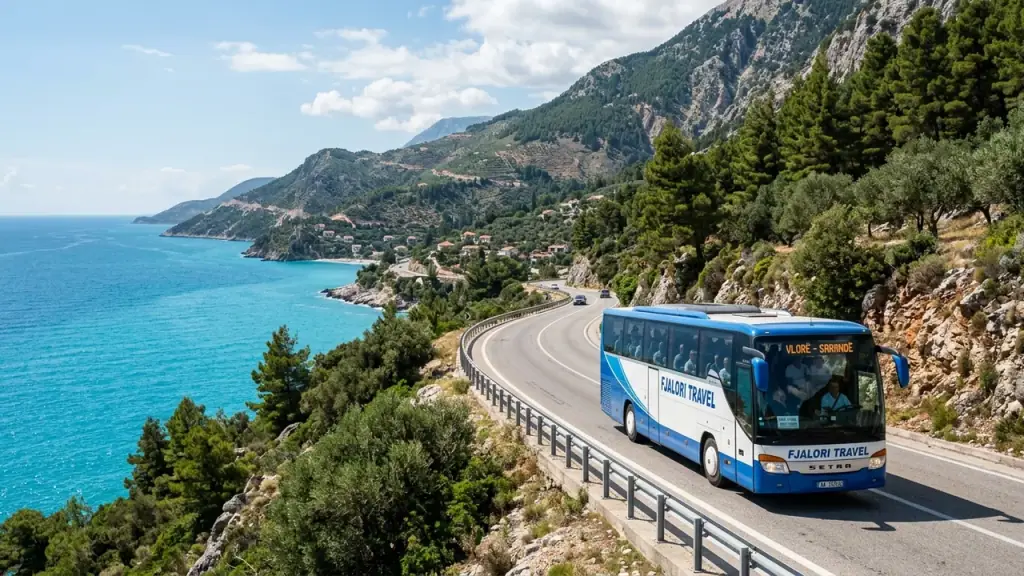
The Saranda to Ksamil bus costs 100 lek (about 1 EUR), takes 15-20 minutes, and runs every 20-30 minutes in summer. It is the cheapest way to reach Ksamil's beaches from Saranda, but peak-season demand means buses fill up fast, especially after 10 AM in July and August. Continuing up the coast afterwards? Compare every south Albania bus route, with fares, durations and frequencies side by side.
Quick facts
| Detail | Info |
|---|---|
| Fare | 100 ALL (~1 EUR / ~1.10 USD) |
| Duration | 15-20 minutes |
| Distance | 14 km |
| Summer frequency | Every 20-30 minutes (roughly 08:00-20:00) |
| Off-season frequency | Every 45-60 minutes (roughly 09:00-17:00) |
| Payment | Cash only (ALL). Have exact change ready. |
| Main boarding point | Saranda bus station, near the port |
Where to board in Saranda
The main departure point is the Saranda bus station near the port area on Rruga Mitat Hoxha. Buses and furgons to Ksamil depart from the same area where intercity buses arrive from Tirana, Gjirokaster, and Himara.
Look for minibuses with "Ksamil" displayed on the windshield or side. There is no formal ticket office. You pay the driver directly in cash when boarding.
GPS coordinates: 39.8661° N, 20.0050° E (Saranda bus station area)
Some buses also make pickups along the main coastal road heading south out of Saranda, near the roundabout. If you are staying in southern Saranda, you can flag down a passing bus here instead of walking to the station.
Summer vs off-season schedule
| Season | Approximate Frequency | First Bus | Last Return |
|---|---|---|---|
| Peak (Jul-Aug) | Every 20-30 min | ~08:00 | ~20:00 |
| Shoulder (Jun, Sep) | Every 30-40 min | ~08:30 | ~19:00 |
| Off-season (Oct-May) | Every 45-60 min | ~09:00 | ~17:00 |
There is no printed timetable. Buses leave when full or on approximate intervals. In peak summer, this means near-continuous service. In winter, you may wait 45 minutes or more.
Pro tip: Board before 10 AM in July-August. By late morning, buses fill at the station and may pass your stop already full.
Ksamil drop-off points
Most buses follow the main road through Ksamil and can drop you at several points:
| Stop | Best For |
|---|---|
| Ksamil center (main intersection) | Restaurants, Mirror Beach, town beaches |
| Ksamil Islands viewpoint | Closest walk to the island beaches |
| Southern Ksamil (near Butrint turnoff) | Butrint National Park, southern beaches |
Tell the driver where you want to get off. If you are heading to Mirror Beach (the most popular). Ask for the center stop.
Bus vs taxi vs water taxi
| Option | Cost | Time | Best When |
|---|---|---|---|
| Bus | 100 ALL (~1 EUR) | 15-20 min | Budget trips, flexible schedule |
| Taxi | 1,500-2,000 ALL (~15-20 EUR) | 12-15 min | Late returns, luggage, groups of 3-4 |
| Water taxi | 2,000-3,000 ALL (~20-30 EUR) | 20-30 min | Scenic route, reaching beach coves |
When a taxi makes more sense: If you are a group of 3-4, a 1,500 ALL taxi split 4 ways costs about 375 ALL each, only slightly more than the bus but with door-to-door convenience. Late-day returns (after 18:00) are also better by taxi since bus frequency drops and you may be tired and sunburned.
Negotiate the taxi fare before getting in. The standard rate is 1,500 ALL but drivers quote 2,000-2,500 ALL to tourists. A firm "1,500" usually works.
Which Ksamil beach should you visit?
If you are coming from Saranda for a day trip, these are the main options:
| Beach | Character | Walk from Bus Stop | Notes |
|---|---|---|---|
| Mirror Beach | Sandy, shallow, crowded | 5 min | Most famous. Sunbed 500-800 ALL. Arrive early. |
| Ksamil Islands | Sandy, turquoise | 10 min + swim/pedalo | Iconic views. Pedalo rental ~1,000 ALL. |
| Pasqyra Beach | Pebble-sand mix | 15 min south | Quieter. Better for snorkeling. |
| Butrint area beaches | Mixed | 5 min from southern stop | Combine with Butrint National Park visit. |
For a full Ksamil breakdown, see our Ksamil honest review. If you'd rather skip the pedalo paddle out to the islands and have a guide handle the logistics, browse Ksamil tours and boat trips for fixed prices and free cancellation.
Skipping the day-trip rush and basing yourself in Ksamil overnight? Compare hotels, guesthouses, and apartments right by the beaches on the map below.
Common mistakes
- No cash. Buses take ALL only. ATMs exist in Saranda but not reliably in Ksamil. Withdraw before you go.
- Wrong stop. Confirm "Ksamil" is on the windshield. Some buses go to Butrint only.
- Waiting too late. After 18:00, bus frequency drops sharply. Have a taxi backup number saved.
- No water or shade plan. The bus stop in Ksamil has no shelter. Bring water if returning midday.
- Overpacking the day. Ksamil beaches get hot by 13:00. A half-day trip (arrive 09:00, leave 14:00) is often better than a full day.
Returning to Saranda
The return bus picks up from the same main road stops. Stand visibly on the road and flag the bus down. In peak summer, buses heading back to Saranda can be full. If one passes without stopping, the next one is 20-30 minutes away.
If you want guaranteed return timing, save a taxi driver's number from the morning trip or ask your beach bar to call one.
Frequently asked questions
How much does the Saranda to Ksamil bus cost?
The Saranda to Ksamil bus costs 100 ALL (approximately 1 EUR or 1.10 USD). Pay the driver in cash when boarding. Cards are not accepted.
How often does the bus run?
In summer (July-August), buses depart every 20-30 minutes from roughly 08:00 to 20:00. In the off-season, frequency drops to every 45-60 minutes with the last bus around 17:00.
Is the bus reliable in peak season?
Yes, but buses fill up quickly after 10 AM in July-August. Board at the Saranda bus station for the best chance of getting a seat. If a bus passes your stop full, wait 20-30 minutes for the next one.
Should I take a taxi instead of the bus?
A taxi costs 1,500-2,000 ALL (15-20 EUR) and takes 12-15 minutes. For groups of 3-4 travelers, splitting a taxi is nearly as cheap as the bus with much more convenience. Taxis are also better for late returns when bus frequency drops.
Can I take the bus to Butrint National Park?
Some buses continue past Ksamil toward Butrint, but not all. Ask the driver before boarding. Alternatively, take any Ksamil bus to the southern stop and walk or taxi the remaining 2 km to Butrint's entrance.