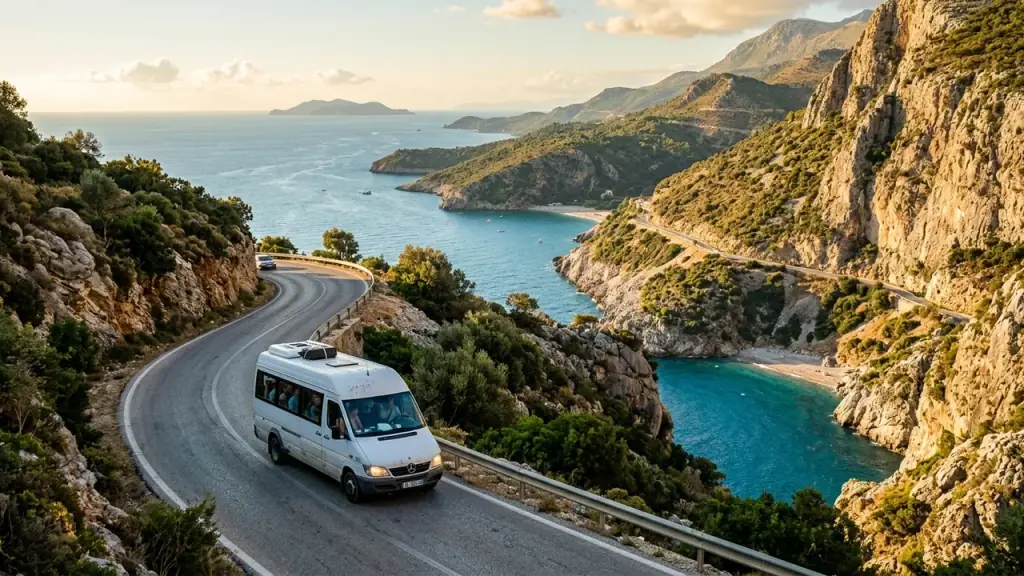
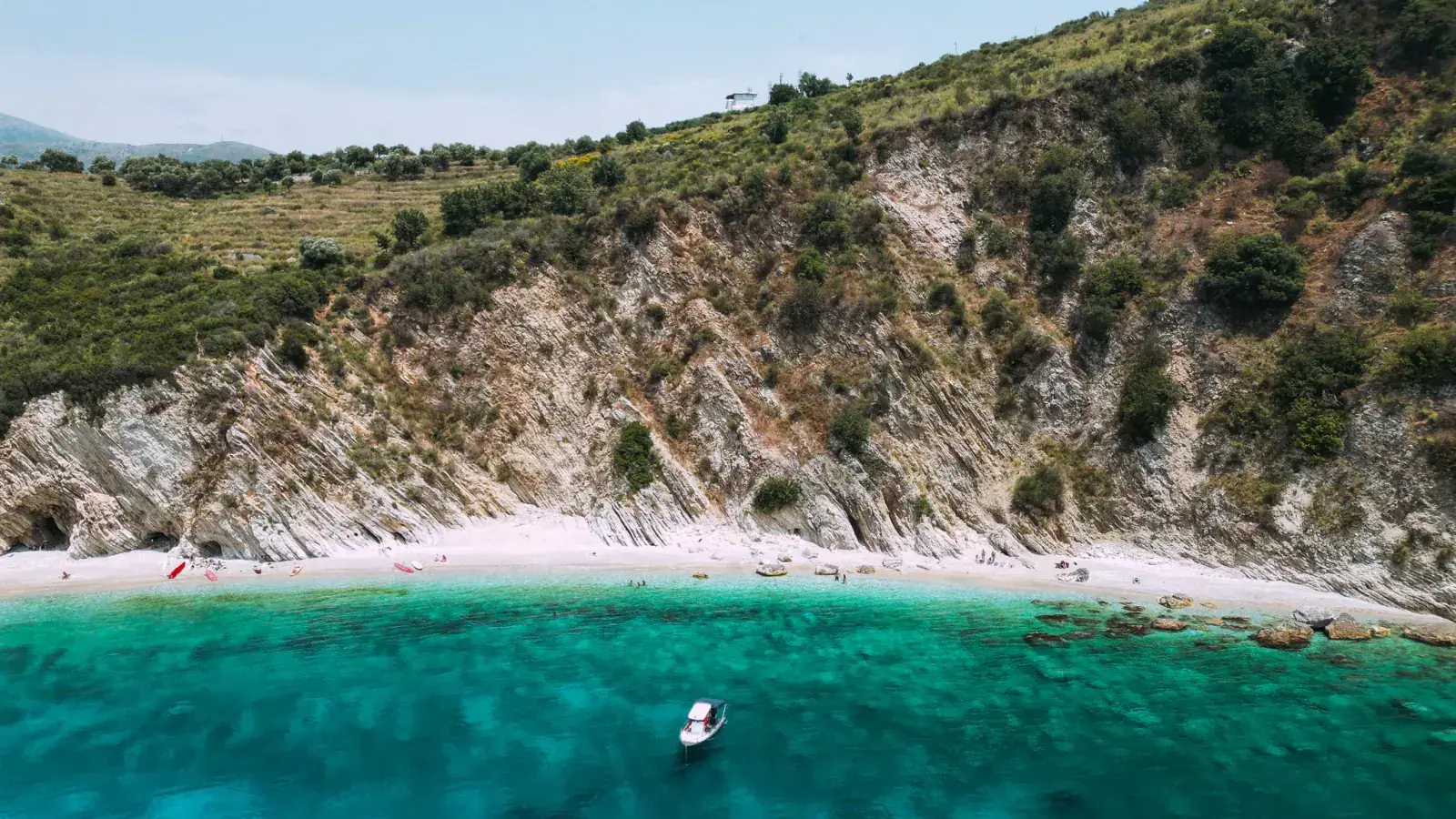
For himara to vlora transport, the fastest cheap option is usually bus, and the most predictable option is a private transfer or taxi. Current bookable route data on the Himara to Vlora corridor shows frequent daily service, low fares, and trip-time variation that can be large enough to break tight same-day plans if you do not add buffer. Compare it against every south Albania bus route with fares and durations side by side.
If you only remember one rule, use this: plan with time ranges, not one number. A trip sold as roughly 1h 39m average can still stretch toward 2h 30m in heavier conditions.
Compare hotels, apartments, and Vrbo rentals on the map. Powered by Stay22.
Quick summary
| Mode | Typical time window | Typical cost window | Reliability pattern |
|---|---|---|---|
| Intercity bus | 1h 15m to 2h 30m | 800 to 1,000 ALL (8EUR to 10EUR) | Best value, variable by traffic/stops |
| Taxi | 1h 30m to 2h 15m | 6,000 to 10,000 ALL (60EUR to 100EUR) | High control, medium price volatility |
| Private transfer | 1h 30m to 2h 15m | 7,000 to 13,000 ALL (70EUR to 130EUR) | Most predictable for deadlines |
| Self-drive | 1h 30m to 2h 30m | Fuel + parking + rental | Flexible, you manage all risk |
Route facts you can plan around
Gjirafa route statistics and product metadata for Himara -> Vlora currently indicate:
- Average trip duration around
99 minutes(1h 39m) - Minimum observed duration around
75 minutes - Maximum observed duration around
150 minutes - Typical low fare around
8EUR - About
5 daily buseson tracked schedules - Road distance around
61.7 km
These values are excellent for planning ranges. They should not be treated as fixed guarantees for your exact date.
Local naming and stop labels
| Place | Greek | Albanian | Common ticket/search label |
|---|---|---|---|
| Himara | Χειμάρρα | Himarë | Himare / Himara |
| Vlora | Αυλώνας | Vlorë | Vlore / Vlorë |
| Saranda | Άγιοι Σαράντα | Sarandë | Saranda |
| Dhermi | Δρυμάδες | Dhërmi | Dhermi |
At boarding points you may see mixed spellings (Vlore, Vlorë, Himare, Himarë). Match the destination and operator, not just one spelling.
Option 1: bus (best price-to-performance)
Current planning baseline
| Metric | Planning value |
|---|---|
| First departures on some dates | around 05:30 |
| Last departures on some dates | around 12:30 |
| Daily departures (published sample) | around 5 |
| Ticket floor | about 800 ALL (8EUR) |
| Typical fare | around 900 to 1,000 ALL (9EUR to 10EUR) |
Why bus works well
- Strong cost efficiency
- Frequent enough for same-morning moves on many dates
- Good option for solo travelers and couples without strict hard-deadline constraints
Where bus fails
- Late boarding arrival at a busy stop
- Heavy luggage with short transfer windows
- Tight onward commitments (airport, ferry, fixed meeting)
Option 2: taxi and private transfer
You pay for control and lower uncertainty.
| Use case | Recommended mode |
|---|---|
| Must arrive by fixed time | Private transfer |
| Family with stroller + bags | Private transfer |
| Flexible leisure move | Taxi or bus |
| Last-minute plan change | Taxi |
Typical range you can budget:
- Taxi:
6,000 to 10,000 ALL (60EUR to 100EUR) - Prebooked transfer:
7,000 to 13,000 ALL (70EUR to 130EUR)
Always confirm:
- Final all-in price.
- Pickup pin and drop pin.
- Payment method.
- Waiting time included or not.
Option 3: self-drive
Self-drive is excellent for side stops, but only if your group can tolerate parking and traffic uncertainty.
| Self-drive factor | What to expect |
|---|---|
| Core road distance | ~62 to 72 km depending on exact start/end and route |
| Drive baseline | ~1h 30m to ~1h 55m in clear conditions |
| Summer reality | often longer, especially near choke points |
| Risk profile | driver fatigue + parking friction + road-quality variability |
FCDO road-risk guidance for Albania remains relevant: drive defensively. Avoid aggressive responses, and use extra caution on rural/coastal roads.
Cost planner (ALL + EUR)
| Traveler type | Transport choice | Typical one-way spend |
|---|---|---|
| Backpacker | Bus | 800 to 1,500 ALL (8EUR to 15EUR) |
| Couple | Bus or taxi | 2,000 to 10,000 ALL (20EUR to 100EUR) total |
| Family of 3-4 | Taxi/private transfer | 7,000 to 13,000 ALL (70EUR to 130EUR) total |
| Remote worker with gear | Hybrid (taxi + bus fallback) | 3,000 to 7,000 ALL (30EUR to 70EUR) |
Timing strategy by travel goal
| Goal | Departure strategy |
|---|---|
| Hotel check-in in Vlora by afternoon | Take first half of day departure window |
| Same-day onward transfer north | Use private transfer or very early bus |
| Leisure day with no deadlines | Bus is usually enough |
| You are weather-sensitive or seasick | Avoid rushing; prioritize predictable window |
Buffer formula
For this corridor, use:
Published duration + 30 to 60 minutes
For high-risk days (holiday weekends, severe weather):
Published duration + 60 to 90 minutes
Transfer-day execution plan
T-24 hours
- Recheck route and operator information.
- Save offline maps and station pins.
- Keep at least
2,000 ALL (20EUR)cash reserve. - Confirm arrival window with accommodation in Vlora.
Boarding-day checklist
- Arrive early enough to solve stop ambiguity.
- Confirm bus destination with staff/driver.
- Keep luggage labels and valuables accessible.
- Monitor delays early and trigger fallback before options collapse.
Fallback trigger
If your projected arrival causes a missed hard commitment, switch immediately to taxi/private transfer. Waiting for perfect recovery usually costs more total time and money.
Seasonality: what changes
July-August
- Highest crowd pressure
- More queue and stop friction
- More variance between optimistic and real arrival time
May-June / September-October
- Often best balance of reliability and value
- Easier loading and transfers
November-March
- Lower demand, but service windows can tighten
- Weather can impact comfort and pace
Common mistakes
- Planning from minimum trip time instead of average-plus-buffer.
- Assuming one stop name means one exact pickup point.
- Not carrying small lek for quick payments.
- Stacking a ferry/flight too close to expected arrival.
- Ignoring weather and road-risk updates on movement day.
Practical mini-scenarios
Scenario A: you must be in Vlora before 12:00
- Choose earliest feasible departure.
- Add minimum
+60 minutesbuffer. - Keep taxi fallback active from the start.
Scenario B: you are traveling light and cost-sensitive
- Bus is usually optimal.
- Keep spending close to
800 to 1,500 ALL (8EUR to 15EUR).
Scenario C: family with two bags and child seat needs
- Private transfer usually beats bus complexity.
- Higher fare, lower stress, better arrival control.
Llogara corridor reality check
This route runs through one of the most scenic but operationally sensitive parts of the Riviera. Beautiful views do not change transport math: elevation changes, turning roads, and seasonal traffic can all widen arrival variance.
| Factor | Why it changes timing | Practical response |
|---|---|---|
| Coastal congestion | Slowdowns near busy beach entries and exits | Depart earlier than minimum needed |
| Multi-stop boarding | Small delays compound across a route | Add 30 to 60 minutes to headline time |
| Weather and visibility | Can reduce pace and increase caution | Avoid stacking hard commitments |
| Luggage load complexity | Slows boarding and alighting | Arrive earlier and keep bags consolidated |
Reliability-first itinerary templates
Template A: deadline day (meeting/check-in)
- Pick earliest feasible departure.
- Apply
+60 to +90 minutesbuffer. - Set taxi/transfer fallback at first sign of threshold breach.
- Notify destination contact early if ETA slips.
Template B: flexible leisure day
- Choose bus for value.
- Apply
+30 to +45 minutesbuffer. - Keep last-mile plan simple in Vlora.
- Avoid overbooking same-day activities.
Template C: family logistics day
- Prefer transfer if group fatigue is likely.
- Keep hydration/food breaks planned, not reactive.
- Protect arrival energy, not just ticket price.
What changes your total cost (not just ticket price)
| Cost driver | Typical impact |
|---|---|
| Ticket price spread | 200 ALL (2EUR) difference between low and high bus fares |
| Missed transfer cascade | 1,000 to 6,000 ALL (10EUR to 60EUR) in unplanned extras |
| Last-mile taxi at peak | 500 to 2,000 ALL (5EUR to 20EUR) |
| Comfort upgrades (water, snacks, stops) | 300 to 1,000 ALL (3EUR to 10EUR) |
The main takeaway: avoiding one disrupted arrival can save more than optimizing for the absolute cheapest seat.
Packing and documentation checklist for this corridor
Even for a short Riviera leg, a small prep list improves reliability:
| Item | Why it matters |
|---|---|
| Offline map screenshot | Prevents stop confusion if signal quality drops |
| Cash reserve in ALL | Fast payments reduce boarding friction |
| Hotel contact saved in chat | Lets you send ETA updates quickly |
| Portable charger | Keeps navigation and tickets accessible |
| Water + small snack | Stabilizes comfort during extended waits |
If you are self-driving or using a private car, add:
- Driver license and rental contract copy
- Insurance proof expected by operator
- Simple daylight-first plan when possible on unfamiliar roads
These details look minor, but they meaningfully reduce the chance that a small problem turns into a missed commitment.
Frequently asked questions
How long is Himara to Vlora by bus?
Published route data suggests an average near 1h 39m, with observed faster and slower outcomes (~1h 15m to ~2h 30m). For planning, do not use minimum duration. Use average plus a practical buffer.
How much does a Himara to Vlora bus ticket cost?
A common published floor is about 800 ALL (8EUR), with many trips around 900 to 1,000 ALL (9EUR to 10EUR). Prices and availability can vary by date and operator.
Is taxi worth it from Himara to Vlora?
Yes when arrival certainty matters. Taxi/private transfer costs more, but usually gives better control for hotel check-ins, family logistics, and tight onward schedules.
Is self-driving easy on this route?
The route is straightforward, but execution depends on traffic, road conditions, and parking decisions. If you are not comfortable with variable coastal driving conditions, bus or transfer may be better.
What is the safest planning method for this route?
Use ranges, not single-point assumptions. Recheck within 24 hours, carry cash backup, and set a clear fallback trigger if delay threatens a hard commitment.
Sources
- Gjirafa Travel
Himare -> Vloreroute page and embedded route statistics:https://travel.gjirafa.com/en/bus/himara-to-vlora - OpenStreetMap Nominatim coordinate baseline:
https://nominatim.openstreetmap.org/ - OSRM routing baseline for distance/time sanity checks:
https://router.project-osrm.org/ - UK FCDO Albania road and safety guidance:
https://www.gov.uk/foreign-travel-advice/albania/safety-and-security
Fact-check notes
- Verified: Durations, fare floor, daily buses, distance for Himara-Vlora via Gjirafa line statistics.
- Range-verified: Taxi/private transfer pricing is presented as flexible bands due date/operator variation.
- Verified: Road-risk context and defensive-driving recommendations align with FCDO Albania guidance.
- Inference: Buffer and fallback framework is operational methodology derived from observed variance in published route data.