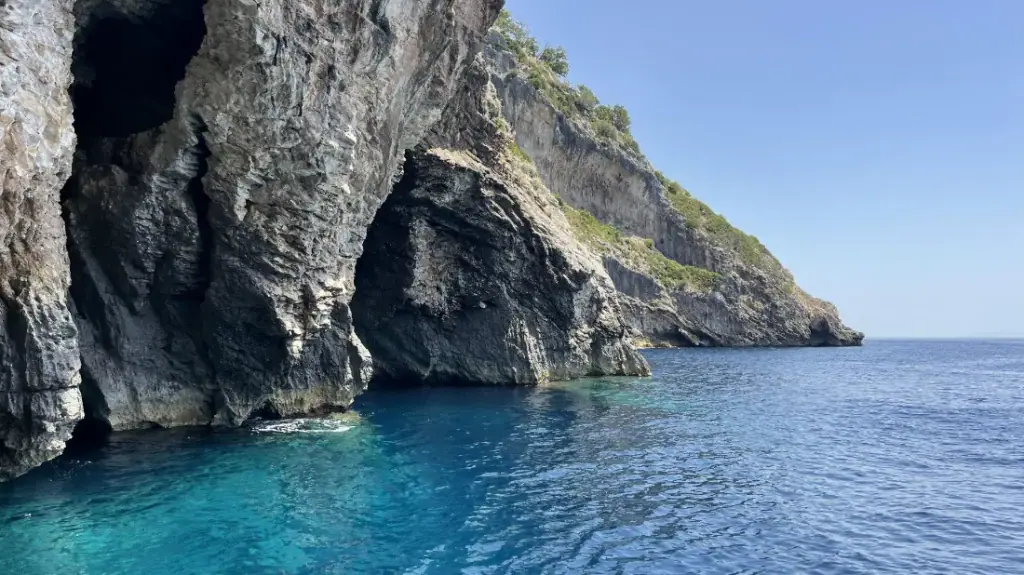
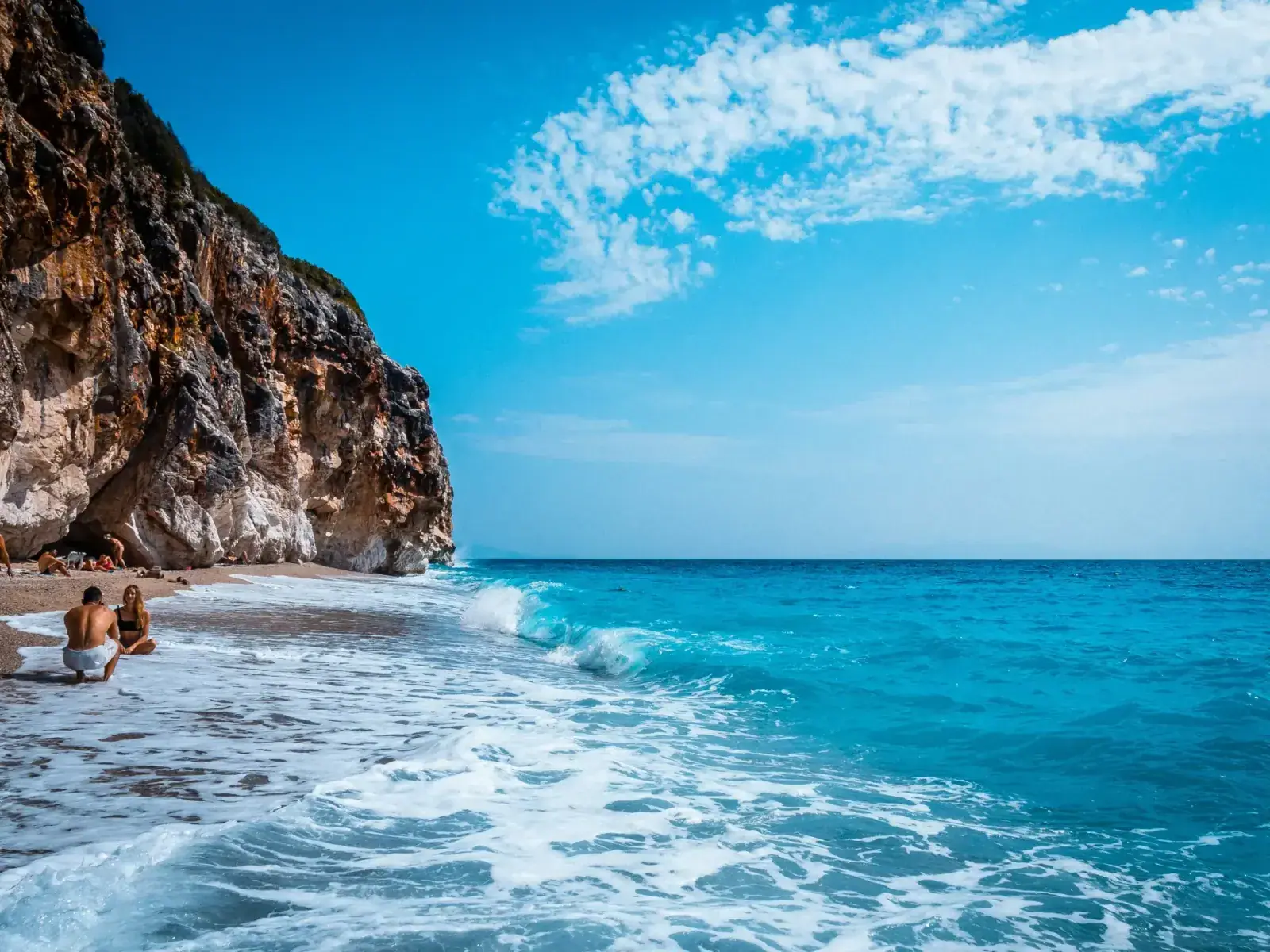
Every other headline stop on this coast has a back door. Gjipe has a footpath, Palasë has a road, Porto Palermo has a car park. Grama Bay has neither road nor practical trail. It is a narrow inlet on the western flank of the Karaburun peninsula, about 30 km north of Himara by sea, walled by cliffs that fall straight into the water. That is the whole reason it costs a day rather than a morning, and also, as it happens, the reason anything is carved there at all.
Why the Only Way In Is a Boat
The inlet is around 100 metres wide at its mouth and averages roughly 200 metres deep, because the cliffs do not stop at the waterline. They keep going. There is no shelf to build a road onto and no gradient to walk down. The overland approach has always been the hard part, which is precisely what made the bay valuable: ancient sailors used it as a refuge, and in the Second World War the British Special Operations Executive used the same combination of sheltered water and unreachable land approaches to run agents and supplies onto the Albanian coast.
From Himara the run north breaks into four legs, roughly 75 to 90 minutes one way depending on sea state:
| Leg | Time |
|---|---|
| Himara → Livadhi → Jale | 15–20 min |
| Jale → Gjipe Beach and Pirate's Cave | 15–20 min |
| Gjipe → Palasë → Saint Andrew's Bay | 25–35 min |
| Saint Andrew's → Grama Bay | ~15 min |
Grama itself is wind-sheltered by its own cliffs. The leg immediately before it is not. The stretch from Saint Andrew's to Grama runs exposed open water, and it is the section that decides whether the day happens. An operator who says the boat may have to turn back is telling you the truth about that leg, not managing expectations.
Compare hotels, apartments, and Vrbo rentals on the map. Powered by Stay22.
What Is Carved Into the Cliffs
Roughly 1,500 inscriptions cover the limestone around the bay, spanning from the 3rd century BC to the 16th century AD. That is the densest concentration of ancient sailors' carvings anywhere on the Albanian coast. The name follows from them: grámma, Ancient Greek for "letter".
The practice started as a by-product. The bay was quarried for limestone by the Greek city of Oricum, founded in the 7th century BC near present-day Orikum, and the quarry workers cut the first marks. Sailors then kept it going for another eighteen centuries.
| Period | Languages | What was written |
|---|---|---|
| 3rd c. BC – 1st c. AD | Ancient Greek, Messapian | Vessel names, crew lists, invocations to the Dioscuri, the twin gods sailors prayed to |
| 1st – 5th c. AD | Latin, Greek | Euploia prayers for good sailing; thanks for surviving storms |
| 6th – 15th c. | Byzantine Greek | Crosses, prayers to the Lord and to saints |
| 15th–16th c. | Ottoman Turkish | Late sailors' marks |
Three named carvings are documented. Pompey the Great anchored here in 48 BC while pursuing Caesar. The Byzantine emperor John V Palaiologos passed through around 1369. And an inscription was commissioned by Sulla in 86 BC to commemorate his victory over Mithridates VI of Pontus. It was carved on his behalf, since he never came in person.
None of it is signposted, and later 19th- and 20th-century graffiti from local fishermen and Hoxha-era soldiers sits alongside the ancient work without any marking to separate them. The panels were catalogued in a 2007 archaeological survey by Hajdari, Reboton, Shpuza and Cabanes; most skippers know where the main ones are, so ask rather than hunt.
The Hour You Get, and What Fits In It
Boat tours allocate about an hour at Grama, the longest stop of the day and roughly double what the cave stops get. Boats anchor off the pebble shore rather than tying up to anything. Swimming in is the normal way ashore, with a tender only on some operators.
An hour covers the swim in, a look along the foot of the cliffs, a snorkel over the eastern wall where the water is clearest, a scramble to the carvings low enough to read, and the swim back out. It is not enough to survey the bay properly. That is the honest trade, and worth knowing before you decide the day is worth €58.
There is a small seasonal café at the bay in peak summer. Bring your own water anyway; the beach is sharp pebble, so aqua shoes are not optional.
The Marine Park, and What It Means on the Day
Grama sits inside Karaburun-Sazan National Marine Park, declared in 2010 as Albania's first protected marine area. The practical effect on a tour is that responsible operators will not chase wildlife for a photograph, and that is the correct behaviour rather than a poor tour.
What lives here: the Mediterranean monk seal (Monachus monachus), whose global population the IUCN put at around 815–997 individuals in 2023, when it was reclassified from Endangered to Vulnerable after recovery efforts; loggerhead turtles; bottlenose dolphins on the open-water leg; and Posidonia seagrass meadows across the bay floor. A seal sighting is genuinely unlikely, but the bay is one of the documented Albanian habitats, and early-morning or shoulder-season runs are when it happens.
Who Runs the Trip
The Grama Bay full day is a €58-per-person itinerary of 17 stops. It is the longest and most expensive of the standard Himara routes, and the only one built around a single destination rather than a stretch of coast.
- Himara Blue Experience. A set Grama Bay run of 5 to 5.5 hours, daily April to October, on boats for up to eleven. It books direct, and we found no independent review score for it in June 2026.
- Aqua & Terra Drymades. Departs Dhermi rather than Himara, taking in the Blue Cave on the way, and sells through GetYourGuide.
- Himara Golden Boat Tours. 4.9 across 30-plus TripAdvisor reviews, verified June 2026, running full-day routes including Grama and Porto Palermo.
- Boat Tours VIP. Full-day Grama trips and private charters for up to 22, booked over WhatsApp, with no independent score we could verify in June 2026.
If you are staying in Dhermi or Drymades, the Aqua & Terra departure shortens the exposed open-water section, which matters on a marginal morning. It is bookable at a fixed price with free cancellation: Dhermi to Grama Bay and the Blue Cave.
For everything that is not Grama, see the Himara beach hopping boat tour guide. That one covers the €20 and €30 half-days, the full operator field and where the boats board. This page answers whether Grama is worth your only boat day; that one answers which boat to get on if it isn't.
Frequently Asked Questions
Can you drive or hike to Grama Bay?
No. There is no road to the bay and no trail practical for a day visit. The cliffs drop vertically into water that averages 200 metres deep. Every visitor arrives by boat, which is why the trip from Himara takes a full day rather than an afternoon.
How much is a Grama Bay tour from Himara?
The full-day Grama Bay itinerary is €58 per person and covers 17 stops. It is the most expensive of the four standard routes out of Himara, and the only one built around a single destination rather than a run of coastline.
How long does the boat take to reach Grama Bay?
Roughly 75 to 90 minutes one way from Himara, over about 30 km of sea, broken into four legs via Jale, Gjipe, Palasë and Saint Andrew's Bay. Sea state moves that figure; the exposed stretch is the final leg from Saint Andrew's.
What are the Grama Bay inscriptions?
About 1,500 carvings cut into the limestone cliffs between the 3rd century BC and the 16th century AD, left by quarry workers and then by sailors, in Greek, Messapian, Latin, Byzantine Greek and Ottoman Turkish. They give the bay its name, from grámma, "letter".
Will the tour be cancelled if the sea is rough?
It can be, and the decision usually turns on the open-water leg from Saint Andrew's Bay to Grama. The bay itself is sheltered by its cliffs, but the approach is not. Operators who warn that they may have to turn back are describing a real constraint.