Why Grama Bay Is the One Stop That Justifies the Long Tour
Grama Bay is the deepest stop on a Himara boat tour, both literally (the bay averages 200 metres deep) and historically. Roughly 1,500 inscriptions carved into the limestone cliffs span from the 3rd century BC to the 16th century AD, making this the densest concentration of ancient sailor graffiti on the Albanian coast. The bay sits inside the Karaburun-Sazan National Marine Park, Albania's first protected marine area, and it's a documented habitat of the Mediterranean monk seal (Monachus monachus), one of the world's rarest seal species, with an estimated global population of around 815–997 individuals (IUCN, 2023).
It's also boat-only. There is no road. The hiking trail in is impractical for a day visit. If you don't take a tour from Himara (or Vlorë), you don't see Grama Bay.
The Inscriptions: What's Actually Carved Into the Cliffs
The bay was originally a limestone quarry for the ancient Greek city of Oricum, founded in the 7th century BC near present-day Orikum. Quarry workers chiselled the first inscriptions. Sailors took over the practice for the next 1,800 years.
| Period | Languages | What sailors wrote |
|---|---|---|
| 3rd c. BC – 1st c. AD | Ancient Greek, Messapian | Vessel names, crew lists, invocations to the Dioscuri (Castor and Pollux, the patron twin-gods of seafarers) |
| 1st c. AD – 5th c. AD | Latin, Greek | Euploia prayers ("good sailing"); thanks for surviving storms |
| 6th c. – 15th c. | Byzantine Greek | Christian crosses, prayers to the Lord and saints |
| 15th–16th c. | Ottoman Turkish | Late-period sailor marks |
Verified named carvings include:
- Pompey the Great, who anchored here in 48 BC during his pursuit of Caesar
- John V Palaiologos, Byzantine emperor, who passed through around 1369
- A commemorative inscription commissioned by Sulla in 86 BC after his victory over Mithridates VI of Pontus (Sulla never visited in person; the inscription was carved on his behalf)
Later 19th- and 20th-century graffiti from Himariot fishermen and Hoxha-era soldiers exists too, but is regarded as archaeologically uninteresting.
Heads up: the cliffs are not signposted. If you want the famous carvings rather than the random graffiti, consult the 2007 archaeological survey by Hajdari, Reboton, Shpuza, and Cabanes, or ask your skipper to point them out (most know the main panels).
What the Stop Is Like
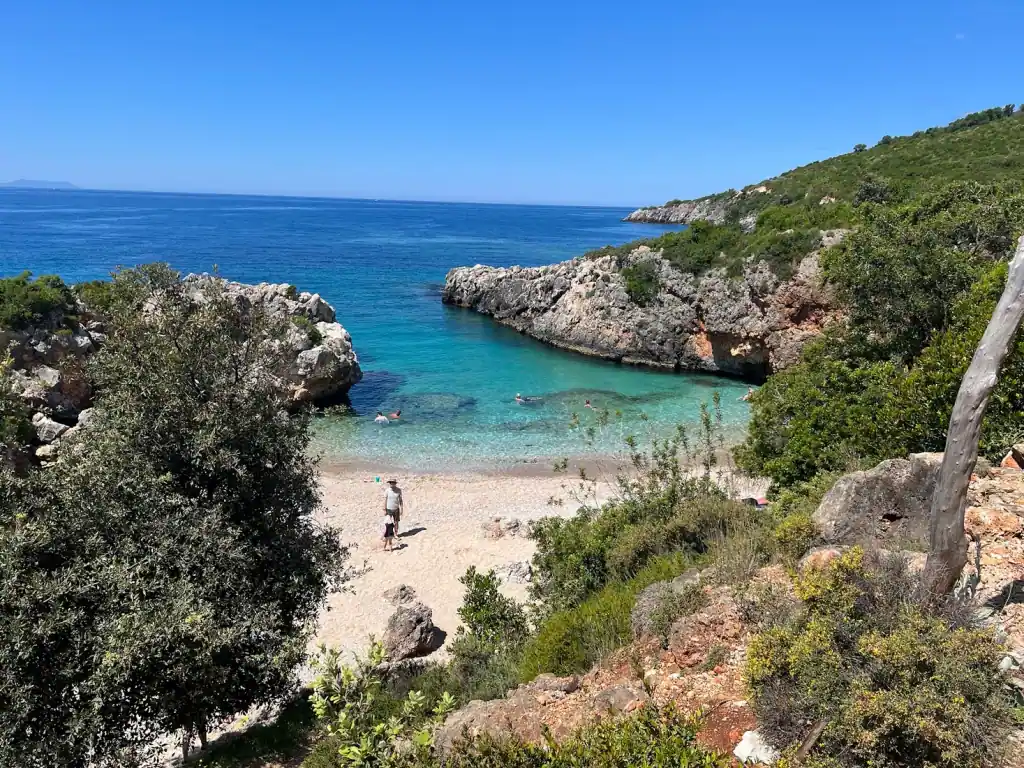
Standard boat-tour swim allocation at Grama Bay is around 1 hour, the longest stop on a Himara → Karaburun day. The boat anchors a short distance from the pebble beach. Most operators let you swim ashore; a few use a tender.
What you get with that time:
- Swim to shore (~5 min)
- Walk the lower beach and inspect the cliff base
- Snorkel along the eastern wall (clearest water, monk-seal habitat)
- Quick climb up to the most legible inscriptions
- Swim back
There is a small seasonal café at Grama Bay run during peak summer; expect overpriced cold drinks and limited snacks. Bring your own water.
Geography
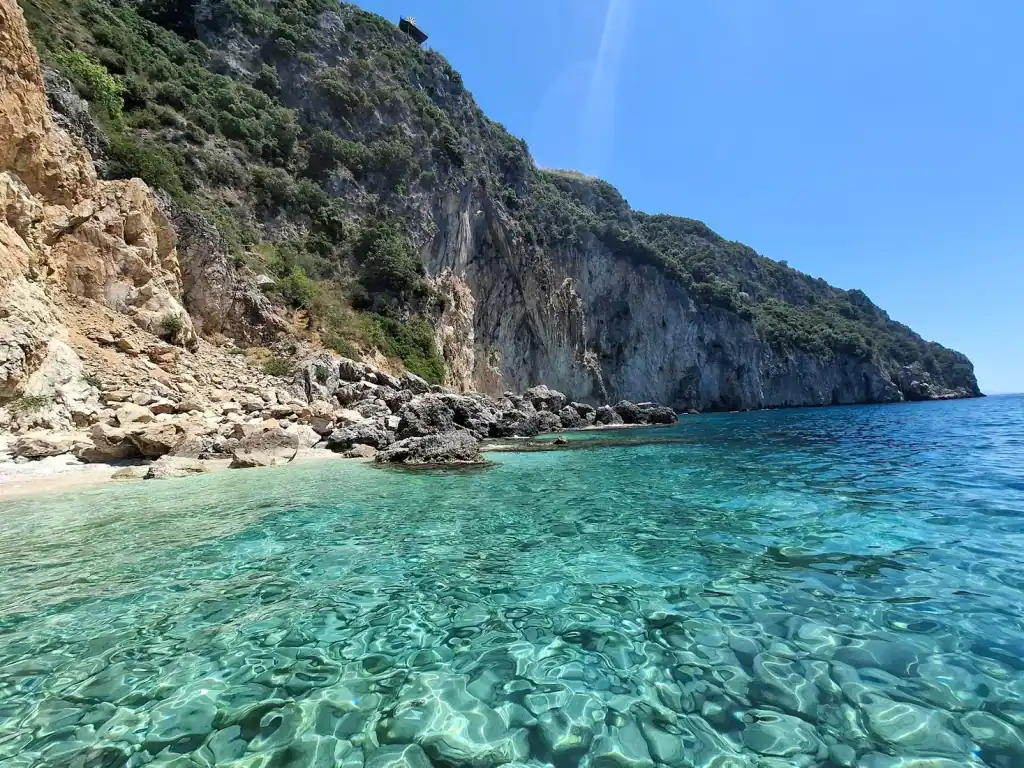
Grama Bay opens westward off the Karaburun Peninsula at coordinates 40°12′56″N, 19°28′24″E. It is approximately 100 metres wide at its mouth and roughly 200 metres deep on average, an unusually deep, narrow inlet caused by sheer cliffs descending vertically into the sea. Karaburun's western flank is part of the Ceraunian Mountain range, the same massif that towers above Himara.
By boat from Himara's mini-dock, the route is roughly:
- Himara → Livadhi → Jale (15–20 min)
- Jale → Gjipe Beach + Pirate's Cave (15–20 min)
- Gjipe → Palasë → Saint Andrew's Bay (25–35 min)
- Saint Andrew's → Grama Bay (~15 min)
Total one-way: ~75–90 minutes depending on sea state and operator pace.
WWII and More Recent History
During WWII, Grama Bay was used as a clandestine base by the British Special Operations Executive (SOE), which inserted agents and supplies along the Albanian coast. The bay's combination of sheltered water and inaccessible overland approaches made it ideal for covert operations, the same qualities that made it valuable to ancient mariners.
Marine Park and Wildlife
Grama Bay sits inside Karaburun-Sazan National Marine Park, declared in 2010 as Albania's first protected marine area. The park covers Karaburun Peninsula's western coast and the small island of Sazan, encompassing some of the Mediterranean's last well-preserved underwater habitats.
Notable species:
- Mediterranean monk seal (Monachus monachus), global population ~815–997 (IUCN, 2023)
- Loggerhead sea turtle (Caretta caretta)
- Bottlenose dolphin, occasionally encountered on the open-water leg between Saint Andrew's and Grama
- Posidonia seagrass meadows along the bay floor
Most boat-tour operators are sensitive to the protected status: don't expect the boat to chase wildlife.
Sea Conditions
Grama Bay itself is wind-sheltered by its sheer cliffs, but the open-water stretch from Saint Andrew's Bay to Grama is exposed. A northwesterly Tramontana can build through the day; afternoon returns are routinely choppier than morning outbound legs. Operators who tell you "we'll go if conditions are good but we may need to turn back" are being responsible, believe them.
Compare With Other Karaburun Stops
| Stop | What it's known for | Swim time |
|---|---|---|
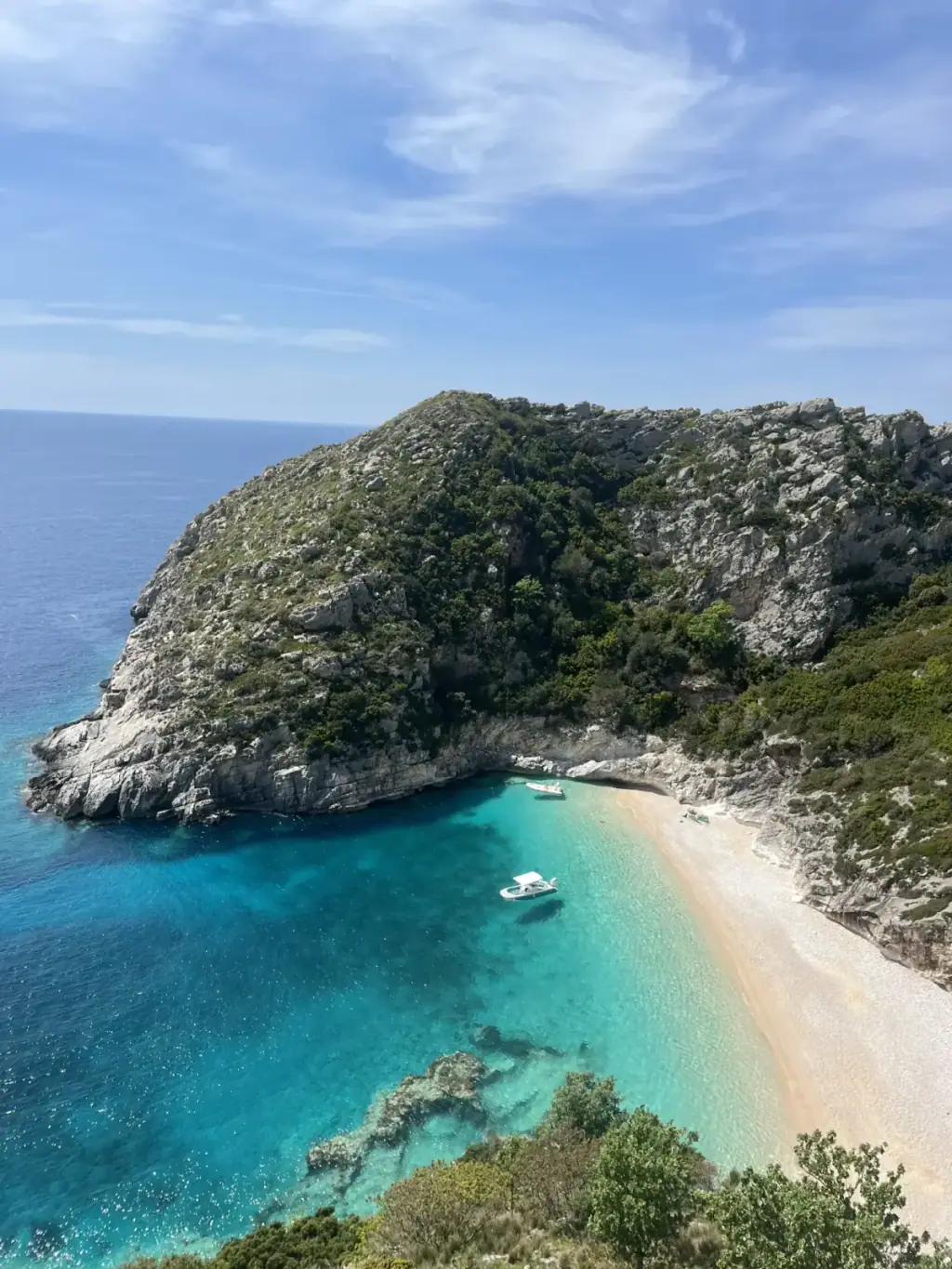
| Saint Andrew's Bay | Sealed-in white-pebble cove | 30 min |
| Grama Bay | 1,500 ancient inscriptions, monk seals | ~1 hr |
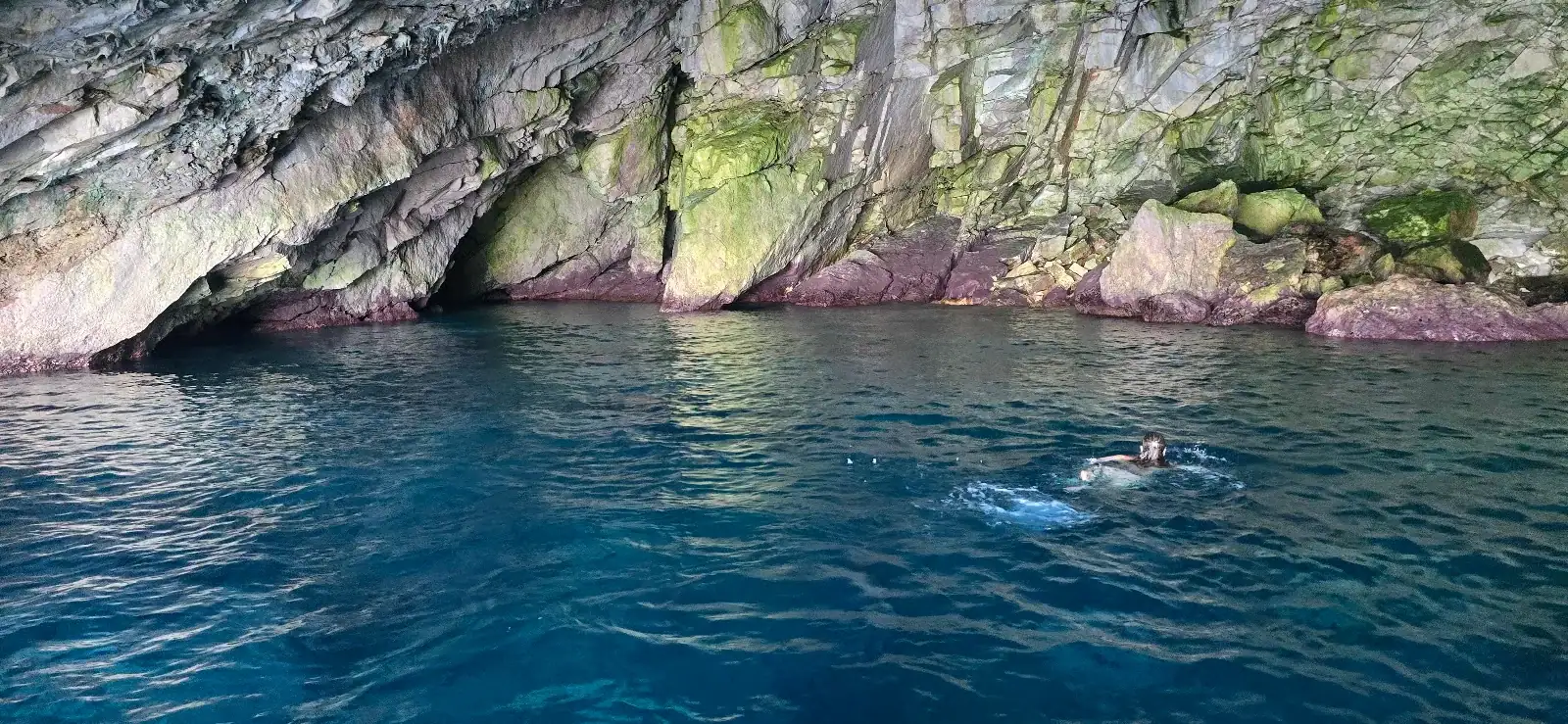
| Blue Cave (if conditions allow) | Naturally curved arch with blue-light reflection | 30 min |
If sea conditions limit you to one stop, the operator will almost always pick Grama, it's the destination the entire long-haul tour is built around.
Want to book a Grama Bay tour? Most travelers book one of two GetYourGuide options: Aqua & Terra Drymades' Dhermi → Grama Bay & Blue Cave full-day (departs Dhermi) or browse all Himara boat tours for Himara-departing alternatives. Both offer fixed-price booking and free cancellation.
Related Reading
- Tour planning, pricing, and routing: Grama Bay Boat Tour from Himara
- Cost benchmarks: Albanian Riviera Boat Tour Prices Guide