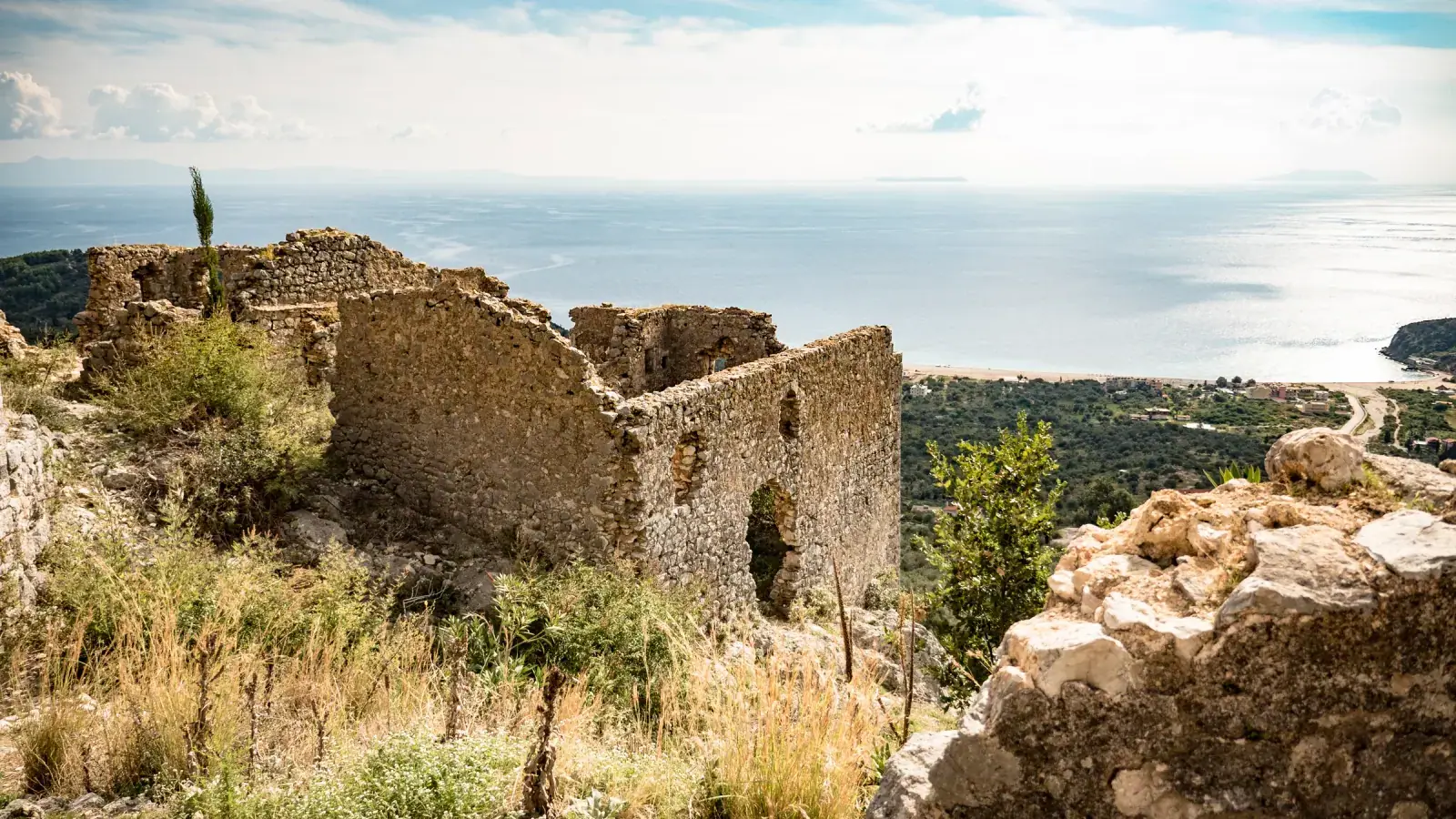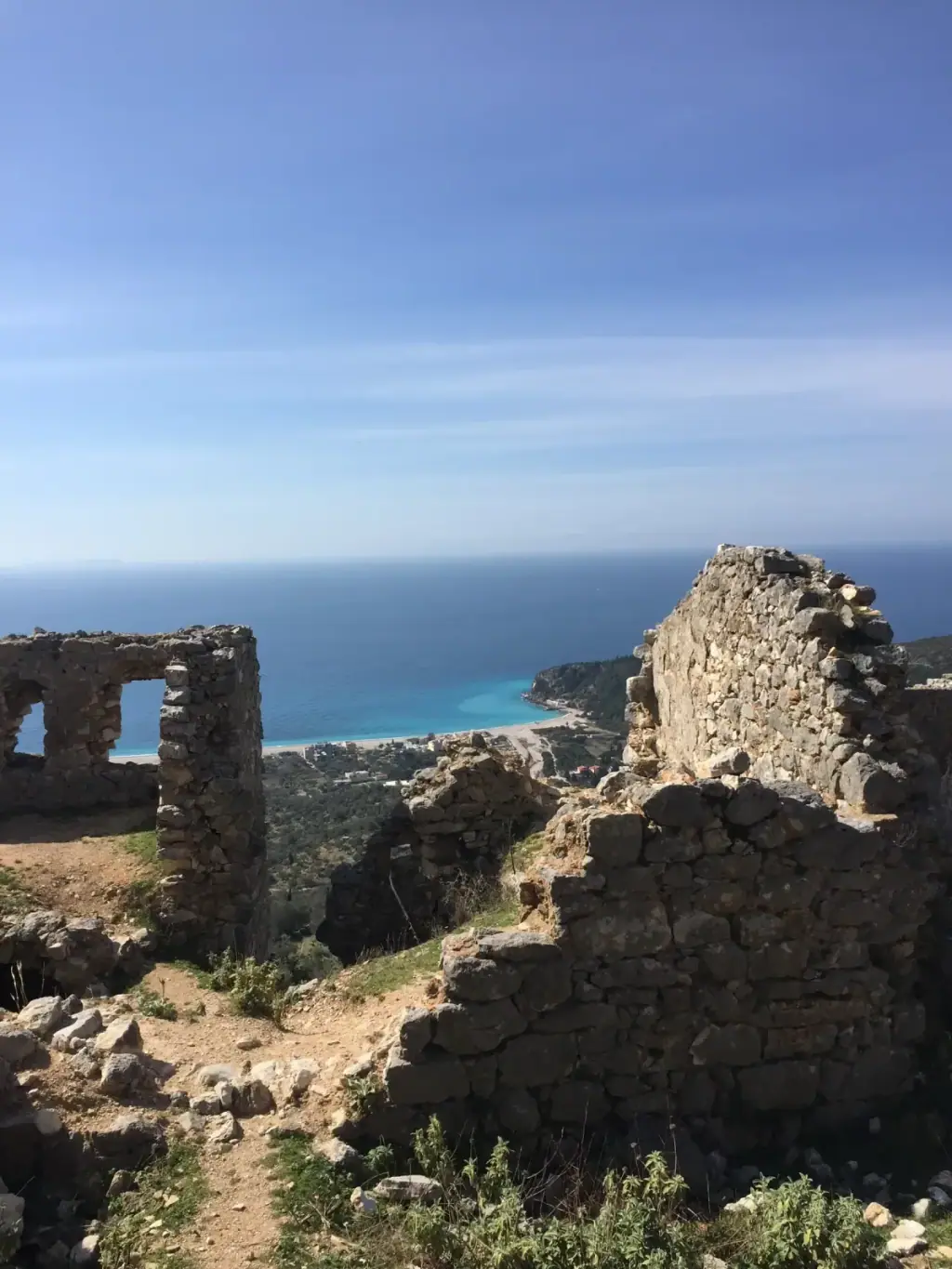
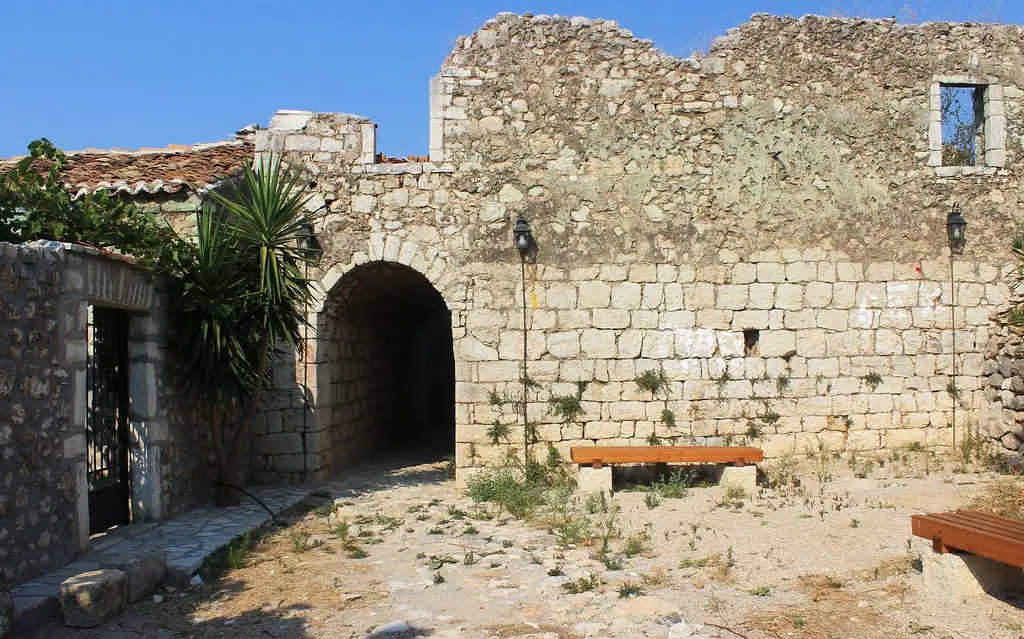
Most Albanian castles are ruins you visit. Himara Castle is a village you walk into. Fortifications have stood on Barbaka hill since the 5th century BC and the site has been inhabited without a break ever since, which makes the enclosure, locally called Kastro, one of the very few castle villages left on the Albanian Riviera where anyone still lives inside the walls. What that means for a visit is less obvious than it sounds, and it changes what you should be looking at.
What Is Actually Still Standing
| Element | What survives |
|---|---|
| Curtain walls | Sections of the encircling wall, plus the main entrance arch |
| Byzantine churches | Three, with partial fresco remains |
| Housing | Stone houses on the hillside; a handful occupied year-round, several restored as guesthouses |
| Terrace | The panoramic terrace occupied by Cafe Butterfly |
| Sightline | Corfu on the western horizon, roughly 70 km out, on clear mornings |
The layering is the point. The earliest walls here are Chaonian, built in the 5th century BC by the Greek tribe that controlled this coast. The Byzantines fortified the site again and built the churches whose ruins you can still walk through. Ottoman rule never fully absorbed Kastro. The Himariot population held de facto autonomy for centuries, paying lip service to Istanbul while practising Orthodox Christianity. Hundreds of families still lived here in the early 20th century; the communist era emptied it.
The Climb
From the Himara promenade it is a 15–20 minute walk uphill on a narrow paved road. That is the honest version of the ascent: not a trail, not steps, a road that climbs.
If you would rather not walk it, you can drive or ride a scooter most of the way and park in the designated lot near the entrance. Parking is free but limited to a handful of spaces, and the road up is narrow and winding without being difficult. What you cannot do is drive into the old town itself; the last stretch is on foot regardless of how you arrive.
The castle pin sits at 40.11771° N, 19.73166° E. From there Livadhi Beach lies about 1.3 km away in a straight line, directly below and visible. That is why the beach-then-castle combination works as a half day.
The Gate: What You Pay
This is the one thing our own records disagree on, so here are both readings rather than one clean answer. Our activities record lists entry at 300 ALL (~€3), a figure added after a fee was introduced. Our landmark record still describes the old town as free to wander, with some operators collecting a small token fee at the gate in peak season. There are no fixed gate hours in either record. The site is open through daylight and closes by darkness, not by a clock.
Practically: carry a few hundred lek in cash. Nothing in our sources suggests the fee, where it is collected, exceeds 300 ALL, and nothing suggests card payment at the gate.
The churches and the terrace viewpoint are not separately ticketed. Whatever you pay at the gate, if anything, covers the lot.
The Two Hours Worth Planning Around
Before 10 AM is the strongest window, for two reasons that compound: the stone has not yet absorbed the day's heat, and the haze that builds over the Ionian through the afternoon has not yet closed off the view west. Corfu is a morning sight or no sight at all.
Between 5 and 7 PM is the other one: golden light on the stone, and the timing to end the visit with sunset and a drink at the Cafe Butterfly terrace, which sits about 55 metres from the castle pin at 40.1172° N, 19.7317° E.
Budget one to two hours on site. That is enough to walk the main paths, look at the church ruins, take the panorama and sit down for a coffee, without the visit turning into a march.
Want a guided walk? Browse Himara walking tours and old-town experiences on GetYourGuide for fixed prices, free cancellation, and verified reviews.
Frequently Asked Questions
Is there an entrance fee for Himara Castle?
Our sources split. The activities record lists 300 ALL (~€3); the landmark record describes the old town as free to wander with a small token fee sometimes collected at the gate in peak season. Bring a few hundred lek in cash and assume no card reader.
How long is the walk up to Himara Castle?
Fifteen to twenty minutes uphill from the promenade, on a narrow paved road rather than a footpath. You can drive or ride most of the way and park free at a small lot near the entrance, but the final stretch into the old town is on foot either way.
What can you actually see inside the castle?
Three Byzantine churches with partial fresco remains, the main entrance arch and surviving sections of curtain wall, stone houses on the hillside, a few of them still lived in year-round, and a panoramic terrace looking down over the coast toward Livadhi Beach.
Can you see Corfu from Himara Castle?
On a clear morning, yes. The island sits roughly 70 km west on the horizon. Afternoon haze usually closes the view, so a visit before 10 AM is the one that gives you a realistic chance of it.
Is the castle the same thing as the old town?
They are one site. The fortified enclosure is the old town, Kastro, and the walls, churches and houses are all inside it. For a stop-by-stop route through its lanes rather than the history of the fortification, see the self-guided old town walking tour. For the long-form history, the full Himara old town and castle guide goes deepest.