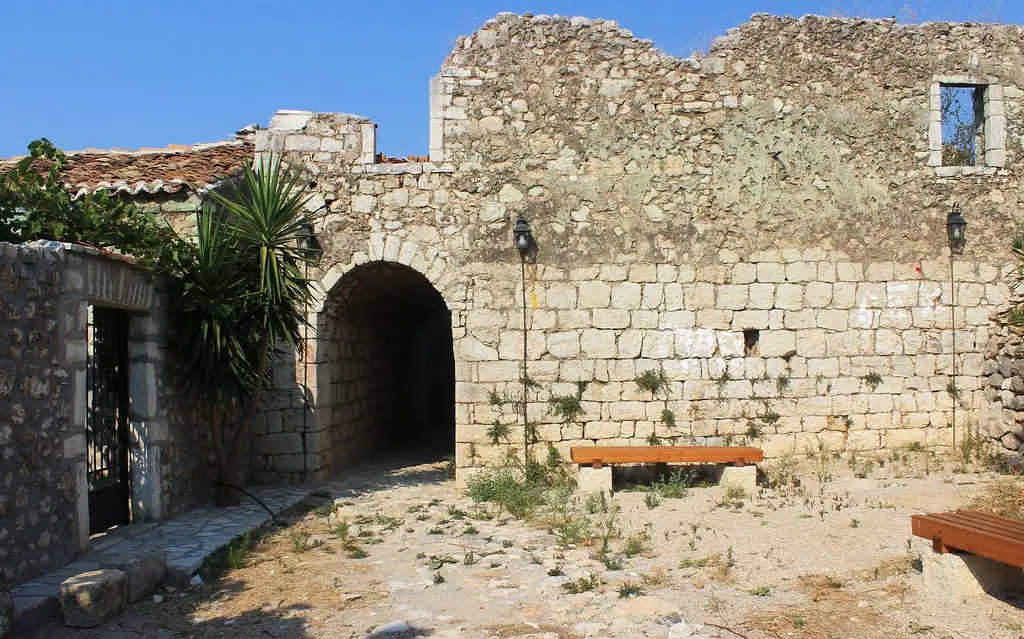
Kastro has no signposted circuit and no ticketed route, which is why most people arrive at the gate, take a photograph of the arch, and leave twenty minutes later having missed the half of the enclosure that lies east of it. The old town is small enough to walk end to end, but only if you know it has an end. The lanes do not loop, and the two things most worth reaching sit in opposite corners.
The Route in Order
| # | Stop | What is there | Time |
|---|---|---|---|
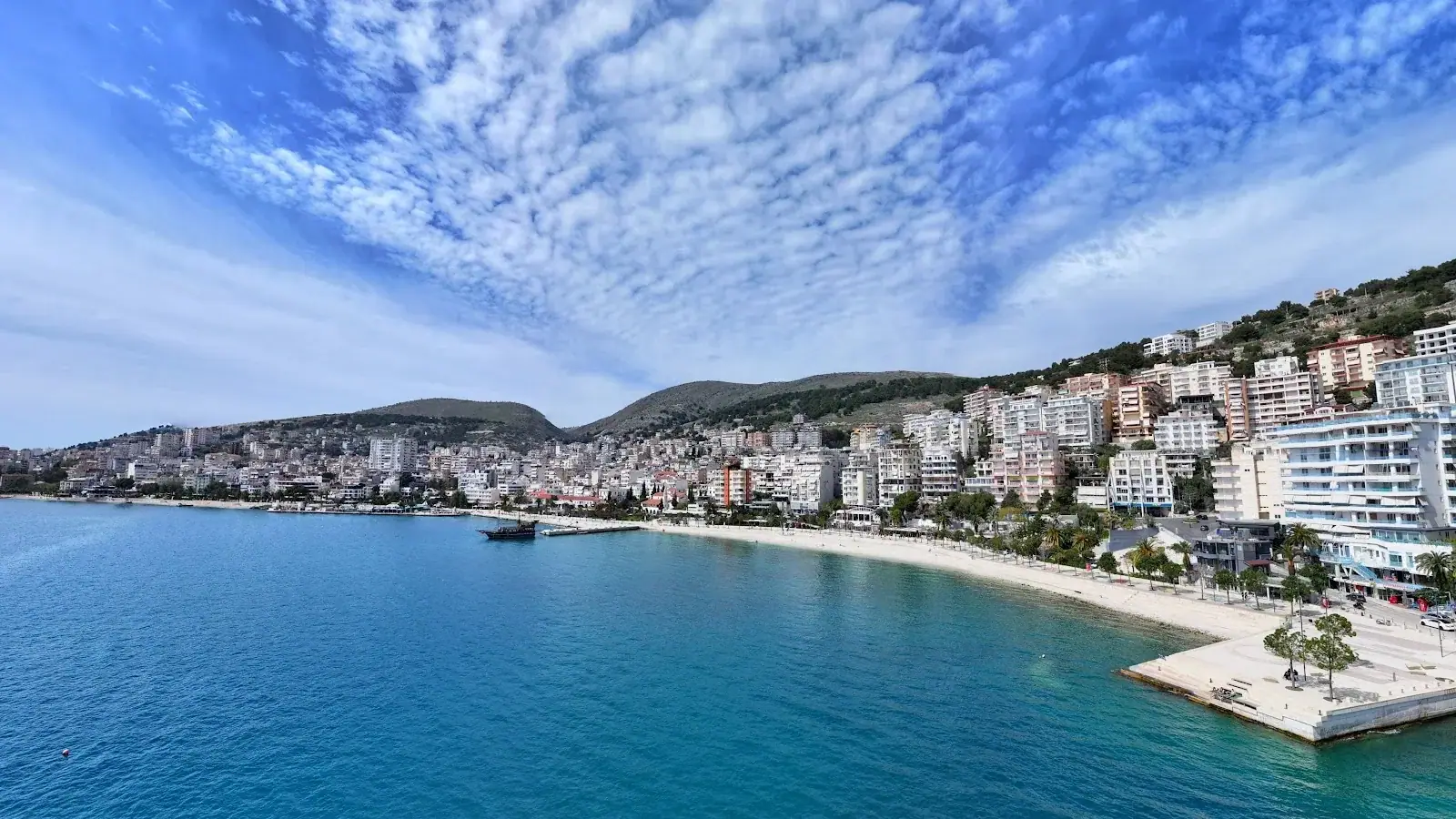
| 1 | Spile Beach promenade | Sea-level start, ~500 m of pebble with the restaurants and cafés behind it | Start |
| 2 | The climb | Narrow paved road inland and up; 15–20 min uphill on foot | 20 min |
| 3 | The main gate | The entrance arch and the surviving curtain wall either side of it | 10 min |
| 4 | The church ruins | Three Byzantine churches, partial frescoes, no fixed opening hours | 20 min |
| 5 | Cafe Butterfly terrace | Reed pergola, geraniums along the stone parapet, the coast a long way below | 30 min |
| 6 | The eastern lanes | Stone houses, restored guesthouses, the lived-in end of Kastro | 15 min |
| 7 | The descent | Back down the same road, or on toward Livadhi | 20 min |
That is roughly two hours moving at a walking pace with one coffee in it. Cut stop 6 and it becomes ninety minutes.
Where the Walk Starts
Start on the Spile Beach promenade rather than at a car park. The reason is orientation: from sea level you can see the hill you are about to climb, and when you get to the parapet at the top you can pick out exactly where you started. The approach is inland from the waterfront and then up. The road narrows as it climbs and the modern town thins out behind you.
Driving up instead is possible, and the parking situation is covered in the Himara Castle visitor guide, which is also the page for what the gate charges and what the fortifications actually are. This page is the route; that page is the site.
Inside the Walls: Order of Stops
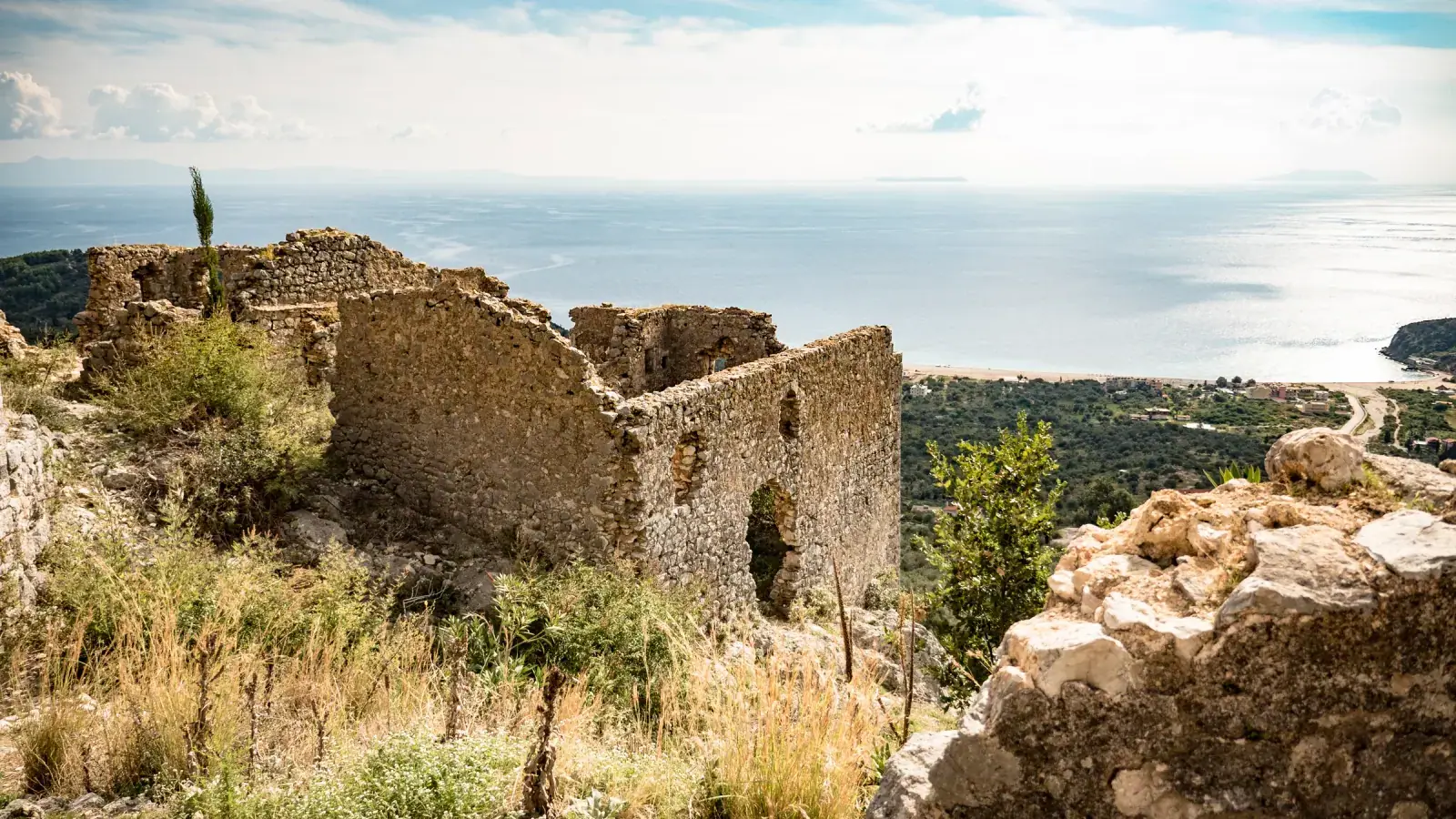
Through the arch, keep left and west first. The church ruins come before the terrace, and they reward a slow pass rather than a glance. What survives is partial fresco on stone, not decorated interiors, so you are looking for figures in remaining pigment rather than a painted ceiling. They are open, unticketed and occasionally still used for services, so keep it quiet if a door is ajar.
Then the terrace. Cafe Butterfly sits at 40.1172° N, 19.7317° E, inside the castle quarter, with tables under a reed pergola behind a parapet of potted geraniums. It is priced as a budget café despite having the best seat in the town, and it is the only place inside the walls to buy anything, so this is the water stop as well as the view stop. Phone +355 69 306 1212 if you need to check it is open out of season.
From there, walk east. About 130 metres away, southeast of the café, at 40.1166° N, 19.7331° E, is Amphora Guesthouse, a stone-built house of eight rooms run by the Kokas family, and the clearest illustration on the whole walk of what Kastro is now: a village where a handful of houses are occupied year-round and several more have been restored to take guests, set among others that have not been. This eastern end is the part visitors skip, and it is the part where the enclosure still reads as somewhere people live rather than a monument.
Where to Finish
Two endings, and they suit different days.
Back down the way you came puts you on the promenade for dinner, which is the simplest option and the one to take if you walked up.
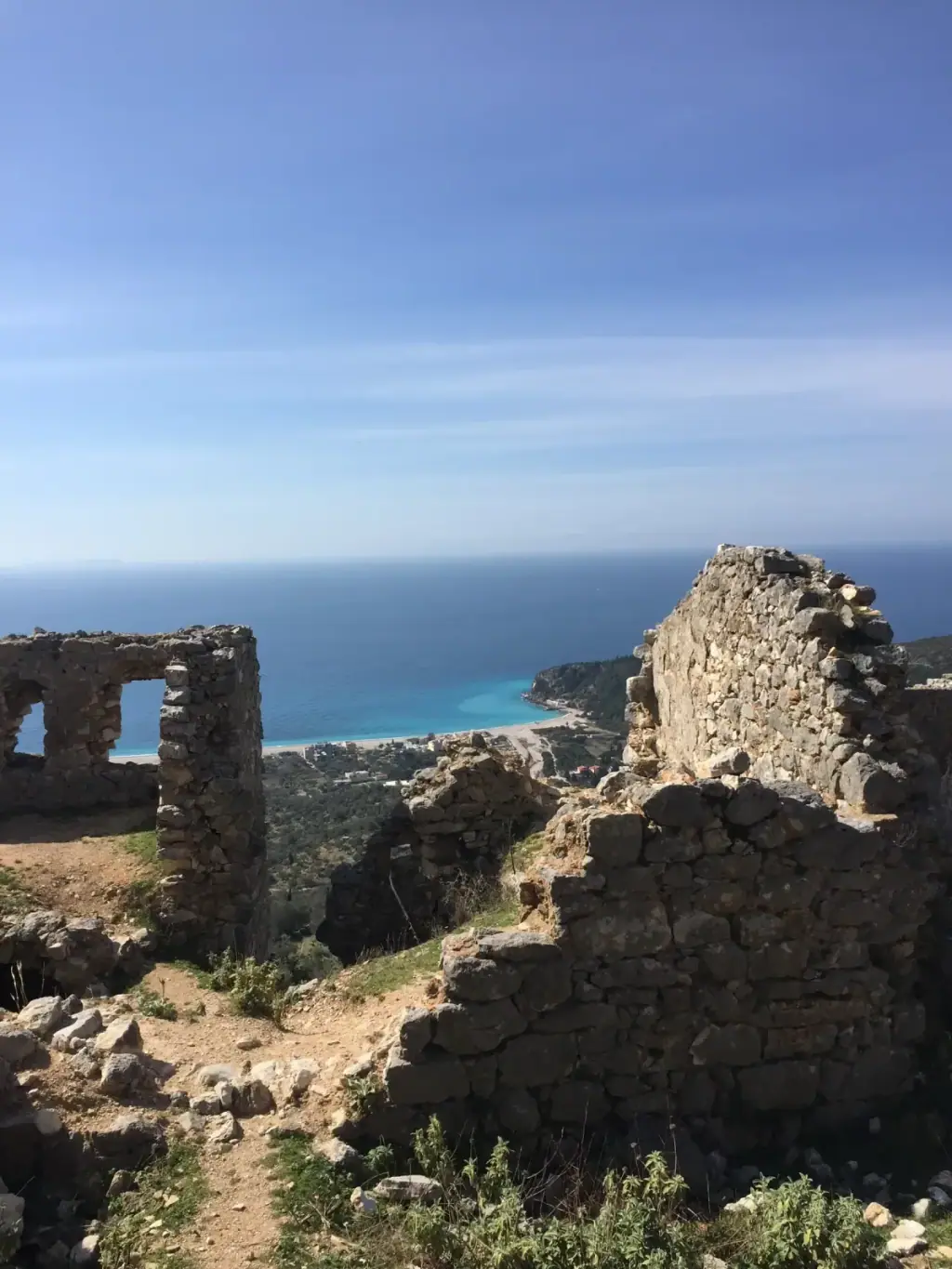
Onward to Livadhi uses the path that drops from the old town toward Livadhi Beach, which is visible directly below from the western parapet. It is 1.5 km of pebble between two headlands, with the quieter, pine-shaded end furthest from the road. Finishing here turns the walk into a half day rather than a morning, and Livadhi faces west, so it is also the better ending if you have timed the walk late.
Two Dates That Change the Walk
The route is the same all year, but twice a year the old town is not a quiet set of lanes.
The Himara International Music Festival runs 20–26 August 2026, with classical, folk and jazz performances staged at Himara Castle and All Saints' Church. During that week the enclosure is a venue, and the terrace and lanes will be busier after dark than at any other point in the summer.
Orthodox Easter falls on 12 April 2026, when services run through Himara's Byzantine churches, followed by family gatherings and the exchange of red eggs. If you walk the route that weekend, the church stops are the point of the walk rather than a ruin on it, and they warrant more deference than usual.
Frequently Asked Questions
How long does the Himara old town walking route take?
About two hours end to end at a walking pace, including the 15–20 minute climb from the promenade, a slow pass through the church ruins and a coffee stop on the terrace. Skipping the eastern lanes brings it down to roughly ninety minutes.
Where does the walk start and end?
It starts on the Spile Beach promenade in central Himara and climbs inland. It ends either back on the promenade by the same road, or by taking the path that drops from the old town down toward Livadhi Beach, which is visible below the western parapet.
Is there anywhere to buy food or water in the old town?
Cafe Butterfly on the panoramic terrace is the only place inside the walls, and it is priced as a budget café. Bring water with you rather than relying on it, particularly out of high season when opening is not guaranteed.
Can I do this route with a stroller or limited mobility?
No. The approach is a sustained climb on a narrow paved road and the lanes inside are uneven stone with no vehicle access. There is no step-free circuit through the enclosure, and the descent toward Livadhi is a path rather than a road.