If you searched valle Himara or valle Himara Piana degli Albanesi, you are almost certainly tracing one of the most interesting threads in Himara's history: the link between this stretch of the Albanian coast and the Arbëresh (Italo-Albanian) communities of southern Italy and Sicily.
This guide explains that link honestly. Some of it is well documented; some of it is folklore and local memory. We will be clear about which is which, because this is sensitive cultural and historical material and it deserves accuracy rather than romance.
Quick Snapshot
| Question | Short Answer |
|---|---|
| Who are the Arbëresh? | Descendants of medieval Albanian refugees who settled in southern Italy and Sicily |
| When did they arrive? | Mostly 15th–18th centuries, after the Ottoman conquest of the Balkans |
| Is Himara connected? | Yes. Himariot families feature in the founding tradition of Piana degli Albanesi, and Himara's ties to Italy are documented separately |
| What is Piana degli Albanesi? | The most important Arbëresh town in Sicily, near Palermo |
| What survives in Himara today? | Iso-polyphony, a bilingual community, and a layered old town |
The Arbëresh Diaspora, Explained
The Arbëresh (in their own language, Arbërisht-speakers; in Italian, Arbëreshë) are an Albanian ethnolinguistic minority who have lived in southern Italy for roughly five centuries. They are concentrated today in Calabria and Sicily, with communities also in Apulia, Basilicata, Molise, Campania, and Abruzzo.
Their ancestors left the Balkans in stages between the 14th and 18th centuries. The largest waves followed the death of Skanderbeg (Gjergj Kastrioti) in 1468 and the gradual Ottoman conquest of Albania and Epirus. Christian Albanian families fleeing the advance crossed the Adriatic, often on Venetian ships, and were resettled in the Kingdom of Naples and in Spanish Sicily, where rulers wanted to repopulate abandoned coastal and interior land.
Two things make the Arbëresh remarkable:
- Language. Arbërisht preserves a form of medieval Tosk Albanian, the southern dialect, with grammar and vocabulary that predate the Ottoman period, later layered with Italian and Sicilian. Linguists treat it as a living window into pre-Ottoman southern Albanian.
- Byzantine rite. Many Arbëresh communities kept their Eastern (Byzantine) Christian rite rather than converting to the Latin rite. For centuries Italians called them simply "Greeks" because of this. Piana degli Albanesi was officially called Piana dei Greci until 1941.
Himara's Place in This Story
Here is where Himara enters, and where we separate the documented from the folkloric.
What the tradition says. The founding tradition of Piana degli Albanesi names families from Himara (Himariots) among the refugees who reached Sicily in the late 15th century; the land concession that established the town was sanctioned in 1488. Crucially, the Himara link comes down to us as folk-legend rather than as documented prosopography, encyclopedic accounts trace the settlers more broadly to central-southern Albania and the Balkans (a later wave of the 1530s is documented as arriving from Corone and Modone in the Morea). According to the legend, after settling on the slopes of Monte Pizzuta near Palermo, a harsh winter pushed the refugees down to the plain, where they built the town now known as Piana degli Albanesi, the Monte Pizzuta-to-plain relocation itself is well attested. So "Himariot families helped settle Piana degli Albanesi" rests on a genuine local tradition, but it remains a tradition, not a documented fact.
What is also documented is Himara's long, direct relationship with Italy across the water. Himariot envoys appear in the records of the Kingdom of Naples, for example, ambassadors reaching Apulia in the early 16th century to report on their fighting against the Ottomans, and Himariots repeatedly seeking refuge and protection from Naples through the 1500s. Himara's resistance and its maritime contacts with the Italian coast are part of the documented record.
What to hedge. The specific phrase "Valle Himara" circulating in Italian searches is not, as far as we can verify, a documented historical place-name for a quarter or valley in Piana degli Albanesi or elsewhere in Italy. It reads more like a modern search phrasing, people in Italy looking up the Himara region in connection with their Arbëresh roots, than a fixed historical term. Treat any source that presents "Valle Himara" as an official Arbëresh toponym with caution unless it cites primary evidence. The underlying connection (Himara → Arbëresh diaspora) is real; that particular label is best left unasserted.
In short: the human link between Himara and the Italo-Albanian world is genuine and traceable in the historical record. The neat, single-origin story some retellings imply is where folklore tends to smooth over a much messier, multi-wave migration.
What Survives in Himara Today
You cannot visit a 15th-century departure point as a monument, but the culture those emigrants carried still lives on this coast, which is exactly why Italian-Albanian visitors find Himara moving.
Iso-polyphony
The clearest living link is sound. Southern Albanian iso-polyphony, the multi-voiced, drone-based singing recognized by UNESCO, belongs to the same broad cultural world the Arbëresh come from, and echoes of this vocal tradition survive in Arbëresh communities in Italy. Hearing it in or near Himara is the closest thing to hearing what those families carried with them.
Read more: Albanian polyphonic singing
A bilingual, layered community
Himara today is a culturally layered place where Albanian is universal and Greek heritage is also present in family and religious life. Understanding that nuance, rather than forcing a single label onto the town, is essential for any heritage-minded visit.
Read more: Greek heritage in Himara
The old town
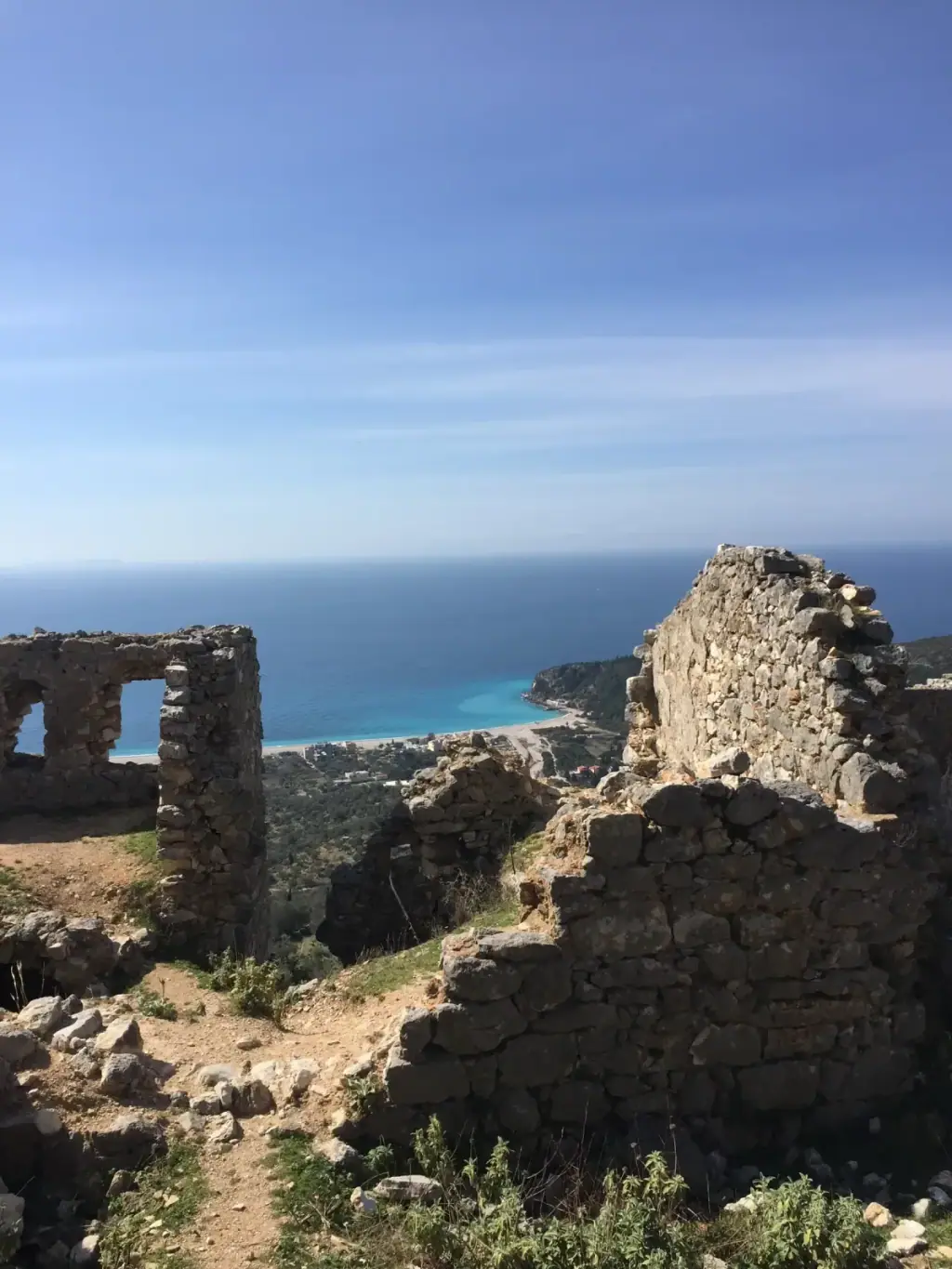
The stone old town below the castle is the most tangible sense of the medieval settlement from which people once emigrated. Its churches, lanes, and defensive layer give you the texture of the world the Arbëresh left behind.
Read more: Himara old town & castle
For Italian & Arbëresh Visitors: What to See
If you are coming to Himara to connect with your roots, or simply because the diaspora story drew you here, focus on the living culture, not on chasing a single "ancestral house."
- Himara old town and castle. Start here for the medieval and Orthodox layer. It is the most direct sense of the pre-Ottoman coastal settlement.
- A polyphony performance or local feast day. If your timing aligns with a festival or a village celebration, the singing is the heritage thread you can actually hear.
- The surrounding villages. Dhërmi, Vuno, and Qeparo show how coastal Himariot culture differed from town to town, useful if your family memory points to a specific hamlet.
- Orthodox churches and monasteries. The Byzantine-rite heritage the Arbëresh preserved in Italy has its parallel in the churches around Himara and Dhërmi.
For broader orientation while you plan, see the regional landmarks overview and the Himara facts and figures explainer.
A note on respect: approach this as living community, not as a heritage theme park. Ask open questions, avoid forcing identity labels, and treat churches and village spaces as places people still use.
Conclusion
The connection behind valle Himara / Piana degli Albanesi is real: Himara was part of the medieval Albanian world whose refugees founded Arbëresh towns in Italy and Sicily, and Himariot families are named in the founding traditions of Piana degli Albanesi. What does not hold up is treating every neat phrase or single-origin story as settled fact, the migration was multi-wave and complex, and "Valle Himara" itself is better understood as a modern search term than a documented place-name. Come for the living heritage, the singing, the bilingual community, the old town, and the history will feel a great deal closer than any plaque could make it.
Frequently Asked Questions
Are the Arbëresh from Himara?
Some are connected to it. Himariot families appear in the founding tradition of Piana degli Albanesi in Sicily in the late 15th century, though this comes down as folk-legend rather than documented record. The Arbëresh as a whole came from many parts of Albania and Epirus across several centuries, not from Himara alone.
What is Piana degli Albanesi?
It is the most important Arbëresh (Italo-Albanian) town in Sicily, in the hills west of Palermo. Founded by Albanian refugees in the late 1400s, it kept the Albanian language and the Byzantine Christian rite and was called Piana dei Greci for centuries.
Is "Valle Himara" a real historical place in Italy?
We could not verify "Valle Himara" as a documented historical toponym in Italy. It appears to be a modern search phrasing linking the Himara region to the Arbëresh diaspora. The Himara–Arbëresh connection is real; that specific label is best treated with caution.
Can I hear the heritage the emigrants carried?
The closest thing is southern Albanian iso-polyphony, the UNESCO-recognized multi-voiced singing of this region. See our polyphonic singing guide.
Is Himara Greek or Albanian?
Both influences are present. The coast has a long, layered history, and identity here is lived through family, language, and village rather than captured by one label. See Greek heritage in Himara.